
Decision Tree
Decision Tree breaks down large problems into a series of smaller problems and provides objective analysis that explicitly considers the risk and effect of the future.
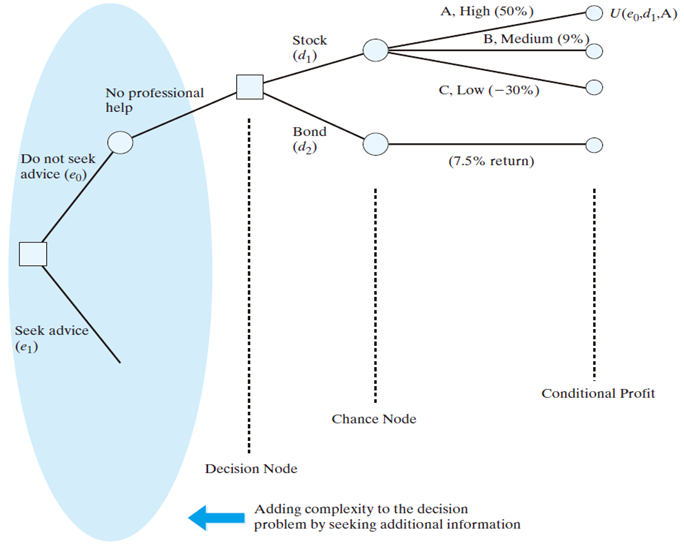
A Decision Tree is built from a series of nodes, where decisions are made or chance outcomes are noted and branches, which specify outcomes.
Random Outcomes
All alternatives emanating from either a decision or chance node must be mutually exclusive (no more than one may be selected) and exhaustive (contain all possible outcomes).
The probabilities on the branches from a chance node must sum to one (like probability tree diagrams).
The value assigned to a chance node is the expected value of the possible outcomes along each of the branches leaving the node.
Rollback Procedure
For each chance node, the expected monetary value (EMV) will be calculated by multiplying probabilities by conditional profits associated with branches emanating from that node and summing these conditional profits.
For each decision node, the one with the highest EMV (or minimum cost) will be selected. Other decision alternatives are eliminated from further consideration.
