
目录

  • 1 Introduction to Basics 绪论
    • 1.1 Engineering Economics Decisions 基本概念
    • 1.2 Course Framework 课程内容
  • 2 Cost & Revenue 成本与收益
    • 2.1 Cost Concepts 成本的概念
    • 2.2 Life Cycle Cost 全生命期成本
      • 2.2.1 Capital Investment 建设总投资
      • 2.2.2 Total Cost & Expense 全成本费用
      • 2.2.3 Asset Depreciation & Amortization 资产折旧与摊销
    • 2.3 Revenue & Profit & Tax 收益、利润与税金
  • 3 Time Value of Money 资金的时间价值
    • 3.1 Basic Concepts 资金时间价值的概念
    • 3.2 Interest Rate 利率
    • 3.3 Project Cash Flow 项目现金流量
    • 3.4 Economic Equivalence and Calculation 资金等值计算
  • 4 Economic Appraisal Indexes 方案经济评价指标
    • 4.1 NPW/NFW/AEW 净现值类指标
    • 4.2 Rate of Return 收益率指标
    • 4.3 Payback Period 投资回收期
    • 4.4 Investment Types 投资类型
  • 5 Economic Appraisal of Multiple Alternatives 多方案经济比选
    • 5.1 Multiple Alternatives 方案的关系类型
    • 5.2 Comparison of MEA 互斥方案的比选
    • 5.3 Capital Budgeting 资本预算方法
  • 6 Financial Evaluation of Projects 项目财务评价
    • 6.1 Introduction 财务评价的主要内容
    • 6.2 Financial Statement 财务报表及其编制
    • 6.3 Financial Evaluation before Financing 融资前财务评价
    • 6.4 Financial Analysis after Financing 融资后财务评价
  • 7 National Economic Evaluation项目国民经济评价
    • 7.1 Benefit-Cost Ratio Analysis费用效益分析
    • 7.2 Economic Benefits & Economic Costs经济效益和经济费用
    • 7.3 National Economic Evaluation Method国民经济评价方法
  • 8 Risk and Uncertainty Analysis项目不确定性与风险评价
    • 8.1 Risk and Uncertainty不确定性与风险的概念
    • 8.2 Breakeven Analysis 盈亏平衡分析
    • 8.3 Sensitivity Analysis 敏感性分析
    • 8.4 Probabilistic Analysis 概率分析
    • 8.5 Decision Tree 决策树方法
  • 9 Asset Replacement 设备更新分析
    • 9.1 Economic Life 设备经济寿命
    • 9.2 Equipment Selection Decision 设备的选型比较
    • 9.3 Real Time Replacement Decision 即时更新决策
    • 9.4 Deferred Time Replacement Decision 延时更新决策
    • 9.5 After-tax Replacement Analysis 税后更新分析
Rate of Return 收益率指标

Internal Rate of Return (IRR, 内部收益率)

IRR is the breakeven rate at which the NPW of a project is zero. 

It represents the real ROR of the project over its life.

Decision Rule of IRR

If IRR ≥ ic, the project is economically justified.

If IRR < ic, the project is not accepted.


Calculation of Internal Rate of Return

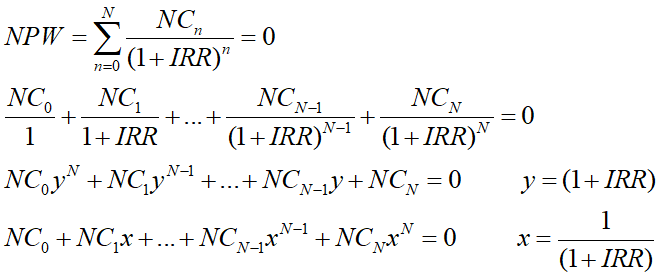
Polynomial Equation Method
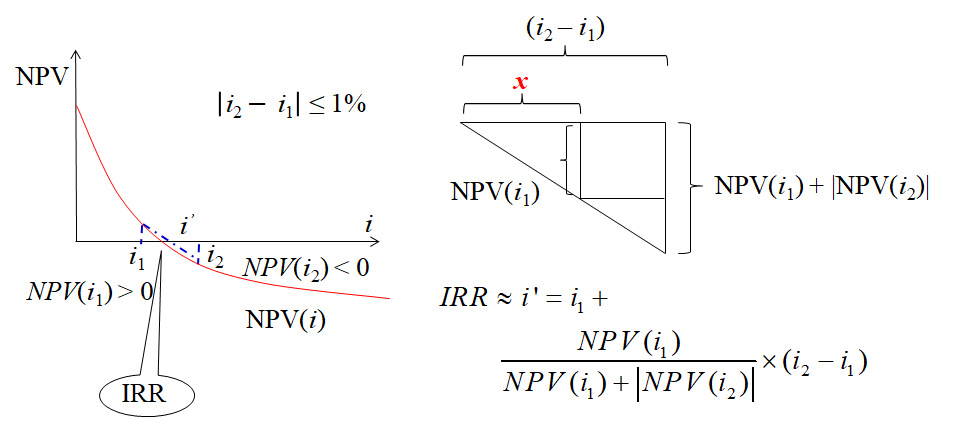
Linear Interpolation Method (Trial and Error Method)

Multiple Real Positive Root Problem of IRR

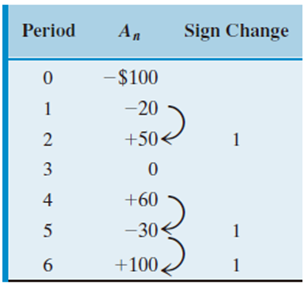
Descartes’ Rule of Signs on Net Cash Flow

Single real positive root: only one sign change occurs in the net cash flow series.

Multiple real positive roots: more than one sign change occurs in the net cash flow series.

The number of real positive roots is never greater than the number of sign changes in the net cash flow series.
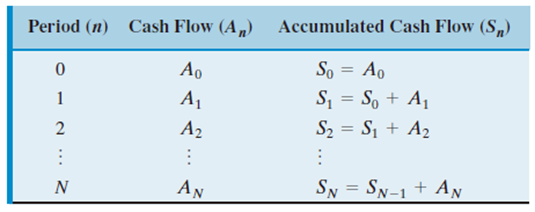
Accumulated Cash Flow Sign Test

If the accumulated cash flow series starts negatively and changes sign only once, then a unique real positive root exists.

External Rate of Return (ERR) 

ERR is a rate external to the project at which the NCs can be reinvested.

The objective is to seek the unique modified IRR* in case of multiple IRRs.
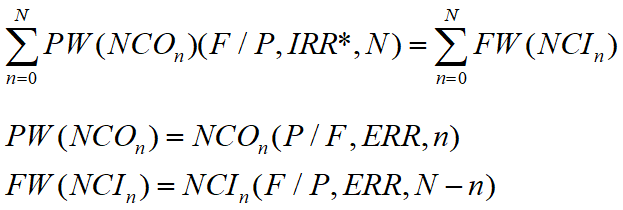
ERR method is not subject to the problem of multiple IRRs. It can usually be solved directly.
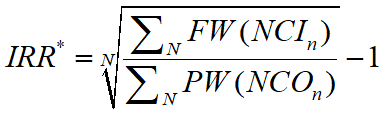
Decision Rule

If IRR* ≥ ic, the project is economically justified.

If IRR* < ic, the project is not accepted.


The IRR* may be different by using cash flows or net cash flows, however, it will not affect the final results.

When ERR ≥ ic, the change of ERR will not change the result of accepting the project or not.

When ERR < ic, the change of ERR may change the result of accepting the project or not.

However, a firm usually like a larger MARR than ERR, which is a ROR commonly obtained by other firms. Therefore, ERR normally should be equal to MARR.