
目录

  • 1 Introduction to Basics 绪论
    • 1.1 Engineering Economics Decisions 基本概念
    • 1.2 Course Framework 课程内容
  • 2 Cost & Revenue 成本与收益
    • 2.1 Cost Concepts 成本的概念
    • 2.2 Life Cycle Cost 全生命期成本
      • 2.2.1 Capital Investment 建设总投资
      • 2.2.2 Total Cost & Expense 全成本费用
      • 2.2.3 Asset Depreciation & Amortization 资产折旧与摊销
    • 2.3 Revenue & Profit & Tax 收益、利润与税金
  • 3 Time Value of Money 资金的时间价值
    • 3.1 Basic Concepts 资金时间价值的概念
    • 3.2 Interest Rate 利率
    • 3.3 Project Cash Flow 项目现金流量
    • 3.4 Economic Equivalence and Calculation 资金等值计算
  • 4 Economic Appraisal Indexes 方案经济评价指标
    • 4.1 NPW/NFW/AEW 净现值类指标
    • 4.2 Rate of Return 收益率指标
    • 4.3 Payback Period 投资回收期
    • 4.4 Investment Types 投资类型
  • 5 Economic Appraisal of Multiple Alternatives 多方案经济比选
    • 5.1 Multiple Alternatives 方案的关系类型
    • 5.2 Comparison of MEA 互斥方案的比选
    • 5.3 Capital Budgeting 资本预算方法
  • 6 Financial Evaluation of Projects 项目财务评价
    • 6.1 Introduction 财务评价的主要内容
    • 6.2 Financial Statement 财务报表及其编制
    • 6.3 Financial Evaluation before Financing 融资前财务评价
    • 6.4 Financial Analysis after Financing 融资后财务评价
  • 7 National Economic Evaluation项目国民经济评价
    • 7.1 Benefit-Cost Ratio Analysis费用效益分析
    • 7.2 Economic Benefits & Economic Costs经济效益和经济费用
    • 7.3 National Economic Evaluation Method国民经济评价方法
  • 8 Risk and Uncertainty Analysis项目不确定性与风险评价
    • 8.1 Risk and Uncertainty不确定性与风险的概念
    • 8.2 Breakeven Analysis 盈亏平衡分析
    • 8.3 Sensitivity Analysis 敏感性分析
    • 8.4 Probabilistic Analysis 概率分析
    • 8.5 Decision Tree 决策树方法
  • 9 Asset Replacement 设备更新分析
    • 9.1 Economic Life 设备经济寿命
    • 9.2 Equipment Selection Decision 设备的选型比较
    • 9.3 Real Time Replacement Decision 即时更新决策
    • 9.4 Deferred Time Replacement Decision 延时更新决策
    • 9.5 After-tax Replacement Analysis 税后更新分析
Interest Rate 利率

Interest Rate vs. Inflation Rate

Interest rate (i, 利率) measures the cost/price of money and is expressed as a percentage per period of time.

Inflation rate (f, 通货膨胀率) is the increase in the average price for goods/services with a decrease in purchasing power of money.

Deflation rate (f, 通货紧缩率) is the decrease in the average price for goods/services with an increase in purchasing power of money.


Real Interest Rate vs. Apparent Interest Rate

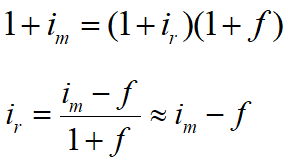
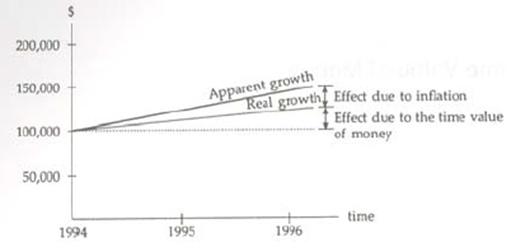
Real Interest Rate (ir) reflects only the time value of money, i.e., the real growth of earning power of money.

Apparent Interest Rate (market interest rate, im) is the combined effect due to inflation and the time value of money.

Simple Interest vs. Compound Interest

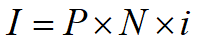
Simple Interest: The total interest earned/charged is linearly proportional to the initial amount of money (principal).
                                                   

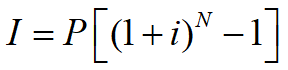
Compound Interest: The interest earned/charged in a period is based on the total amount (principal plus accumulated interest) at the beginning of this period. 

Nominal Interest Rate vs. Effective Interest Rate

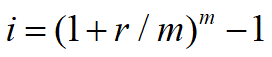
Nominal Interest Rate (r): The stated interest rate on a stated interest period (e.g. month, quarter), normally on an annual basis. 

Effective Interest Rate (i): The calculated interest rate on the stated interest period which is not equal to the actual interest period.  

Number of Compounding Periods (m):  The stated interest period divided by the actual interest period.

Rate of Return (ROR, 收益率) 

ROR measures the profitability of a project over a period of time, expressed as a percentage. 

Minimum Attractive Rate of Return (MARR, ic,基准收益率) is the expected ROR decided by the top management of a firm.

is (i0, 社会基准折现率) is basic ROR of the society.


Determination of MARR

Weighted Average Cost of Capital (WACC) 

λ — Percentage of the total capital obtained from debt;

CDebt — Cost of debt financing;

CEquity— Cost of equity financing;