Accounting Cost & Economic Cost
Accounting Cost(会计成本)
It includes the explicit cost which is shown on the accounting book.
It records all expenditures which are actually incurred of a firm, such as the material, machine, labor, interest.
Economic Cost(经济成本)
It includes both explicit cost and implicit cost which measures the value of input resources by the opportunity cost.
We should concern economic cost in the engineering economic decisions.
Cash Cost & Book Cost
Cash Cost:Expenses which involve payment of cash.
Labor cost
Management cost
Book Cost:Expenses which are not payable in cash, i.e., the payments that firm pays it to itself.
Depreciation cost
Opportunity Cost & Sunk Cost
Opportunity Cost(机会成本)
Opportunity cost is equal to the revenues of the best rejected opportunity due to selecting and putting resources on one specific project.
It must be considered in the economic decisions.
Sunk Cost(沉没成本)
Cost occurred in the past or promised to be paid.
Sunk cost has no difference on selecting alternatives in the future. It will not be involved in the economic decisions.
Direct Cost & Indirect Cost
Direct Cost: Cost reasonably to be allocated to a work activity.
Labor cost
Material cost
Machine cost
Indirect Cost: Cost difficultly to be attributed to a work activity.
Overhead (Management cost)
Marketing cost
Fixed Cost & Variable Cost
Fixed Cost/Capacity Cost: Cost unaffected by changes of the quantity of product.
Machine cost, Insurance, Interest, Tax
Management cost/Overhead
Variable Cost: Cost changed associated with changes of the quantity of product.
Raw materials
Fuel, oils and lubricants, hydraulics fluid, grease, filters
Average Cost & Marginal Cost
Average Cost/Unit Cost: Cost per unit, including both fixed and variable costs.
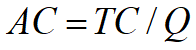
TC — The summation of fixed cost and variable cost;
Q — Quantity of the product.
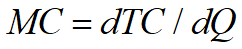
Marginal Cost (边际成本): Added cost that results from the increase of output by a single unit.