
目录

  • 1 Outline
    • 1.1 Teaching syllabus
    • 1.2 Test syllabus
    • 1.3 Group work
    • 1.4 Collection of Past Group Project Presentations
    • 1.5 After the First Lecture
  • 2 Chapter 1 Accounting and the Business Environment
    • 2.1 Learning framework
    • 2.2 Words and Phrases
    • 2.3 The organizations and rules that govern accounting
    • 2.4 The accounting equation
    • 2.5 The financial statements
    • 2.6 Critical thinking
  • 3 Chapter 2 Recording Business Transactions
    • 3.1 Learning framework
    • 3.2 Words and Phrases
    • 3.3 Double-entry accouting
    • 3.4 The Trial Balance
    • 3.5 Business Ethics
    • 3.6 group work
  • 4 Chapter 3 The Adjusting Process
    • 4.1 Learning framework
    • 4.2 Words and Phrases
    • 4.3 The difference between Cash basis and Accrual basis accounting
    • 4.4 What are adjusting entries
    • 4.5 The adjusted trial balance
    • 4.6 group work
  • 5 Chapter 4 Completing the Accounting Cycle
    • 5.1 Learning framework
    • 5.2 Words and Phrases
    • 5.3 The accounting cycle
    • 5.4 The closing process
    • 5.5 Exercise
  • 6 Chapter 5 Merchandising Operations
    • 6.1 Learning framework
    • 6.2 Words and Phrases
    • 6.3 Two different inventory system
    • 6.4 FOB terms determine who pays the Freight
    • 6.5 Discounts
  • 7 Chapter 6 Merchandise Inventory
    • 7.1 Learning framework
    • 7.2 Words and Phrases
    • 7.3 key points
    • 7.4 four inventory costing methods
  • 8 Chapter 8 Internal control and Cash
    • 8.1 Enron: The Smartest Guys in the Room
    • 8.2 Words and Phrases
    • 8.3 internal control
      • 8.3.1 Catch me if you can
  • 9 Chapter 9 Receivables
    • 9.1 key points
    • 9.2 Words and Phrases
  • 10 Chapter 10 Plant Assets, Natural Resources, & Intangibles
    • 10.1 Words and Phrases
  • 11 Chapter 11 Current Liabilities and Payroll
  • 12 Chapter 14 Long-Term Liabilities
  • 13 Course Review
    • 13.1 Review outline
    • 13.2 Review mind map
    • 13.3 章节小测(客观题)
The closing process


Closing journal entries are made at the end of an accounting period to prepare temporary accounts for the next period.

This is becaues temporary or nominal accounts, (also called income statement accounts), are measured periodically; and so, the amounts in one accounting period should be closed or brought to zero so that they won't get mixed with those of the next period.

Temporary accounts consist of all revenue and expense accounts, and also withdrawal accounts of owner/s in the case of sole proprietorships and partnerships. Take note that closing entries are prepared only for temporary accounts. Permanent accounts are never closed.

Four Steps in Preparing Closing Entries

Close all revenue accounts to Income Summary

Close all expense accounts to Income Summary

Close Income Summary to the appropriate capital account

Close withdrawals to the capital account/s (this step is for sole proprietorship and partnership only)
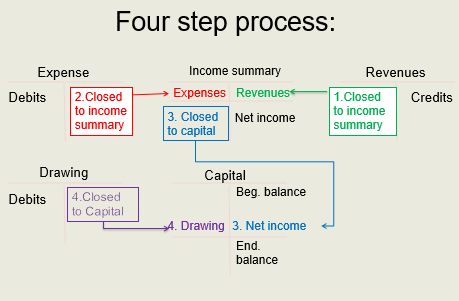
The purpose of closing entries is to prepare the temporary accounts for the next accounting period. In other words, the income and expense accounts are "restarted".