Get Ready for Sport?
Sport has the power to change the world. It has the power to 1) inspire. It has the power to 2) unite people in a way that little else does. Sport can 3) awaken hope where there was previously only 4) despair. Sport speaks to people in a 5) language they can understand. Sport is not just about the players, the 6) competition and the spectacle — it also plays an important role at the individual level. For the individual, sport 7) enhances our personal abilities, general 8) health and self-knowledge. Remember Pierre de Coubertin once said, “The most important thing in the Olympic Games is not 9) winning but taking part; the essential thing in life is not 10) conqueringbut fighting well.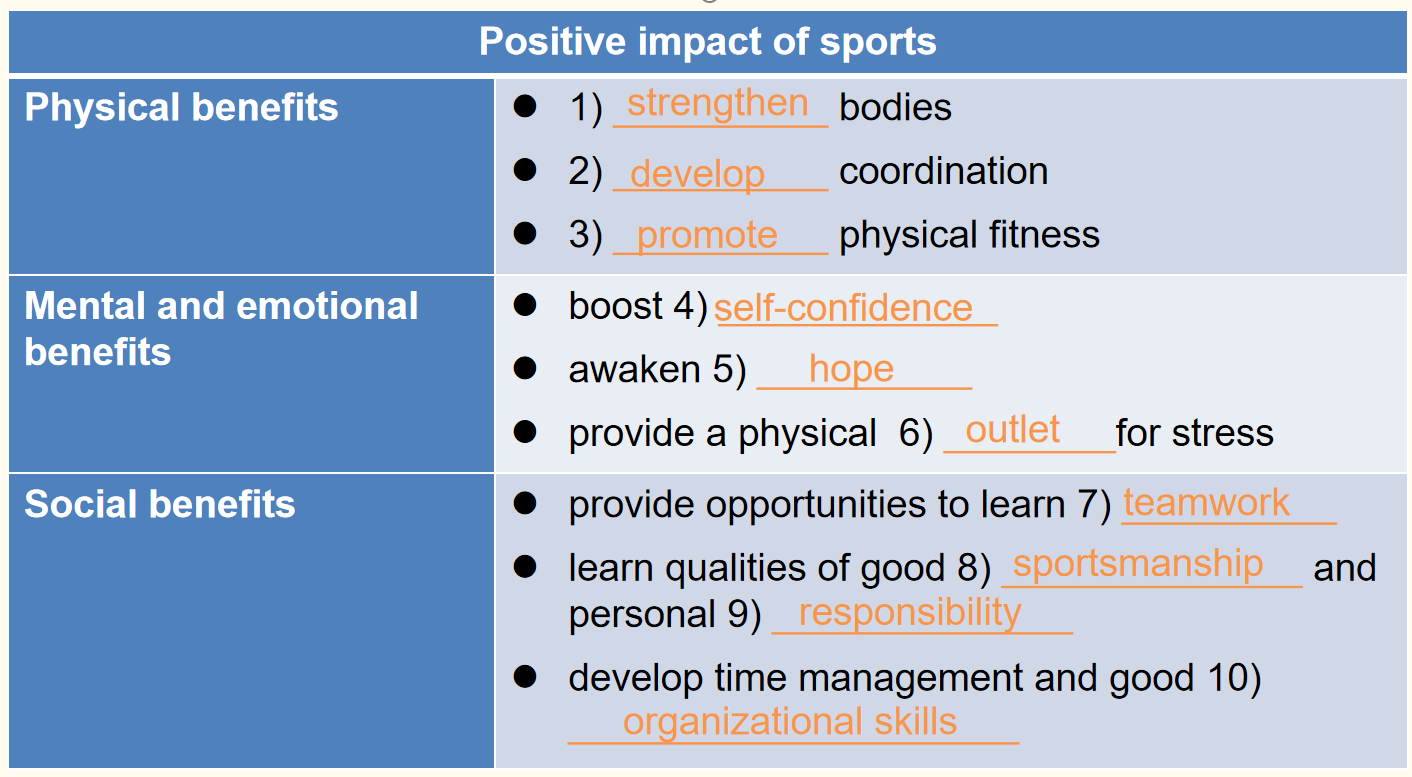
2. For reference
My favorite sport is basketball, which I think is very exciting and demanding. It takes a lot of time to practice and involves team spirit, which I think is the most important. Team spirit is not only important in basketball, but also in other sports. Even in individual events like diving or tennis, you still need assistance from a team of coaches, instructors and physical condition experts. You have to rely not only on yourself but on your teammates as well in order to win.
Text A
Reading Comprehension
1.
2.
A. When the swim season began, Elizabeth cut a deal with her father because she:
1) does not like swim meets; gets horribly nervous; doesn’t want to win; doesn’t expect to win; doesn’t care if she wins.
2) would be scared all day during the day of a meet, saying that she didn’t have a good time at all.
3) started to talk about quitting swimming though she loves swimming.
B. Before the swim meet, Elizabeth:
1) fought back furiously at her father’s request for her to take part in the swim meet but finally agreed.
2) was nervous when the day arrived; became even more nervous when they got to the pool.
3) panicked; spent all her time by her father’s side, shivering.
C. During the swim meet, Elizabeth:
1) swam very well but missed the wall in the 50-meter freestyle.
2) had no incident in her backstroke and breaststroke, but her butterflies just kept flapping.
3) swam her heart out for the last 15 meters in the T-shirt relay and beat the other girl to the wall for the victory.
D. After the swim meet, Elizabeth:
1) relived her moment of glory again and again.
2) talked about how scared she was when someone grabbed her foot and how funny it was when she was sloshing to the finish and how great the night was.
3) said that her team would win the gold medal if the T-shirt relay was an Olympic event.
Reading and Discussing
3.
For reference
1) Elizabeth didn’t want to compete because of her nerves; she was worried she would do something wrong and let everyone down.
The swim night may motivate Elizabeth to compete in the future, because she gained confidence from the T-shirt relay.
2) The ways include: train to become physically strong; study strategies to perform better; practice to be consistent; practice with their teammates and build mutual trust; set goals to reach.
Language in Use
4.
1) E
2) I
3) F
4) H
5) A
6) J
7) C
8) B
9) L
10) M
5.
1) buid up; teaming up; prepared for
2) gain on; in the zone; in the lead
3) compete in; let down; cut a deal
6.
使某人心碎 break one’s heart
违背诺言 break one’s promise
打破纪录 break the record
摆脱老习惯 break the habit
违反规则 break the rules
斥巨资 break the bank
打破僵局 break the ice
开辟新天地 break new ground
1) break the record
2) break the ice
3) breaks the rules
4) breaks his promise
5) broke my heart
6) break the habit
7.
For reference
tain maintain; attain; obtain
volv evolve; revolver; involvement
vis visible; video; visit; visual
serv conserve; observe; deserve; reservation
rupt bankrupt; abrupt; disruptive; erupt
scrib ascribe; inscribe; scribble
mot automotive; promote; demote
tact (tag) tactile; contagion; intact
viv vivid; revival; survivor
ject inject; project; subject
dict contradict; dictionary; dictator
1) revolutions
2) involved
3) involvement
4) evolved
5) revise
6) supervise
7) visible
8) visual
9) dictators
10) contradicted
11) dictation
12) predict
8.
Reference translation
1) 看她游泳真是太棒了!她转身转得非常好。
2) 她又得游回去触碰池壁,这样一来耽搁了时间。
3) 这样不断交换,直到每个队员都完成一个来回。
4) 队友给她穿袜子时,伊丽莎白踩着水。
5) 但是伊丽莎白先于另一个女孩触壁,赢得了比赛。
9.
Reference translation
1) None of the competitors could catch up with the untiring runner who was in the lead.
2) The football team was in the zone and won the game with the score of 3 to 2.
3) If you make a great effort to keep fit with exercise, it will pay off in the long run.
5) Whether she can win the final is still up in the air, but she is fully confident in herself.
Text B
Reading Comprehension
1.
1) Para. 5
2) Para. 13
3) Para. 3
4) Para. 12
5) Para. 14
6) Para. 7
Language in Use
2.
1) feats
2) persist
3) literally
4) transition
5) rebounding
6) remarkable
7) peers
8) championship
9) staff
10) dictate
3.
1) wind down
2) take over
3) get over
4) hang out
5) look forward to
6) go about
4.
Reference translation
1) She is not sure whether she will be able to come back to the court after she has had a baby.
2) We will move on to the next phase soon, and you all have to make quick adjustments.
3) In this interview he talked about how he had transitioned from a successful player to a responsible coach.
4) Summer holiday is approaching and children are looking forward to playing soccer every afternoon.
5) Children aspire to hang out with friends or do whatever they want after school.
Writing
Exercise 1
1)
8–5–7–1–4–9–10–3–2–6
2)
Then it was time for the T-shirt relay, ... Then it was Elizabeth’s turn to swim.
By that point, all tactics were out the window; everyone was pulling and yanking to get her inside the shirt and to get those socks on. And then she was off.
Approaching the halfway mark, she was still in the lead.
Then somebody noticed that one of Elizabeth’s socks had fallen off and was floating in the pool. ... Everybody on her team started screaming, “Elizabeth! Eliszabeth! Stop! Get the sock!”
One of her teammates jumped in the water, grabbed the sock, and threw it at Elizabeth. She still didn’t notice. She was in the zone.
She made the turn and started her last 25 meters.
Meanwhile, a girl in lane two was gaining on Elizabeth. It was time for desperate measures. A girl on my daughter’s team jumped in the pool, grabbed the sock, and swam after Elizabeth. She grabbed Elizabeth’s foot. “You have to put the sock on,” the girl screamed.
Elizabeth treaded water while her teammate put on the sock. ... By now, the girl in lane two was about to pass Elizabeth.
With the sock finally on, Elizabeth swam her heart out for the last 15 meters. It was close. But Elizabeth beat the other girl to the wall for the victory.
There was much celebration and joy. Hugs. High fives. Cheers. And, for a few minutes, Elizabeth was the hero.
Exercise 2
A Memorable Sports Event
Sample 1
The most memorable sports event I have ever taken part in was the city marathon, which I ran with my family last week. Last month, my family saw a news ad for the city marathon and we immediately decided to sign up for it. Our running practice started immediately the next morning. On the day of the marathon, we got to the starting point early enough for the warm-up. At 9 o’clock, lots of runners arrived.
Soon, we began to put number tags on our T-shirts. At 9:30, as the starting gun went off, all of us headed out and the long run began. People along the road cheered us on and provided drinking water for us. After 20 miles, all of us slowed down and felt a little tired. Dad, who still led our team, told us to adjust our breathing and pace. Then later, we started walking and encouraging one another to finish the race. We were so thrilled when we got to the finish, though we didn’t win. Exhausted as we were, we realized that joy and satisfaction came from participation, not from winning the race.
Sample 2
The most exciting soccer match this year was the final game of our school’s soccer tournament to determine the champion. At the beginning, both teams — the chemistry department and the biology department — put forth supreme defensive performances. Meanwhile, both teams kept seeking chances to score a goal, but neither one got the opportunity. At half-time, the advantage lay with the chemistry department.
In the second half, the game opened up and several attractive shots were made. But 15 minutes before the end of the game, the chemistry department team’s forward got a red card and sent off for serious foul play. The advantage in the number of players enabled the biology department team to play confidently and they finally scored 2 goals in the last 10 minutes. That was a very unexpected but memorable soccer game.