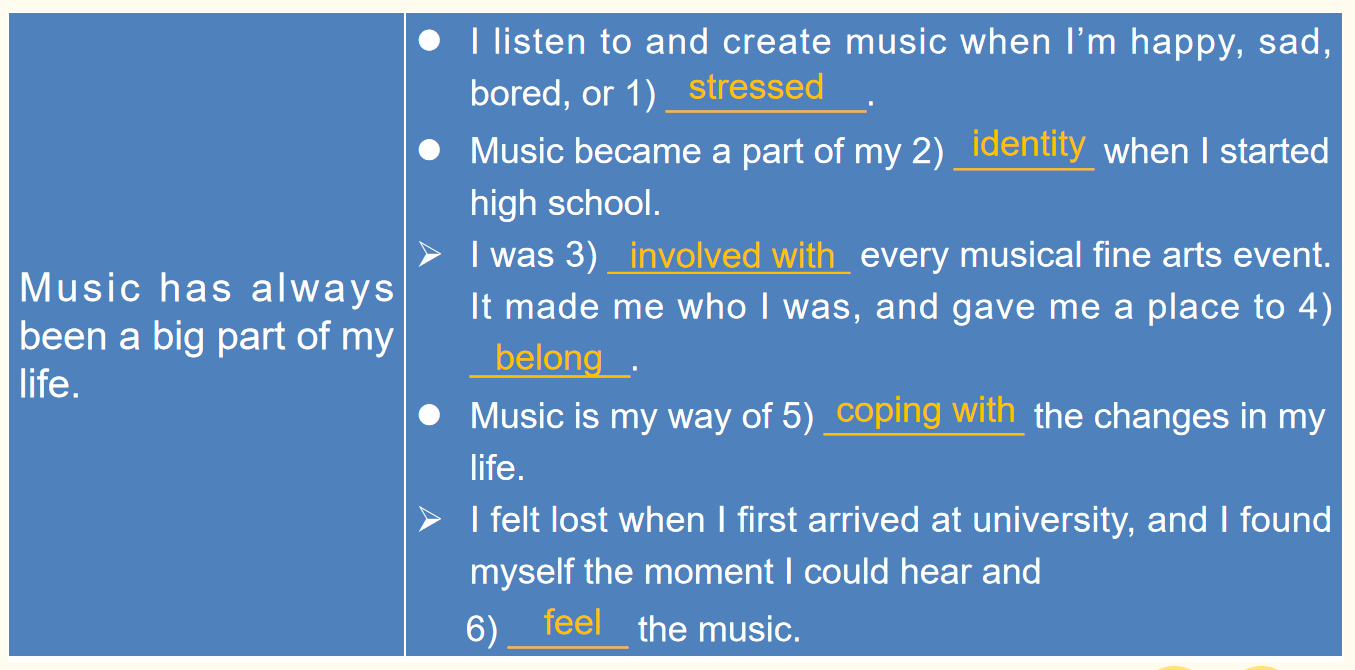
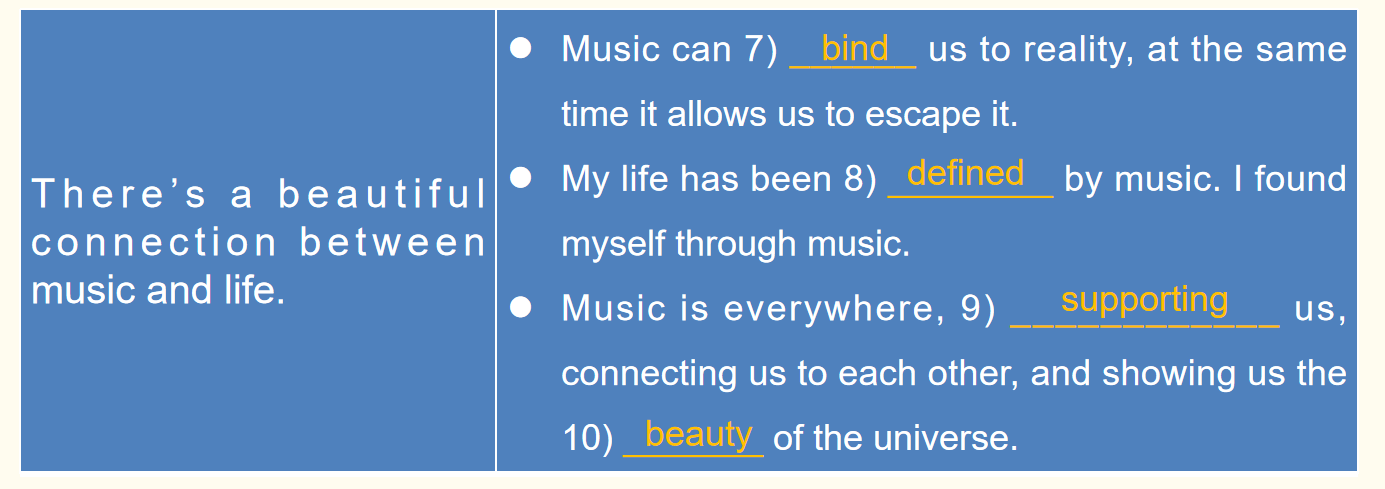
1.
低阶练习:
Music, Rock the Hearts!
William Shakespeare once wrote, “If music be the food of love, play on.” The 1) beauty of music is food for the ears, loaded with mental nutrition, providing relief from the fast paced daily life, and inspiring unimaginable 2) creativity. Music is a faithful friend of ours, at times of 3) happiness, sadness, loneliness, and many other 4) emotions that we experience in life; it will cheer us up or 5) comfort us wherever we are. Good music crosses all boundaries of 6) culture, and language, and touches the heart and soul of everyone. There is a way in which music can make a 7) difference to your IQ. Learning to play a musical instrument can have a 8) beneficial effect on your brain. Music definitely helps bring out the real genius in some great scientists.
1.
6) d
7) j
8) g
9) h
10) i
2.
A. Einstein’s academic popularity:
1) There is no other personality in the academic world that has even half Einstein’s popularity.
2) There is no genius in the world as respected and as loved as Albert Einstein.
3) Nowhere in the world could we find another academic that rivals the popularity of rock superstars.
4) His opus “E=mc2” would rival any Beatles’ platinum record.
5) His “Theory of Relativity” even shook Newton’s gravitational theory off the charts.
B. Einstein’s love of and gift for music:
1) Had he lived later, he could easily pass as the only male member of the Bond electric Quartet.
2) Had he not been a scientist, he would have been a musician.
3) Einstein, with unclipped moustache and unkempt hair, did actually perform in solo concerts!
4) Einstein shone in a deeply felt performance of an adagio from one of the Beethoven sonatas before his 17th birthday.
5) In addition to his prowess on the violin, he also played the piano and, in particular, loved to improvise.
C. Einstein’s gift brought out by music:
1) Albert Einstein believed that he got most joy in life out of music.
2) Albert Einstein himself admitted that the reason he was so smart was because he played the violin.
3) One friend, G. J. Withrow, confided that the way Einstein dealt with problems and equations was by improvising on the violin.
4) Einstein’s second wife, Elsa said that music helped him when he was thinking about his theories.
5) His son Hans said that Albert Einstein took refuge in music, which would usually resolve all his difficulties.
Reading and Discussing
3.
For reference
1) Albert Einstein himself admitted that the reason he was so smart was because he played the violin. One friend, G. J. Withrow, confided that the way Einstein dealt with problems and equations was by improvising on the violin. His second wife, Elsa, said music helped him when he was thinking about his theories. His son Hans Albert Einstein too recalled his father using music as a tool to help his work.
2) Music is important to most people, including me. Music can help me concentrate on my homework. Music is a way of life. It can be interpreted in many ways and life without it would be like life without color. It gives me a chance to express myself in ways that nothing else can.
Language in Use
4.
1) G
2) M
3) A
4) C
5) K
6) L
7) J
8) E
9) B
10) F
5.
1) deal with; bring out; coming from
2) leading to; falling in love with; take refuge
3) Instead of;In particular; In fact; head the advice
6.
7.
1) hardship
2) popularized
3) Creative
4) impression
5) significant
6) admirable
7) simplify
8) musical
9) performance
10) professional
8.
Reference translation
1) 描述天才时,爱因斯坦是你能找到的最合适的例子,就连小孩都熟悉他。
2) 在学术界,其他人的知名度连爱因斯坦的一半都不及。
3) 世界上没有哪个天才如同阿尔伯特•爱因斯坦一样受到人们如此的尊敬和爱戴。他那留着与众不同的发型的照片甚至成为一种流行文化的标志。
4) 全世界都找不到另一个像他那样的学者,其知名度可以与摇滚巨星媲美。
5) 没有谁比父母更爱你。
9.
Reference translation
1) Country music is one of the most popular forms of music in the United States today.
2) No classical music aould rival Beijing Opera in terms of its popularity.
3) There is no song as inspiring as the Natioal Anthem for a soldier.
4) Nowhere else in the world can you find a wall as amazing as the Great Wall in China.
1.
Research question: Is playing your favorite song an easy way to make homework bearable, or are you hurting your performance?
Previous research: Numerous benefits from listening to music: it improves attention, memory, and even mental math ability; it also alleviates depression and anxiety.
Research method: Students were given a serial recall test in five different scenarios: 1) a quiet environment; 2) with “steady state” speech; 3) with “changing state” speech; 4) with “liked” music, a song of the students’ choice; 5) with “disliked” music.
Findings: 1) No significant difference between test scores with liked music, disliked music, and changing state speech. 2) Scores were significantly higher for tests taken in a quiet environment or with steady state speech.
Conclusion: In general, it seems that music with vocals is distracting, while instrumental music might actually help your performance.
Language in Use
2.
1) bet
2) preferences
3) distracting
4) be alleviated
5) implies
6) affecting
7) random
8) spatial
9) subjective
10) variations
3.
1) a variety of
2) feel like resorting
3) In general
4) in other words
5) lighten up
6) tune out
4.
Reference translation
1) 之前的研究发现,在完成某一任务之前听音乐有许多好处:可以提高注意力、记忆力,甚至心算能力。
2) 然而,更加现实的情况却是,学生边听背景音乐边学习或者做家庭作业。
3) 令人惊讶的是,实验结果竟然显示,无论受试者听喜欢的、不喜欢的音乐或者持续变化的言语,测试成绩并没有明显区别。
4) 研究者们推测,如果他们用阅读理解测试来重复这次实验程序,可能会得到相似的结果。
5) 所以你是不是应该一边学习或做家庭作业一边听音乐呢?
Writing
Exercise 1
Para. 1
1) General idea: Say “genius” and his name immediately comes to mind.
2) Examples: Einstein is the closest you get to describing genius; even small kids know him. There is no other personality in the academic world that has even half Einstein’s popularity.
3) By supplying these examples, the author adds more information about who the genius is, how popular he is, and why he is the person people will mention when talking about genius.
Para. 2
1) General idea: There is no genius in the world as respected and as loved as Albert Einstein.
2) Example: His picture with his distinctive hairstyle even became a pop culture icon.
3) By supplying this example, the author adds specific evidence about how people love and admire Einstein.
Para. 3
1) General idea: Nowhere in the world could we find another academic that rivals the popularity of rock superstars.
2) Examples: His opus “E=mc2” would rival any Beatles’ platinum record, his “Theory of Relativity” even shook Newton’s gravitational theory off the charts.
3) By supplying the examples, the author adds more specific evidence about how popular he is compared with rock stars and other scientists.
Exercise 2
Music Fuels My Mood
Sample 1
Music never fails me. The beauty about it is that I can always find a song to identify with, whether at a time of happiness, loneliness or sorrow. Some scientists have found that people can boost their mood simply by listening to upbeat music. For instance, I listen to pop music with happy melodies when I have something to celebrate. When feeling relaxed, I love to lie back and listen to jazz in particular. While I am disturbed by the problems of my study, soft music without lyrics will soothe me and make me concentrate. To me, listening to music can fuel my soul and ultimately lead to a better quality of life.
Sample 2
Everyone has an instinctive understanding of how music interacts with our moods. Some scientists have found that listening to music can improve our moods. Of all types of music I love classical music most because it gives me power and comfort. At a time of happiness, classical music creates such a calming atmosphere that I feel completely at peace. When life disappoints me, however, those masterpieces encourage me and give me strength to recover. Specifically, I love Bach’s music best. Some pieces help me concentrate during work while some other pieces assist me in battling insomnia. Listening to classical music fuels my life and leads to a better quality of life.