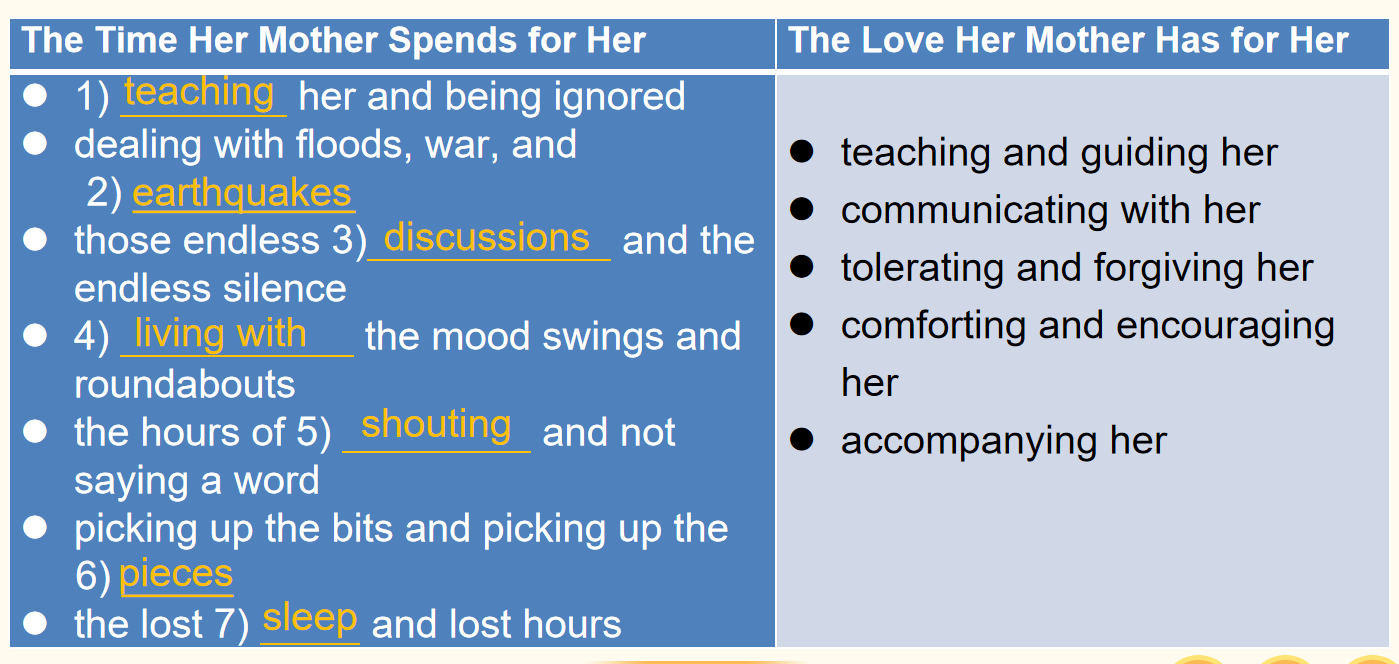
1.
Love and Friendship
Love and friendship are the brightest moments of our life. They are the 1) source of joy and energy to motivate us.
Parents are the unsung 2) heroes of every person that has ever done anything great. They sow the seeds of greatness in our life. Friendship is the 3) bread of life. It is essential to our well-being. We could not survive without it. Falling in love may be one of the 4) greatest feelings ever. Colors seem brighter, sounds more resonant and smells more powerful when you are in love. They reflect different aspects of our life. They represent 5) relationships which require time, effort and many other characteristics. They assume emotional involvement, care, respect and 6) devotion. They make people happier. They bring 7)positive emotions and feelings even in the periods of conflicts and 8) misunderstandings , which are inevitable parts of our life.
1.
A.
Location | Specific items left behind or messed up |
|---|
on the floor | pillows and a few stuffed animals |
on my mirror | little fingerprints |
in my box of toys | a flying dinosaur, a skeleton and a Frankenstein |
in a ziplock bag | Tegan's tooth |
in the freezer | a teething ring |
beside the sink | Tessa's bottle brush and a baby outfit |
B.
1) The insides of a turkey fryer reminded the author of the delicious Thanksgiving meal that the family all enjoyed.
2) The empty pie pan let the author think of Katie’s delicious pies.
3) The memory of the white elephant gift exchange game came back to the author when she saw the angel figurine.
4) The trip to the emergency room with Rowan reoccurred to the author as she found the baby outfit.
5) The author recalled how frightened she was at the sound of Rowan’s cry.
2.
Some stressful and difficult moments in the past become stories of the future, because when we look back on them, they give us laughter and joy. The memories of past hurts, unforgiveness, bitterness, and anger should be left behind forever. These things should never be kept until the next time, never be mailed back, or never be brought with us to our next visit. Besides memories, love should be left behind. According to Elizabeth Stone, when you decide to be a parent, your heart will not belong to you anymore, but to your children. No matter where your children are, your heart goes with them.
Reading and Discussing
3.For reference
2) When you decide to be a parent, it means all your attention and your love will be focused on your child. Your heart will not belong to you anymore, but to your child. No matter where your child is, your heart goes with him/her.
Language in Use
4.
1) D
2) A
3) K
4) I
5) C
6) N
7) O
8) L
9) M
10) E
5.
1) sort through; looking back to; remind of
2) picked up; no longer; teared up
3) in particular; due to; left behind
6.
1) at the sight of
2) on the occasion of
3) on rare occasions
4) at the smell of
5) on every occasion
6) on occasion
7) at the thought of
8) at the sound of
7.
1) foresee
2) postwar
3) rebuild
4) transatlantic
5) interact
6) preview; review
7) ex-president
8) engraved
8.Reference translation
1) “哈,连泰莎的东西也忘带走了,”我说道。
2) 似乎每次我们家庭聚会以后,都会留下点什么东西。
3) 我寻思着,有些记忆总是留存在脑海里,美好的记忆对我们来说是多么珍贵。
4) 当然,也有一些记忆是该忘却的。那些曾经的伤害、怨恨、苦痛、愤怒的记忆应该永远忘却。
5) 那是因为,除了留下的记忆以外,还有一样东西保留下来了……那就是爱。
9.Reference translation
1) It's hard to take a mother's mind off her child onec she had one.
2) Rather than keepin off the topic of the death of a family member, a healthy family should talk about it openly and help children to overcome the fear.
3) He didn't even stop to wipe the sweat off his forehead before he went to rescue the rest of the injured.
4) They are cut off from the outside world, with only emails and video messages from friends and family.
1.Paras. 1–5
Topic: the importance of friendship
A recent Public Library of Science review found that social relationships also dramatically influence our mortality rate.
Professor Timothy Smith thinks social relationships have as much of an impact on mortality as risk factors such as smoking and alcohol consumption, and even more of an impact than physical inactivity and obesity.
Clinical psychologist Renée Mill points out that we exhibit a spontaneous social instinct to make friends from a very early age.
Paras. 6–11
Topic: ways of making new friends
Psychologist Martin Seligman states that the highest predictor of happiness is good relationships.
Renée Mill states friendships are often fluid, dependent on where you live and work — and, interestingly, proximity is the highest indicator of a continuing friendship.
Psychologist Nikki Kaplan believes without face-to-face connection, we lose something precious in our quality of interaction and she recommends we focus on regularly doing enjoyable things with our friends.
Paras. 12–16
Topic: nurturing friendships
Hilary Levine states she stays away from people who are negative and drain her energies, and enjoys having friends from different cultures to expand her world instead of relying on one person.
Stephanie Dowrick says that deeper friendships expand our inner horizons and enhance the quality of our life.
Language in Use
2.
1) consumption
2) instinct
3) nurture
4) priorities
5) sustain
6) sufficient
7) enhances
8) factor
9) attributes
10) gossip
3.
1) engage in
2) with a view to
3) take the initiative
4) invest in
5) interact with
6) a wide range of
4.Reference translation
1) 在你的生活中,有没有一些人能在你人生起伏时陪你同欢笑同哭泣呢?
2) 负责此项研究的蒂莫西•史密斯教授指出,人际关系对死亡的影响如同吸烟和酗酒等危险因素一样大,甚至比缺乏运动和肥胖产生的影响更大。
3) 到了小孩上幼儿园或者读书之后,你就有机会和你孩子同学的父母交流了。
4) 也许你会搬到一个新社区、新城市甚至是另一个国家,离婚,或者做一份新工作。
5) 我正在车上,这时我的收件箱里弹出一封邮件,告知我已经被梦寐以求的学校录取了,我顿时喜极而泣。
Writing
Exercise 1
1) The problem: “So how does one make a friend?”
2) The solutions given:
a. At work, it’s easier than anywhere else because you often meet like-minded colleagues who eventually become your friends.
b. But if the workplace isn’t an option, you may have to enrol in a course or a sporting activity, or join a book club. The important thing is to do something you really like — such as painting, sailing or bushwalking — so that you can meet others who like these activities too. There’s no point in joining a bridge club if you hate playing cards.
c. It’s also possible to make good friends in surprising places; even a friendly chat in a bank queue can lead to a friendship that lasts years, as one of my friends attests!
d. Being open to opportunities is the key to making new friends, as is a healthy dose of courage: you must take the initiative. Even if you’re shy or reluctant to make the first move, when you meet someone you feel a rapport with, it’s important to suggest exchanging contact details with a view to meeting.
Exercise 2
Sample
Lack of Face-to-Face Communication
Nowadays, with the increasing pace of life, lack of face-to-face communication is becoming a problem that is changing the way we live. The reason is our accelerated pace of life and our failure to control it. Meanwhile, people are getting lazier and spoiled by the convenience of modern life. To get back the happy life we used to have, one solution is to spend less time on the computer and put down our cellphones. We need to talk to our family and friends more, instead of sending emails or text messages. Another possible solution is that we should spend more time doing things together with loved ones. For example, we could organize parties, visit neighbors, plan family trips, just like in the old times. We should not let social media and electronic devices control us and destroy our way of life.