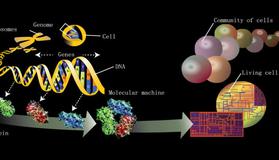
蛋白质组信息学(Proteomics)
具体内容:蛋白质组学概述、蛋白质组信息学、蛋白质组分析的内容与基本方法、蛋白质组 信息学相关资源、蛋白质结构预测、蛋白质工程分子设计简介、蛋白质组学的应 用与前景。
重点:蛋白质组研究的技术方法原理和蛋白质结构预测。
难点:蛋白质结构预测软件的使用。
教学目标:使学生掌握蛋白质组学的研究内容、主要技术方法以及蛋白质结构预测。
1. The concept of the proteome and proteomics (蛋白质组和蛋白质组学的概念)
Proteome means theentire set of proteins expressed by a genome, cell, tissue or organism at acertain time.(蛋白质组是一个基因组或细胞或组织或生物体某个时间某种状态下所表达的所有蛋白质。)
Proteomicsis the science of large-scale study of proteins, particularly their structuresand functions. It includes not only the identification and quantification ofproteins, but also the determination of their localization, modification,interaction, activities, and, ultimately, their function.(蛋白质组学的研究内容不仅包括对各种蛋白质的识别和定量,还包括确定它们在细胞内外的定位、修饰、相互反应、活性,并最终确定它们的功能。)
2. The reason to studyproteomics(进行蛋白质组学研究的原因)
1)Any phenomenon of life depends onmany factors that will involve a number of proteins.
2)The involvement of these proteinsinterweaves into network, or parallel to each other, or function cascaded.
3)The performance of proteins isdiverse and dynamic when they implement physiological functions, not likegenomes.
1)生命现象的发生往往是多因素影响的,必然涉及到多个蛋白质;
2)并且多个蛋白质的参与是交织成网络的,或平行发生的,或级联因果的;
3)蛋白质在执行生理功能时的表现是多样的、动态的,并不像基因组那样基本固定不变。)
3.The research contents of the proteomics. (蛋白质组学的研究内容)
There are mainly two parts inthis section, one is the Structural Proteomics and another is FunctionalProteomics. (蛋白质组学的研究内容主要有两方面:分别是结构蛋白质组学和功能蛋白质组学。)
The structural proteomics mainly focuson the expression patterns of proteins, including the amino acid sequenceanalysis and the spatial structure analysis.( 结构蛋白质组学主要是蛋白质表达模式的研究,包括蛋白质氨基酸序列分析及空间结构的解析。)
The Functional Proteomics mainlyfocus on the functional patterns of proteins, including studies on proteinfunctions and interactions.( 功能蛋白质组学主要是蛋白质功能模式的研究,包括蛋白质的功能和蛋白质间的相互作用。)
4.Theapplications of the proteomics (蛋白质组学的应用)
In basicresearch, technologies of the proteome have been applied to all kinds of lifescience fields these years, such as molecular biology, cellular biology,neurobiology, and so on.( 在基础研究方面,近年来蛋白质组研究技术已经被应用到各种生命科学领域,如分子生物学、细胞生物学、神经生物学等。)
For the research objects, proteomicscovers prokaryotic microorganisms, eukaryotic microorganisms, plants andanimals, which involve a variety of important biology phenomenon, such assignal transduction, cell differentiation, protein folding, and so on.(在研究对象上,蛋白质组学研究已经覆盖了原核微生物、真核微生物、植物和动物等,涉及各种重要的生物学现象,如信号转导、细胞分化、蛋白质折叠等等。)
In disease study,proteomics mainly do research on discovering new disease bio-markers, identificationof disease related proteins as tools of early clinical diagnosis, and explorationof the pathogenesis and treatments of human diseases.( 蛋白质组学在疾病研究中的应用主要是发现新的疾病标志物,鉴定疾病相关蛋白质作为早期临床诊断的工具,以及探索人类疾病的发病机制与治疗途径。)
The most promising application ofproteomics is in the field of drug development. It can not only confirm theexisting drug targets, but also illuminate the mechanism of drug action anddiscover new drug sites and receptors. And it can be also used for the analysisof drug toxicology and drug metabolites.(蛋白质组学最大的应用前景在药物开发领域,不但能证实已有的药物靶点,进一步阐明药物作用的机制,发现新的药物作用位点和受体,还可以用来进行药物毒理学分析及药物代谢产物的研究。)