
Who Are the Joneses and Why Are We Trying to Keep Up with Them?
By Mary Pritchard
1 In America today, it seems like we are always striving for something. To be bigger, better than who we are. We're never content with what we have. But why? Where did this sense of not being enough come from?
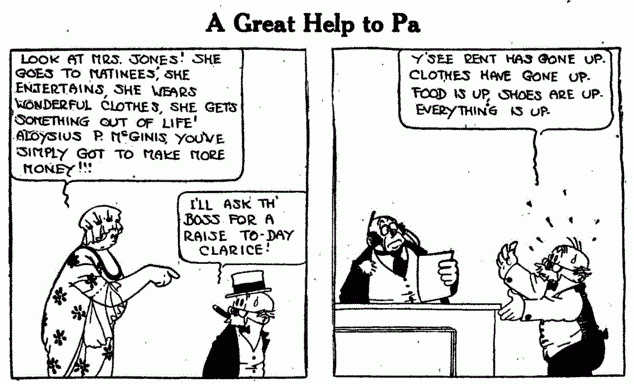
2 As it turns out, the phrase “keeping up with the Joneses” derives from a cartoon strip of that name that launched in 1913 and ran for 26 years. In the strip, creator “Pop”Momand poked fun at our need to do things in order to impress other people. I’d love to say that need vanished when the last episode of that comic strip ran, but alas, it seems to have only gotten worse. These days we don't care about the Joneses, we're trying to keep up with the Kardashians. (Thank God I don't have cable TV!)
Notes:
Arthur Mormand created “Keeping Up with the Joneses” in 1913. This comic strip (which was very typical for its time) parodied American domestic life, especially the increasing drive toward conspicuous consumption.)

2. The Kardashians:

卡戴珊家族在美国体育圈和娱乐圈享有很高的声望和地位,也是纽约知名的名媛家族。卡戴珊家族很善于经营,在将名望转化为经济利益方面可谓登峰造极。据相关媒体统计报道,2010年卡戴珊家族疯狂揽金6500万美元。在“妈妈经理”克里斯汀·玛丽·霍顿的精心管理下,卡戴珊家族的成员个个都成了“吸金机器”。卡戴珊家族总共有10名成员,分别是父亲罗伯特·卡戴珊、母亲克里斯汀·玛丽·霍顿、继父布鲁斯·詹纳、大女儿考特尼·卡戴珊、二女儿金·卡戴珊、三女儿科勒·卡戴珊、儿子小罗伯特·卡戴珊、四女儿肯达尔·詹娜和小女儿凯莉·詹娜,其中肯达尔和凯莉是卡戴珊姐妹同母异父的妹妹。
More information: ABC News 特别专访:卡戴珊家族 中英双语字幕https://www.bilibili.com/video/BV1nr4y1j7k1/?spm_id_from=333.788.recommend_more_video.0
3 Which really gets to the core of the matter? Who is telling us that we need to keep up with the Kardashians? The media. Until the late 1880s, magazines were not widely read. They were for the rich, who could afford both the time and money to read them. But toward the end of the 19th century, two events happened that forever changed our world: second class mail came into being and the rotary printing press (轮转印刷机) was invented. This dropped the price of magazines so that they wereaffordable for the working class. Mass media was born. And this opened up a whole new world.
4 Prior to the late 1880s, most of us were so busy trying to make a living that we didn't care what the Joneses were doing, nor did we know, for that matter. But with the birth of mass media, suddenly we were being told in no uncertain terms that not only were the Joneses far better than we were, but also that we should do something about it. You see, we didn't know that we weren't good enough until someone told us. And much of that assessment was, and still is, based on a perceived lack of things we're told we should want or have. “Fortunately,”those same magazines provided us with ready solutions in the form of advertisements for products that would “catch us up” to the Joneses. Of course, by the time we got there, the Joneses were ahead of us again (kind of like how your brand-new computer is out of date as soon as you walk out of the store)and the vicious cycle of keeping up with the Joneses perpetuated itself ad infinitum.
5 So here we are,feeling like we're not good enough. It's reflected in the music we listen to,the shows we watch (think “reality” TV), the things we say to ourselves and our loved ones. And we feel guilt, and most of all, shame.
6 I think Brené Brown puts it best when she says, “I see the cultural messaging everywhere thatsays that an ordinary life is a meaningless life.” (Daring Greatly, p. 23). She calls this the “never enough” problem and attributes it, for most of us, to a singular early childhood event that perpetuated our need to be a people-pleaser — at least, until someone tells us we can stop.
7 Fortunately, there are a number of anti-Joneses movements popping up. Websites like Operation Beautiful, Body Heart, and Superhero Life. Media influence is not going away and it's nice to have some sites that advocate positive self-regard out there. Because ultimately, you decide if you’re going to buy into this idea that you're not good enough.
8 So it's time to take some pressure off yourself and stop trying to keep up with the Joneses —or anyone else for that matter. Who cares what they think, anyway?
9 It's not worth it! It only leads to disappointment in the end — even if you get what you’reafter. You’ll have a better life if you just forget about what other people think and hold onto what you know is true:
Stuff will never make you happy. “We used to have everything you could want — the big house, the nice cars — but we were miserable,” a Mr.Travis said. “I was working up to 90 hours a week to cover our payments.” But after going through careful budgeting and getting out of debt, he and his wife, Lisa, are happier than they’ve ever been in their lives — renting a two-bedroom apartment.
More is never enough. If you are trying to earn money for the sakeof having more money, you will never be satisfied. Do some soul searching and ask yourself what “enough” really looks like. If you can't put a cap on it, you’re chasing the wind. Learn to be happy with what you have. Just rememberthat if you can’t buy it outright, you can't afford it. And it won't really beyours if you buy it on credit.
Contentment comes from within. It's easy to blame feelings of discontentment on outside sources like money or stuff, but true contentment and lasting joy don't come from anything money can buy. Think of the times you've felt most satisfied in life. Think of the moments you look back on as your fondest memories. Would you trade those for a pile of cash?
10 So act now! Stop buying into the message that you're not good enough. Stop buying things to“improve” who you are. Actions speak louder than words, so every time your kids see you berating yourself, they, too, are getting the message that they aren’t good enough. So stop the madness. Do it for your kids. Do it for yourself. Just do it.

