
All synonymic groups have a “central” word whose meaning is equal to the denotation common to all synonymic groups. This word is called the dominant synonym. Here are examples of the dominant synonyms with their groups:
to surprise – to astonish – to amaze – to astound; to tremble – to shiver– to shudder – to shake. The dominant synonym expresses the notion common to all synonyms of the group in the most general way without any additional information. So, any dominant synonym is a typical basic-vocabulary word, its meaning is broad and generalized, more or less “covers” the meanings of the rest of the synonyms. E.g.: the verb to look instead of to glare, to stare, to peer, to peep, to ogle.
The following table of analysis of the numerous synonyms of the verb to look is suggested by G.B. Antrushina.
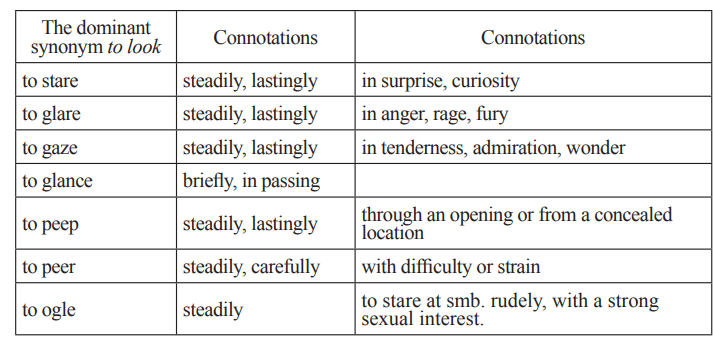
The common denotation shows that, according to the semantic criterion, the words grouped in the above table are synonyms. The connotative components represented on the right side of the table highlight their differentiations. Summing up what has been said the following characteristic features of the dominant synonym can be underlined:
high frequency of usage;
broad combinability, i.e. ability to be used in combinations with various classes of words;
a broad general meaning.

