
Every word has two aspects: the outer aspect (its sound form) and the inner form (its meaning) which presents a structure called the semantic structure of the word. It is known that most words convey several concepts and possess the corresponding number of meanings. One and the same word in different syntactical relations can develop different meanings, e.g. the verb treat in sentences:
The wood is treated with chemicals.
She was treated for minor injuries.
They treated me to sweets.
He treats his son cruelly.
These payments will be treated as income.
He treated my words as a joke.
In all these sentences the verb «treat» has different meanings and we can speak about polysemy. A word having several meanings is called polysemantic and words having only one meaning are called monosemantic these words are few in number, e.g. molecule, hydrogen, oxygen. These words are mainly scientifi c terms. The bulk of English words are polysemantic. The ability of words to have more than one meaning is described by the term polysemy. Polysemy is a phenomenon which has an exceptional importance for the description of a language system and for the solution of practical tasks connected with an adequate understanding of the meaning of a word and its use. Different meanings of a polysemantic word may come together due to the proximity of notions which they express. For example, the word blanket has the following meanings: a woolen covering used on beds, a covering for keeping a horse warm, a covering of any kind (a blanket of snow), covering all or most cases used attributively, e.g. we can say (a blanket insurance policy). The semantic structure of a polysemantic word can be distinguished between two levels of analysis. On the fi rst level the semantic structure is presented by different meaning as the main or primary meaning stands in the centre and the secondary meanings proceed out of it like rays. Each secondary meaning can be traced to the primary meaning. This type of the semantic structure of a polysemantic word is called as
radial polysemy and can be presented on the diagram.

From the diagram above it is observed that all secondary meanings of the key word “air” are connected with the primary meaning in the center and motivated by it. The second level of analysis is determined as the semantic components within each separate meaning, where some semantic structures are arranged on different principles, they are not correlated with each other and have variable meanings. This type of a polysemantic word can be called the chain polysemy. In the following list of meanings of the adjectives dull and high one can hardly fi nd a generalized meaning covering and holding together the rest of the semantic structure. (See the table).

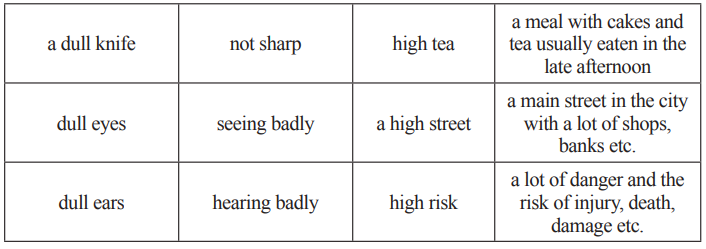
As you see from this table the adjectives dull and high with the different nouns forming new word-groups which are distinguished into separate meanings. In most cases in the semantic development of a word both ways: radial polysemy and chain polysemy are combined.

