
Dear students,
PPP and TBL are two important teaching models. Please review this part carefully with the instructions and academic resources.
1. PPP

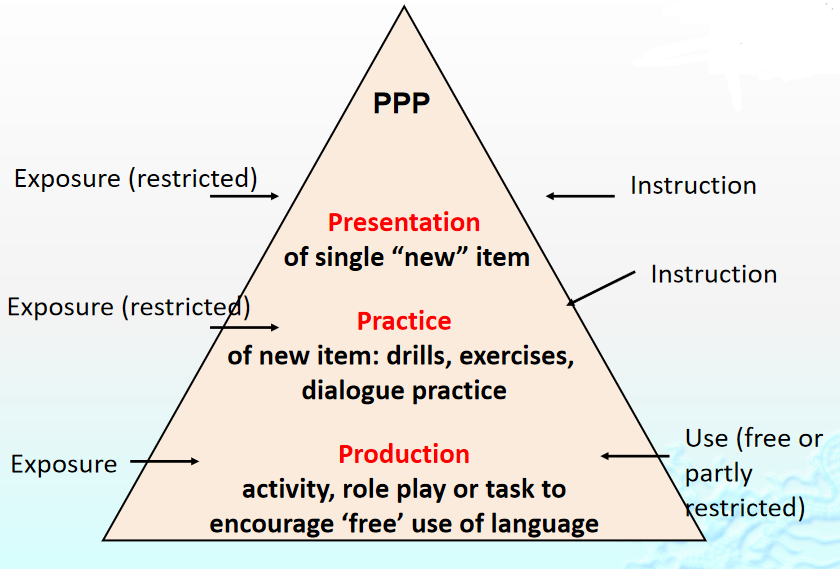
1) Three stages
P: presentation
The teacher introduces a new language item in a context
P: practice
Students are asked to some controlled practice, such as drills, exercises, dialogue reading, repetition.
P: production
Students produce the language in a more meaningful way: role-play, drama, interview
2) Key words
Exposure: Students' exposure to a variety of language
Restrict: Students' exposure to a variety of language is restricted by the teacher (especially in the first two stages). Teachers pre-select the language (forms) to be taught and exercises for students to do.
Instruction: Teachers' instruction takes up a large part of the whole class.
Use (free or partly restricted): In the last stage, students have the chance to practice using the language in a more communicative context. If students are asked to do a task, then they can use the language freely. If students are asked to do an exercise-task, then their exposure to a variety of language is partly restricted by the teacher.
2. TBL
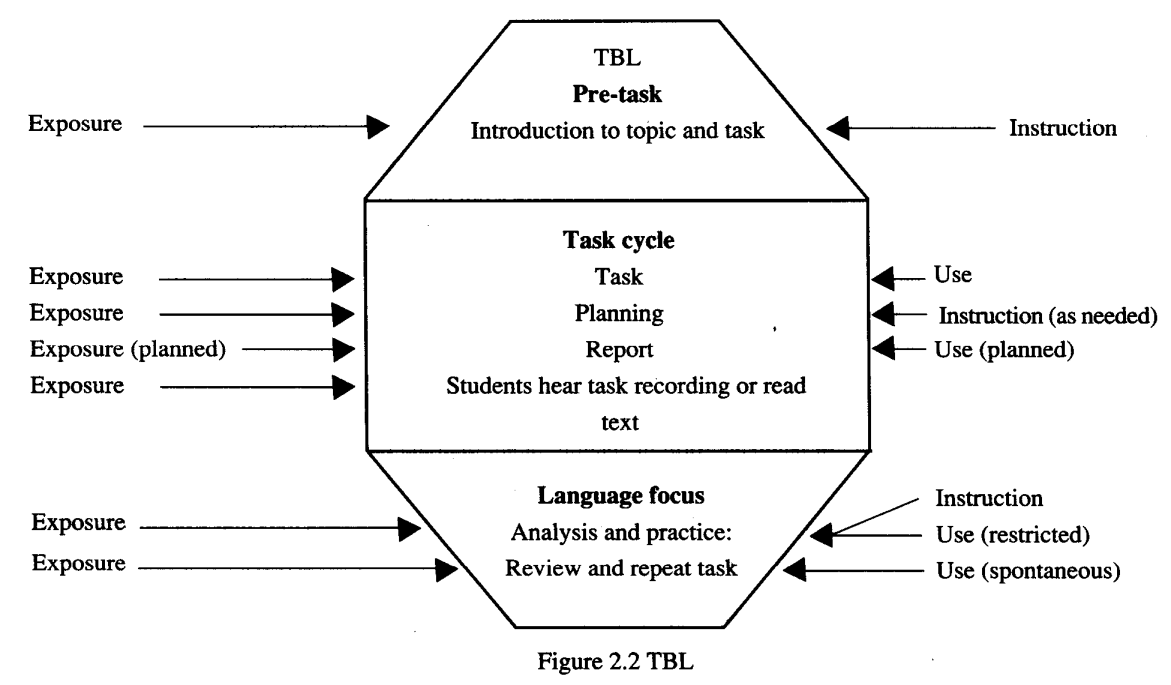
1) Three stages
Pre-task: The teacher will present what will be expected of the students in the task phase.
Weak form: The teacher may prime the students with key vocabulary or grammatical constructs, although this can mean that the activity is more similar to PPP paradigm.
Strong form: Learners are responsible for selecting the appropriate language for any given context themselves. The teacher may also present a model of the task by either doing it themselves or by presenting picture, audio, or video demonstrating the task.
Task: During the task phase, the students perform the task, typically in small groups, although this is dependent on the type of activity. And unless the teacher plays a particular role in the task, then the teacher's role is typically limited to one of an observer or counselor.
planning stage: drafting, rehearsal and practice (help learners adjust their language for the report stage; encourage learners to consider appropriateness and accuracy of language in general, rather than a single form)
report: a free exchange of ideas, summarizing learners' achievements
Post-task:
Analysis and practice: Teachers can analyze the language problems existing in common and guide students to do more practice.
Review: learners can review each other's work and offer constructive feedback.
2) Key words:
Exposure: The exposure include a whole range of words, collocations, lexical phrases and patterns in addition to language forms pre-selected for focus (weak-form in the pre-task stage). Students feel free to use a variety of language and they rely on their own linguistic resources.
Restrict: Students' exposure to a variety of language is only restricted in the post-task stage when teachers help students to analyze common language problems in their report.
Instruction: Teachers' instruction is not the main part of the whole class.
Use: The task supplies a genuine need to use language to communicate and students feel free to use a variety of language. They will realize there is more to language than verb tenses and new words.
3. Academic materials
1) Read these two pages please, which can help you to understand the two language teaching models. Click the link and study it by yourself.
2) This example can help you to understand how to conduct a TBL class:
You may take part in the following discussion:

