1.Please download the following audio to familiarize the text.
Firm belief, eternal friendship
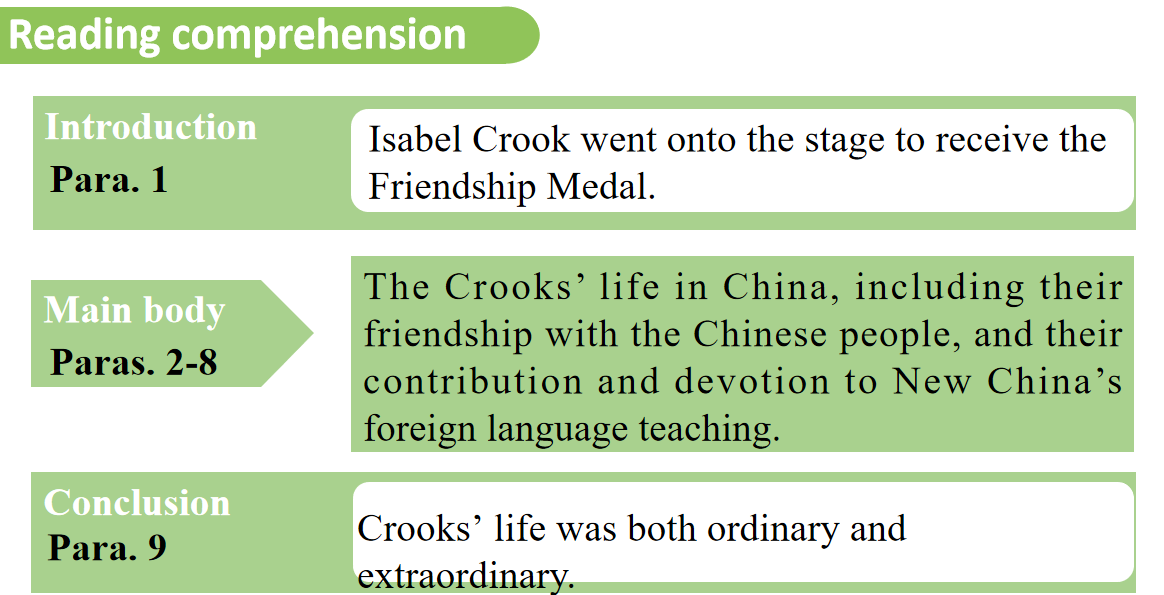
1 The presentation ceremony for the national medals and honorary titles of the People’s Republic of China was held at the Great Hall of the People in 2019. Among all the laureates, a white-haired elderly lady was in the spotlight. She was awarded the Friendship Medal, China’s highest order of honor for foreigners. When Isabel Crook walked slowly onto the stage, there was a burst of enthusiastic applause to salute this 104-year-old laureate. At that moment, she couldn’t help thinking of her husband David Crook. If he were still alive, he would have definitely appeared on the podium with her.
2 The Crooks belonged to the generation who grew up during the raging flames of the two world wars. The call of the times prompted them to hold a communist belief, so later they both joined the British Communist Party. In November 1947, with a letter of introduction from the British Communist Party, they crossed the oceans, broke through the blockade lines, and finally arrived in Shilidian in the old revolutionary base area of the Taihang Mountains in China.
3 Arranged by relevant leaders of the Communist Party of China, the Crooks became members of a work team in Shilidian, which reexamined the whole process of the land reform, together with the peasants and the Party organization there. Meanwhile, they noted down what they had observed. The observations were later published in the book Revolution in a Chinese Village: Ten Mile Inn. In 1948, when they were preparing to leave China, some leaders of the Party invited them to stay to help train foreign language personnel for New China.
4 Although totally unprepared, the Crooks put aside their original plan. Out of their heartfelt dedication to the cause of the Chinese revolution, they went to the Central Foreign Affairs School, the predecessor of Beijing Foreign Studies University, to report for duty – a turning point in the course of their life. For more than half a century, they worked tirelessly and conscientiously for China’s foreign language education. When people asked them, “Why did you choose to work in China?”, they responded, “The main reason, of course, is our political commitment.”
5 It is this sense of commitment derived from their belief that enabled them to cultivate brotherly friendships with the Chinese people. While working in Shilidian, they always shared their joys and sorrows with the villagers. The Crooks learned how to carry manure to the fields on a shoulder pole and how to use a Chinese hoe. They were often seen squatting by the fields with rice bowls in their hands, chatting while eating with the villagers. As a result, the villagers ceased to regard the Crooks as “foreigners” and treated them as their members of the family.
6 The Crooks were always eager to integrate with the masses no matter when and where. Tall and dressed in the blue cotton-padded uniform, they looked like everyone else around them, except for their faces. They gnawed wowotou and pickles and ate cabbage soup together with others during the difficult times. They also took the initiative to request cutting their salary. They never complained about the harsh conditions because of their faith in communism.
7 The common belief in communism also led to comradely friendships. People always called the Crooks comrades. When they revisited Shilidian, the local people affectionately called them “Comrade David” and “Comrade Isabel”. Even our beloved Premier Zhou Enlai cordially called them comrades and regarded them as good friends of the Chinese people.
8 The Crooks, who blazed a trail in the field of English teaching in New China, contributed to the training of generation after generation of foreign language talent in the fields of foreign affairs, history, trade and finance, journalism, education, etc. They were all inspired by the Crooks’ spirit of selfless devotion. In the early 1960s, when the Soviet Union withdrew all their experts from China, the Crooks chose to stay. They said, “China is faced with economic difficulties. At a crucial moment like this, we can’t just leave.” So, without hesitation, they turned down the job offer from the University of Leeds.
9 The life of the Crooks in China was both ordinary and extraordinary. It was ordinary because they were always in the grass roots – a member of the Shilidian work team and a faculty member at school. It was extraordinary because they left their homeland for the Chinese revolutionary cause, to which they made an absolute commitment. The friendship between the Crooks and the Chinese people is eternal! The Chinese people will never forget what David Crook said in the 1980s: “I am confident that by the end of this century … China, which Isabel and I love, which has become our second homeland, will be creating a strong socialist society.”