1.Please download the following audio to familiarize the text.
Social media: How much is too much
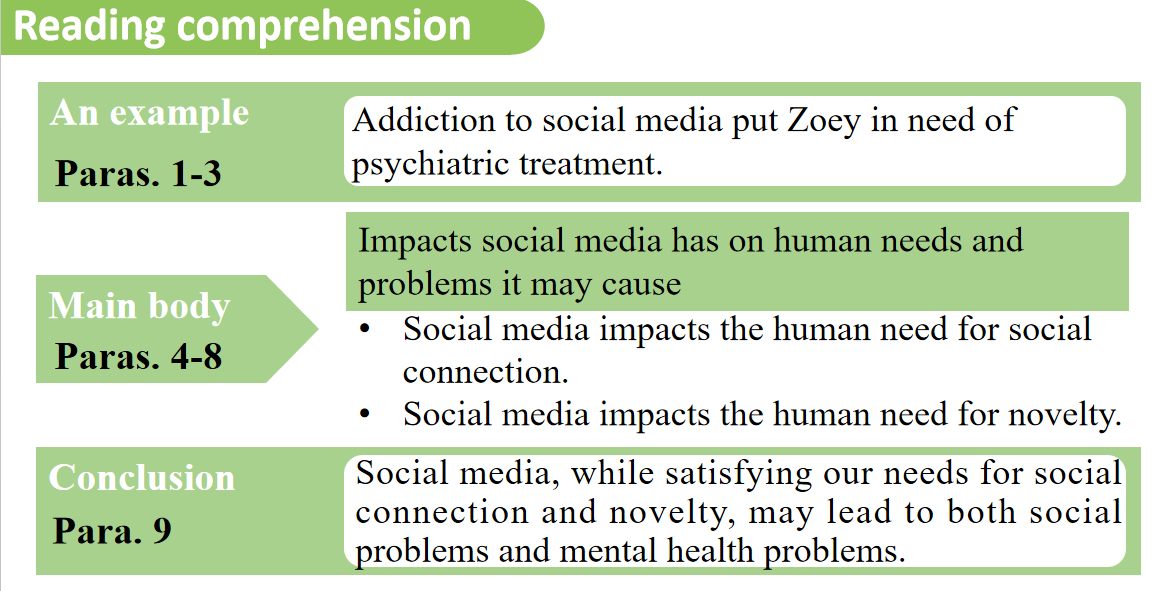
1 “I hate you!” the wild-eyed teenage girl shouted as she kicked her father before biting his arm. This was the second time that week that Zoey had flown into a violent rage because her parents had taken away her access to social media.
2 At our psychiatric clinic, when her parents, David and Amanda, came to enlist our help for her sake, they described Zoey as a sweet, happy girl and a good student. She loved playing soccer, hiking, and taking mountain bike rides with her dad. David and Amanda, supportive parents with college degrees and their own tech business, were startled by Zoey’s social media addiction. “It all started after she came home in seventh grade with a notebook the school had given her,” they said. This brand-new computer, provided for classwork, contained many online chat apps.
3 Soon they noticed Zoey was devoting her late-night hours to chat rooms and seemed fascinated by videos and online games. Their daughter changed from a sweet, innocent child who enjoyed spending time with them into a rude, angry terror. Her academic performance declined, and sadly, she ended up needing psychiatric treatment.
4 Given that the teenage years are a time of dramatic change for most kids, Zoey may have been headed for trouble with or without social media. It’s also true that many students use social media responsibly without compromising their health or school performance. However, growing evidence shows that social media impacts some human needs, and absorption in the digital world can generate a number of psychological problems – from addiction to depression. Young people are especially in danger of a breakdown.
5 One human need considerably impacted by social media is social connection. No doubt, social connection is an essential part of being human and also a significant factor contributing to happiness and health. Thanks to social media, we are the most connected society ever in history. Worldwide, approximately 3.5 million emails are sent per second. Predictably, the younger you are, the more you text. Yet the rise of social media is problematic, for it goes along with an apparent decline in mental health. More people have reported symptoms of being depressed in recent years than in the 1980s. Today’s teens, in particular, are more likely to have trouble sleeping and more likely to need a professional for their mental health problems.
6 Certainly, numerous other factors may be driving this trend, but preliminary research links depression with social media usage. A University of Houston study found that the more time college students spent posting and chatting online, the greater the chance they would experience mild depression. The researchers attributed this to something called social comparison. When we compare ourselves to others online, it hurts our self-confidence. We think everyone is doing better than we are. But this is misleading since other people usually post only their successes and good news.
7 It has also been discovered that spending too much time online is interfering with or even causing withdrawal from face-to-face encounters. That is troubling because we know that we can get physically and psychologically ill if cut off from human influence. We improve our emotional state largely through being out in society. Not getting the right kind of human contact and support at key developmental periods of childhood may lead to serious emotional and psychological problems.
8 Another basic need impacted by social media is the need for novelty. Our human brain is biologically prepared for novelty, which, in turn, has helped us survive disastrous environmental change. Unfortunately, this natural thirst can become obsessive in the information age, in which every post, text, email, and online photograph is an opportunity to experience something new. As with an ardent chocolate lover at a candy store, the many choices are too stimulating, even exhausting.
9 Social media, which feeds our needs for connection and novelty, risks causing social problems and also undermining people’s mental health. If kids develop compulsive texting and social media habits, like Zoey, they can suffer badly. It’s high time that educators and families rethought how to change the extent to which we expose our children to social media. As for David and Amanda, they would do anything to have their sweet, loving Zoey back.