
Unit 1 Food Science
Teaching objectives: after learning this unit, students will:
1. Know the relationship between food and health.
2. Use reading skills(surveying an article, skimming and scanning, recognizing classification) to improve reading comprehension.
3. Use listening skills(predicting and key words) to improve listening comprehension.
4. Write an introduction and develop an effective thesis statement.
5. Open a discussion and show agreement and disagreement.
Time arrangement:
Period 1 pre-reading activities (familiarizing with new words, warming-up questions and background information)
Period 2 while reading (highlights of the text, after-reading activities)
Period 3 listening and speaking
Period 4 writing
Key teaching points:
1.Reading skills:skimming and scanning
2.Listening skills:predicting
Difficult teaching points:
Introduction to academic paper and a lecture about how to give paper a title, write an impressive introduction and develop an effective thesis statement.
Reading 1 Are Potatoes Now a Cancer Risk?
Global reading(60mins)
1. In this section students will be divided into groups and do a theme-related discussion and complete the K&W of (KWL+ worksheet) (10mins) handouts are needed here
2. Pre-Reading (5mins): familiarize with new words
3. While-Reading:(35mins)
1)In this section students will work in groups and answer/guess the questions assigned by the teacher.(Surveying the text, 5mins)
---What is the text about?
---Where would you possibly find this type of article?
---Who is the target audience?
Teacher gives reflection
You can survey an article by:
looking at the title, subtitle and headings;
looking at the pictures and captions;
looking at the graphs or diagrams.
2) In this section students will work in groups and answer/guess thequestions assigned by the teacher.(skimming and scanning 10mins)
l If you skim a text, you can know how the information is organized and gain a general understanding of the main ideas.
l If you scan a text, you read fast to try to locate specific pieces of information, such as a name, a date, a definition, or a number.
Task A: Skim the text and answer the following questions.P6
---Is there an introduction?
---How many parts are there?
---Is there a conclusion?
Task B: Skim and scan the text. Write down the correct section headings for the following information.P7
Text study(20mins): In this section students will be divided into groups and each group read the corresponding paragraphs and answer the following questions within 5mins.
Group 1 (para.1-3)
1. What is the text about?
2. How is acrylamide produced in food?
3. Explain Maillard reaction in your own words.
4. What’s the result of Maillard reaction?
Group 2 (para.4-6)
1. Is acrylamide dangerous to animals?
2. Do you think acrylamide directly causes cancer in humans? How do you know?
3. Can you list some other factors that are highly cancer risky?
Group3 (para7-10)
1. What does Shield suggest people?
2. What does FSA suggest people?
3. What is the meaning of the quotation from Steve Wearne of the UK Food Standards Agency (FSA)?
Group 4 (para.11-12)
1. List the ways to reduce the risk mentioned in this part.
2. How do you understand “varieties” in “potatoes varieties” and “develop varieties”?
4. Post-Reading:(10mins):Close reading and critical thinking. P7-8
Assignments:
1. Each student re-read Text A and complete L&+
2. Each group read Text B and complete KWL+
Language enhancement P8-10
Session 2
I Reviewing and assignments checking(35mins)
In this section students will exchange their answers to the questions about the last 6 paras in reading 1 and share KWL+worksheet. (15mins)
(para7-10)
1. What does Shield suggest people?
2. What does FSA suggest people?
3. What is the meaning of the quotation from Steve Wearne of the UK Food Standards Agency (FSA)?
(para.11-12)
1. List the ways to reduce the risk mentioned in this part.
2. How do you understand “varieties” in “potatoes varieties” and “develop varieties”?
Decide if the following statements are true (T) or false (F). Correct the false statements and give further explanations.(5mins)
1) Acrylamide is a rare and dangerous chemical.
2) There is evidence that the acrylamide in potatoes will cause cancer in humans.
3) If starchy foods are cooked at a rather high temperature, the amount of acrylamide in the food may increase drastically.
4) Bad habits in people’s lifestyle like smoking and drinking can cause cancer.
5) Putting potatoes in the refrigerator is a good way to store them.
Sum up the main ideas of reading 1 and try to organize the summary by following the order of the heading questions. (10mins)
---What’s the problem?
---Which foods contain acrylamide?
---Is acrylamide dangerous?
---What should we do?
---How else can we reduce the risk?
II Text Study(15mins)
In this section teacher will ask some students interpret the difficult sentences in Reading 1.
1. The UK Food Standards Agency (FSA) has launched a campaign warning of the cancer risk associated with cooking potatoes and other starchy foods at high temperatures. (Para. 1)
FSA of the UK has started a movement. The movement warns the public of the cancer risk connected with cooking starchy foods such as potatoes at high temperatures.
英国食品标准局发起宣传活动,提醒人们警惕高温烹饪土豆及其他淀粉类食物时可能产生致癌物。
2.“It’s those kinds of trade-offs we’re encouraging people to just think about,” … (Para.10)
We are encouraging people to weigh up the two choices and act accordingly: to cook potatoes at high temperatures or to have a healthy diet and reduce the risk of cancer.
“这就是我们鼓励大家考虑的‘权衡利弊’,”……
3.Now growers are looking to develop varieties that contain less asparagine, an amino acid that seems to be important for making the chemical. (Para. 12)
Now potato growers hope to develop potato varieties that contain less of the element that may cause the production of acrylamide.
目前土豆种植者们也在尝试培育天冬酰胺含量较低的品种,而天冬酰胺似乎也是产生丙烯酰胺的重要氨基酸。
Preparation for Students Before Class
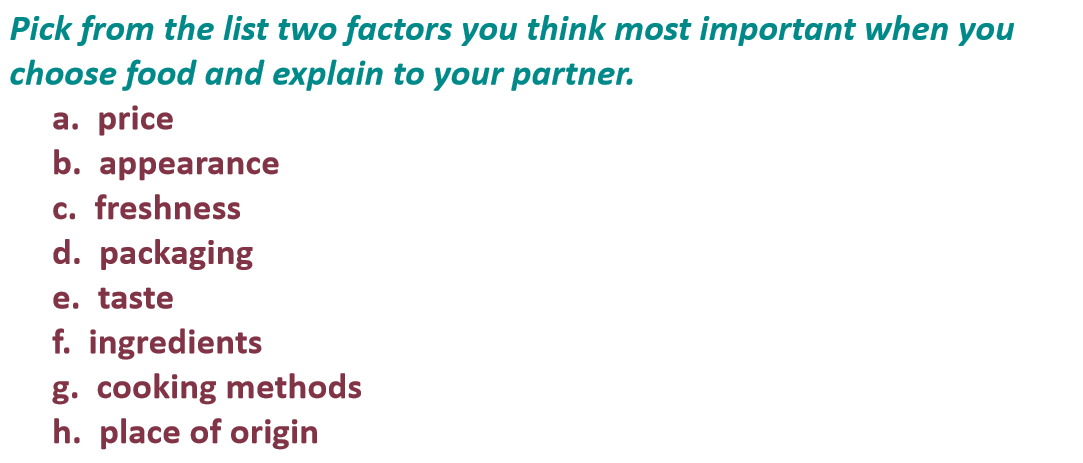
准备 Before Reading部分的讨论题。
2. 学习下面的词汇课件,学习本课的生词、短语的用法。
3. 观看下面的视频,学习Reading1 的文章结构。
4. 完成课本 P6.7.8.9 的练习。
5. 学习 p9构词法:Word Building Skill — Prefixes (I): “con-” and “com-”
6. 找出并记下关于Reading1 的课文和练习中所有你不清楚和有疑问的内容,在课堂上分享和解决。

