
9-1 Television Video Signals
Although over 50 years old,the standard television signal is still one of the most common way to transmit an image. Figure 1 shows how the television signal appears on an oscilloscope. This is called composite video,meaning that there are vertical and horizontal synchronization(sync)pulses mixed with the actual picture information. [1] These pulses are used in the television receiver to synchronize the vertical and horizontal deflection circuits to match the video being displayed. Each second of standard video contains 30 complete images, commonly called frames. A video engineer would say that each frame contains 525 lines, the television jargon for what programmers call rows. This number is a little deceptive because only 480 to 486 of these lines contain video information; the remaining 39 to 45 lines are reserved for sync pulses to keep the television’s circuits synchronized with the video signal. [2]
Standard television uses an interlaced format to reduce flicker in the displayed image. This means that all the odd lines of each frame are transmitted first, followed by the even lines. The group of odd lines is called the odd field, and the group of even lines is called the even field. Since each frame consists of two fields,the video signal transmits 60 fields per second. Each field starts with a complex series of vertical sync pulses lasting 1.3 milliseconds. This is followed by either the even or odd lines of video. Each line lasts for 63.5 microseconds,including a 10.2 microsecond horizontal sync pulse,separating one line from the next. Within each line,the analog voltage corresponds to the gray scale of the image,with brighter values being in the direction away from the sync pulses. This place the sync pulses beyond the black range. In video jargon,the sync pulses are said to be blacker than black.
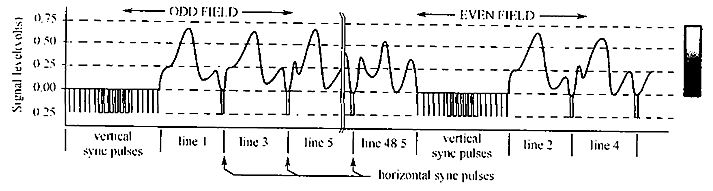
Figure 1 Composite video signal
The hardware used for analog-to-digital conversion of video signals is called a frame grabber. This is usually in the form of an electronics card that plugs into a computer,and connects to a camera through a coaxial cable. Upon command from software,the grabber waits for the beginning of the next frame,as indicated by the vertical pulses. During the following two fields,each line of video is sampled many times,typically 512,640 or 720 samples per line,at 8 bits per sample. These samples are in memory as one row of the digital image.
This way of acquiring a digital image results in an important difference between the vertical and horizontal directions. Each row in the digital image corresponds to one line in the video signal,and therefore to one row of wells in the CCD. Unfortunately,the columns are not so straightforward. In the CCD,each row contains between about 400 to 800 wells(columns), depending on the particular device used. When a row of wells is read from the CCD,the resulting line of video is filtered into a smooth analog signal,such as in Figure 1.In other words,the video signal does not depend on how many are present in the CCD. The resolution in the horizontal direction is limited by how rapidly the analog signal is allowed to change. This is usually set at 3.2 MHz for color television,resulting in a rise time of about 100 nanoseconds,i.e.,about 1/500th of the 53.2 microsecond video line.
When the video signal is digitized in the frame grabber,it is converted back into columns.However,these columns in the digitized image have no relation to the columns in the CCD. The number of columns in the digital image depends solely on how many the frame grabber [3] samples each line of video. For example,a CCD might have wells per row,while the digitized image might only have 512 pixels(i.e.,columns) per row.
The number of columns in the digitized image is also important for another reason. The standard television image has an aspect ratio of 4 to 3,i. e.,it is slightly wider than it is high. Motion pictures have the wider aspect ratio of 25 to 9.CCDs used for applications often have an aspect ratio of 1 to 1,i.e., a perfect square. In any event,the aspect ratio of a CCD is fixed by the placement of the electrodes,and cannot be altered. However,the aspect ratio of the digitized image depends on the number of per line. This becomes a problem when the image is displayed,either on a video monitor or in a hardcopy.[3] If the aspect ratio isn’t properly reproduced,the images quashed horizontally or vertically.
The 525 line video signal described here is called NTSC(National Television Committee)[4],a standard defined way back in 1954.This is the system used in United States and Japan. In Europe there are two similar standards called PAL(Phase Alternation by Line)[5] and SECAM(Sequential Chrominance And Memory)[6].The basic concepts are the same,just the numbers are different. Both PAL and SECAM with 25 interlaced frames per second,with 625 lines per frame. Just as with NTSC,some of these lines occur during the vertical sync,resulting in about 576 lines that carry picture information. Other more subtle differences relate to how color and sound are added to the signal.
The most straightforward way of transmitting color television would be to have three separate analog signals,one for each of the three colors the human eye can detect: red,green and blue.[7] Unfortunately, the historical development of television did not allow such a simple scheme. The color television signal was developed to allow existing and white television sets to remain in use without modification. This was done by retaining the same signal for brightness information,but adding a separate signal for color information. In video jargon,the brightness is called the luminance signal,while the color is the chrominance signal. The chrominance signal is contained on a 3.58 MHz carrier wave added to the black and white video signal. Sound is added in this same way, on a 4.5 MHz carrier wave. The television receiver separates these three signals, processes them individually,and recombines them in the final display.
WORDS AND PHRASES
oscilloscope 示波器
deflection 偏转,偏差
jargon 行话
luminance 亮度
chrominance 色度
squash 挤压
frame grabber 帧采集器
odd field 奇数场
even field 偶数场
NOTES
[1] This is called composite video,meaning that there are vertical and horizontal synchronization(sync)pulses mixed with the actual picture information
该信号被称为‘复合视频信号’,意思是在实际的图像信息中加入了垂直和水平同步脉冲。
[2] This number is a little deceptive because only 480 to 486 of these lines contain video information; the remaining 39 to 45 lines are reserved for sync pulses to keep the television’s circuits synchronized with the video signal.
这个数字有些名不符实,因为只有480~486线包含视频信息,而剩下的39~45线用以同步脉冲来保持电视机电路与视频信号的同步。
[3] This becomes a problem when the image is displayed,either on a video monitor or in a hardcopy.
在视频监视器上显示数字图像或进行数字图像硬拷贝时,这将是个问题。
[4] NTSC(National Television Committee):NTSC制式(又称N制式),是1952年12月由美国国家电视系统委员会(NTSC)制定的彩色电视标准。
[5] PAL(Phase Alternation by Line):PAL制式(帕尔制),是1962年由前联邦德国在NTSC技术上研制出的改进方案。
[6] SECAM(Sequential Chrominance And Memory):SECAM制式(塞康制),是1966年由法国研制出的彩色电视制式。
[7] The most straightforward way of transmitting color television would be to have three separate analog signals,one for each of the three colors the human eye can detect: red,green and blue.
传送彩色电视信号最直接的方法是用独立的三路模拟信号分别表示人眼可检测到的红、绿、蓝三种颜色

