
-
1 Writing
-
2 Task1
-
3 Task2
-
4 Academic wri...
Methodology/Results writing
Your research methodology discusses and explains the data collection and analysis methods you used inyour research. A key part of your thesis, dissertation, or research paper, the methodology chapter explains what you did and how you did it, allowing readers to evaluate the reliability and validity of your research andyour dissertation topic.
It should include:
The type of research you conducted
How you collected and analyzed your data
Any tools or materials you used in the research
How you mitigated or avoided research biases
Why you chose these methods
Tips
Your methodology section should generally be written in the past tense.
Academic style guides in your field may provide detailed guidelines on what to include for different types of studies.
Your citation style might provide guidelines for your methodology section (e.g., an APA Style methods section).
Table of contents
How to write a research methodology
Why is a methods section important?
Step 1: Explain your methodological approach
Step 2: Describe your data collection methods
Step 3: Describe your analysis method
Step 4: Evaluate and justify the methodological choices you made
Tips for writing a strong methodology chapter
Why is a methods section important?
Your methods section is your opportunity to share how you conducted your research and why you chose the methods you chose.It’s also the place to show that your research was rigorously conducted and can be replicated.
It gives your research legitimacy and situates it within your field, and also gives your readers a place to refer to if they have any questions or critiques in other sections.
Step 1: Explain your methodological approach
You can start by introducing your overall approach to your research. You have two options here.
Option 1: Start with your “what”
What research problem or question did you investigate?
Aim to describe the characteristics of something?
Explore an under-researched topic?
Establish a causal relationship?
And what type of data did you need to achieve this aim?
Quantitative data, qualitative data, or a mix of both?
Primary data collected yourself, or secondary data collected by someone else?
Experimental data gathered by controlling and manipulating variables, or descriptive data gathered via observations?
Option 2: Start with your “why”
Depending on your discipline, you can also start with a discussion of the rationale and assumptions underpinning your methodology. In other words, why did you choose these methods for your study?
Why is this the best way to answer your research question?
Is this a standard methodology in your field, or does it require justification?
Were there any ethical considerations involved in your choices?
What are the criteria for validity and reliability in this type of research? How did you prevent bias from affecting your data?
Quantitative example
In a quantitative experimental study, you may aim to produce generalizable knowledge about the causes of aphenomenon. This requires a carefully designed study under controlled conditions that can be replicated by other researchers.
Qualitative example
In a qualitative ethnography, you mayaim to produce contextual, real-world knowledge about the behaviors, social structures, or shared beliefs of a specific group of people. This methodologyis less controlled and more interpretive, so you will need to reflect on your position as a researcher.
Step 2: Describe your data collection methods
Once you have introduced your reader to your methodological approach, you should share full details about your data collection methods.
Quantitative methods
In order to be considered generalizable, you should describe quantitative research methods in enough detail for another researcher to replicate your study.
Here, explain how you operationalized your concepts and measured your variables. Discuss your sampling method or inclusion and exclusion criteria, as well as any tools, procedures, and materials you used to gather your data.
Surveys
Describe where, when, and how the survey was conducted.
How did you design the questionnaire?
What form did your questions take (e.g., multiple choice, Likert scale)?
Were your surveys conducted in-person or virtually?
What sampling method did you use to select participants?
What was your sample size and response rate?
Tip:
You may also want to include the full questionnaire as an appendix. This way, your readers can see exactly how your questions and data align.
Experiments
Share full details of the tools, techniques, and procedures you used to conduct your experiment.
How did you design the experiment?
How did you recruit participants?
How did you manipulate and measure the variables?
What tools did you use?
Existing data
Explain how you gathered and selected the material (such as data sets or archival data) that you used in your analysis.
Where did you source the material?
How was the data originally produced?
What criteria did you use to select material (e.g., date range)?
Example: Quantitative methods
The survey consisted of 5 multiple-choice questions and 10 questions measured on a 7-point Likert scale.
The goal was to collect survey responses from 350 customers visiting the fitness apparel company’s brick-and-mortar location in Boston on July 4–8, 2022, between 11:00 and 15:00.
Here, a customer was defined as a person who had purchased a product from the company on the day they took the survey. Participants were given 5 minutes to fill in the survey anonymously. In total, 408 customers responded, but not all surveys were fully completed. Due to this, 371 survey results were included in the analysis.
Note:
Keep in mind that quantitative methods areat risk for a few types of research bias arising from data collection and statistical analysis in research settings. These include:
Information bias
Omitted variable bias
Regression to the mean
Survivorship bias
Undercoverage bias
Sampling bias
Qualitative methods
In qualitative research, methods are often more flexible and subjective. For this reason, it's crucial to robustly explain the methodology choices you made.
Be sure to discuss the criteria you used toselect your data, the context in which your research was conducted, and the role you played in collecting your data (e.g., were you an active participant, or a passive observer?)
Interviews or focus groups
Describe where, when, and how the interviews were conducted.
How did you find and select participants?
How many participants took part?
What form did the interviews take (structured, semi-structured, or unstructured)?
How long were the interviews?
How were they recorded?
Participant observation
Describe where, when, and how you conducted the observationor ethnography.
What group or community did you observe? How long did you spend there?
How did you gain access to this group? What role did you play in the community?
How long did you spend conducting the research? Where was it located?
How did you record your data (e.g., audiovisual recordings, note-taking)?
Existing data
Explain how you selected case study materials for your analysis.
What type of materials did you analyze?
How did you select them?
Example: Qualitative methods
In order to gain better insight into possibilities for future improvement of the fitness store's product range, semi-structured interviews were conducted with 8 returning customers.
Here, a returning customer was defined as someone who usually bought products at least twice a week from the store.
Surveys were used to select participants. Interviews were conducted in a small office next to the cash register and lasted approximately 20 minutes each. Answers were recorded by note-taking, and seven interviews were also filmed with consent. One interviewee preferred not to be filmed.
Note:
Keep in mind that qualitative methods areat risk for a few types of research bias and demand characteristics arising from human behavior and interactions in research settings. These include:
The Hawthorne effect
Observer bias
The placebo effect
Response bias and Nonresponse bias
The Pygmalion effect
Recall bias
Social desirability bias
Self-selection bias
Mixed methods
Mixed methods research combines quantitative and qualitative approaches. If a stand alone quantitative or qualitative study is insufficient to answer your research question, mixed methods may be a good fit for you.
Note:
Keep in mind that mixed methods research doesn't just mean collecting both types of data. Rather, it encompasses careful consideration and integration of both types of data into robust and strong conclusions.
Mixed methods are less common than stand alone analyses, largely because they require a great deal of effort topull off successfully. If you choose to pursue mixed methods, it's especially important to robustly justify your methods.
Example: Mixed met
Example: Mixed methods
Quantitative and qualitative methods were combined to see if there was a statistically significant relationship between the speed with which the fitness store shelved new releases from popular brands and the likelihood that customers would return. Quantitative research involved running analyses in R on purchase data, while qualitative research focused onthe likelihood that interviewed participants mentioned new releases.
Step 3: Describe your analysis method
Next, you should indicate how you processed and analyzed your data. Avoid going into too much detail: you should not start introducing or discussing any of your results at this stage.
Quantitative methods
In quantitative research, your analysis will be based on numbers. In your methods section, you can include:
How you prepared the data before analyzing it (e.g., checking for missing data, removing outliers, transforming variables)
Which software you used (e.g., SPSS, Stata or R)
Which statistical tests you used (e.g., two-tailed t test, simple linear regression)
Example: Quantitative methods
Before analysis, the gathered data was prepared. The dataset was checked for missing data and outliers. For this, the“outlier labeling rule” was used. All values outside the calculated range were considered outliers (Hoaglin & Iglewicz, 1987). The data were then analyzed using a two-way ANOVA with statistical software SPSS.
Qualitative methods
In qualitative research, your analysis will be based on language, images, and observations (often involving some formof textual analysis).
Specific methods might include:
Content analysis: Categorizing and discussing the meaning of words, phrases and sentences
Thematic analysis: Coding and closely examining the data to identify broad themes and patterns
Discourse analysis: Studying communication and meaning in relation to their social context
Example: Qualitative methods
The interviews were transcribed and thematic analysis was conducted. This involved coding all the data before identifying and reviewing six key themes. Each theme was examined to gain an understanding of participants' perceptions and motivations.
Mixed methods
Mixed methods combine the above two research methods, integrating both qualitative and quantitative approaches into one coherent analytical process.
Step 4: Evaluate and justify the methodological choices you made
Above all, your methodology section should clearly make the case for why you chose the methods you did. This is especially true if you did not take the most standard approach to your topic. In this case, discuss why other methods were not suitable for your objectives, and show how this approach contributes new knowledge or understanding.
In any case, it should be overwhelmingly clear to your reader that you set yourself up for success in terms of your methodology's design. Show how your methods should lead to results that arevalid and reliable, while leaving the analysis of the meaning, importance, and relevance of your results for your discussion section.
Tip:
You can acknowledge limitations or weaknesses in the approach you chose, but justify why these were outweighed bythe strengths. Here are a few examples:
Quantitative: Lab-based experiments cannot always accurately simulate real-life situations and behaviors, but they are effective for testing causal relationships between variables.
Qualitative: Unstructured interviews usually produce results that cannot be generalized beyond the sample group, but they provide a more in-depth understanding of participants' perceptions, motivations, and emotions.
Mixed methods: Despite issues systematically comparing differing types of data, a solely quantitative study would not sufficiently incorporate the lived experience of each participant, while a solely qualitative study would be insufficiently generalizable.
Tips for writing a strong methodology chapter
Remember that your aim is not just to describe your methods, but to show how and why you applied them. Again, it's critical to demonstrate that your research was rigorously conducted and can be replicated.
1. Focus on your objectives and research questions
The methodology section should clearly show why your methods suit your objectives and convince the reader that you chose the best possible approach to answering your problem statement and research questions.
2. Cite relevant sources
Your methodology can be strengthened by referencing existing research in your field. This can help you to:
Show that you followed established practice for your type of research
Discuss how you decided on your approach by evaluating existing research
Present a novel methodological approach to address a gap in the literature
3. Write for your audience
Consider how much information you need togive, and avoid getting too lengthy. If you are using methods that are standard for your discipline, you probably don't need to give a lot of background or justification.
Regardless, your methodology should be a clear, well-structured text that makes an argument for your approach, not justa list of technical details and procedures.
Note:
Generative AI tools like ChatGPT can be useful at various stages of the writing and research process and can help you to write your methodology. However, we strongly advise against trying to pass AI-generated text off as your own work.
ChatGPT outputs are not always original andmay be detected by your university's plagiarism checker or AI detector.
A results section is where you report the main findings of the data collection and analysis you conducted for your thesis or dissertation. You should report all relevant results concisely and objectively, in a logical order. Don't include subjective interpretations of why you found these results or what they mean—any evaluation should be saved for the discussion section.
Table of contents
How to write a results section
Reporting quantitative research results
Reporting qualitative research results
Results vs. discussion vs. conclusion
How to write a results section
When conducting research, it's important to report the results of your study prior to discussing your interpretations of it. This gives your reader a clear idea of exactly what you found and keeps the data itself separate from your subjective analysis.
Here are a few best practices:
Your results should always be written in the past tense.
While the length of this section depends on how much data you collected and analyzed, it should be written as concisely as possible.
Only include results that are directly relevant to answering your research questions. Avoid speculative or interpretative words like “appears” or “implies.”
If you have other results you'd like to include, consider adding them to an appendix or footnotes.
Always start out with your broadest results first, and then flow into your more granular (but still relevant) ones. Think of it like a shoe store: first discuss the shoes as a whole, then the sneakers, boots, sandals, etc.
Note:
In a few fields, including a separate results section is not common practice. In some types of qualitative research, such as ethnographies, the results are often woven together withthe discussion. Be sure to check your departmental guidelines for any formatting questions.
Reporting quantitative research results
If you conducted quantitativeresearch, you’ll likely be working with the results of some sortof statistical analysis.
Your results section should report theresults of any statistical tests you used to compare groups or assess relationships between variables. It should also state whether or noteach hypothesis was supported.
The most logical way to structure quantitative results is to frame them around your research questions or hypotheses. For each question or hypothesis, share:
A reminder of the type of analysis you used (e.g., a two-sample t test or simple linear regression). A more detailed description of your analysis should go in your methodology section.
A concise summary of each relevant result, both positive and negative. This can include any relevant descriptive statistics (e.g., means and standard deviations) as well as inferential statistics (e.g., t scores, degrees of freedom, and p values). Remember, these numbers are often placed in parentheses.
A brief statement of how each result relates to the question, or whether the hypothesis was supported. You can briefly mention any results that didn't fit with your expectations and assumptions, but save any speculation on their meaning or consequences for your discussion and conclusion.
Tip:
The statistics you report (and the conventions for presenting them) depend both on the type of analysis you conducted and the style guide you are following. For example, there are specific rules for writing a results section in APA Style.
If you're unsure, read the results sections of other papers in your field. This can help you get a clear sense of what information to include.
A note on tables and figures
In quantitative research, it's often helpful to include visual elements such as graphs, charts, and tables, but only if they are directly relevant to your results. Give these elements clear, descriptive titles and labels so that your reader can easily understand what is being shown. If you want to include any other visual elements that are more tangential in nature, consider adding a figure and table list.
As a rule of thumb:
Tables are used to communicate exact values, giving a concise overview of various results
Graphs and charts are used to visualize trends and relationships, giving an at-a-glance illustration of key findings
Don't forget to also mention any tables and figures you used within the text of your results section. Summarize or elaborate on specific aspects you think your reader should know about rather than merely restating the same numbers already shown.
Example: Reporting survey results
A two-sample t test wasused to test the hypothesis that higher social distance from environmental problems would reduce the intent to donate to environmental organizations, with donation intention (recorded as a score from 1 to 10) as the outcome variable and social distance (categorized as either a low or high level of social distance) as the predictor variable. Social distance was found to be positively correlated with donation intention, t(98) = 12.19, p <.001, with the donation intention of the high social distance group 0.28 points higher, on average, than the low social distance group (see figure 1). This contradicts the initial hypothesis that social distance would decrease donation intention, and in fact suggests a small effect in the opposite direction.
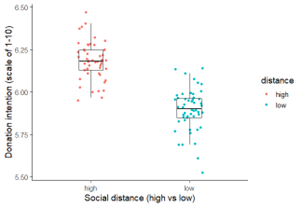
Figure 1: Intention to donate to environmental organizations based onsocial distance from impact of environmental damage.
Reporting qualitative research results
In qualitative research, your results might not all be directly related to specific hypotheses. In this case, you can structure your results section around key themes or topics that emerged from your analysis of the data.
For each theme, start with general observations about what the data showed. You can mention:
Recurring points of agreement or disagreement
Patterns and trends
Particularly significant snippets from individual responses
Next, clarify and support these points with direct quotations. Be sure to report any relevant demographic information about participants. Further information (such as full transcripts, if appropriate) can be included in an appendix.
Example: Reporting interview results
When asked about video games as a form of art, the respondents tended to believe that video games themselves are not anart form, but agreed that creativity is involved in their production. The criteria used to identify artistic video games included design, story, music, and creative teams. One respondent (male, 24) noted a difference in creativity between popular video game genres:
“I think that in role-playing games, there's more attention to character design, to world design, because the whole story is important and more attention is paid to certain game elements […] so that perhaps you do need bigger teams of creative experts than in an average shooter or something.”
Responses suggest that video game consumers consider some types of games to have more artistic potential than others.
Results vs. discussion vs. conclusion
Your results section should objectively report your findings, presenting only brief observations in relation to eachquestion, hypothesis, or theme.
It should not speculate about the meaning of the results or attempt to answer your main research question. Detailed interpretation of your results is more suitable foryour discussion section, while synthesis of your results into an overall answer to your main research question is best left for your conclusion.

