-
1 speaking
-
2 Task 1
-
3 Task 2
-
4 Grading Rubric
Making Academic Presentation
A presentation is a means of communicating the presenter’s thoughts and ideas to the audience. It requires presenters to develop their communication skills and learn how to deliver the message in an effective way. Such skills are crucial in exchanging and transmitting information in the academic environment, whether you are a graduate student giving a presentation for a course or a researcher presentingat a conference.
Key components for planning apresentation
Thorough planning enables you to present your views in an effective and logical way. Some key components should be addressed in planning your presentation.
Finding relevant and intriguing topics. Finding unique presentation topics is essential to inspiring your audience and keeping them engaged. Topics that require further research or would attract attention are an important component of a successful academic presentation.
Knowing your purpose of giving the presentation.
What specifically do you want the audienceto know or to do as a result of listening to you? What does the audience already know about the topic? What do they not know? What do they expect? How will you get and keep their interest and attention? How will you get and keep their interest and attention? Answers to these questions will shape the presentation, since it must be designed to achieve the objectives and deliver the desired outcomes.
Tailoring your presentation to your audience.
While the audience receives the presenter’s message, this reception will be affected by factors such as their own experience, knowledge and personal sense of values. The type of audience might have a significant influence on the planning of the presentation format and its content. Hence the success of the presentation will largely depend onthe presenter’s effective communication of the message and his / her knowledge about the audience and their expectations.
Having access to the venue.
The location where the presentation takes place can have important implications for how the content is planned and organized. Knowing it in advance might help the presenter check the aspects of planning, which include type andsize of the room, seating arrangement, platform position, equipment available, acoustics and facilities for special needs.
Determining the length of presentation.
Make sure you know how long you are to talk and whether it includes or excludes time for questions. Find out if there are other presenters and where you are placed in the running order. Given that it is difficult for the audience to maintain concentration for long periods of time, making a presentation concise, well-structured and interesting would be crucial.
Possible obstacles.
The effectiveness of how the presenter’s message is communicated to the audience can be influenced by factors such as background noise or other distractions. The presenter has to be prepared to cope with any such problems and tries to keep the audience focused on the message.
Organizing presentation material.
In planning a presentation, you concentrateon establishing objectives. When it comes to structuring it, your emphasis should be placed on these objectives and how you are going to achieve them. Creating an outline can be helpful in making a logical flow throughout a presentation. A clear structure will also allow your audience to understand your main points. Clarity of ideas and good organization help a presenter deliver messages in a logical and confident way. Organizing presentation material may include keeping your objectives in mind and writing down all the points you wish to make, selecting the main points and deciding whether to usevisual aids, and working on the introduction and conclusion.
Key structure of a presentation
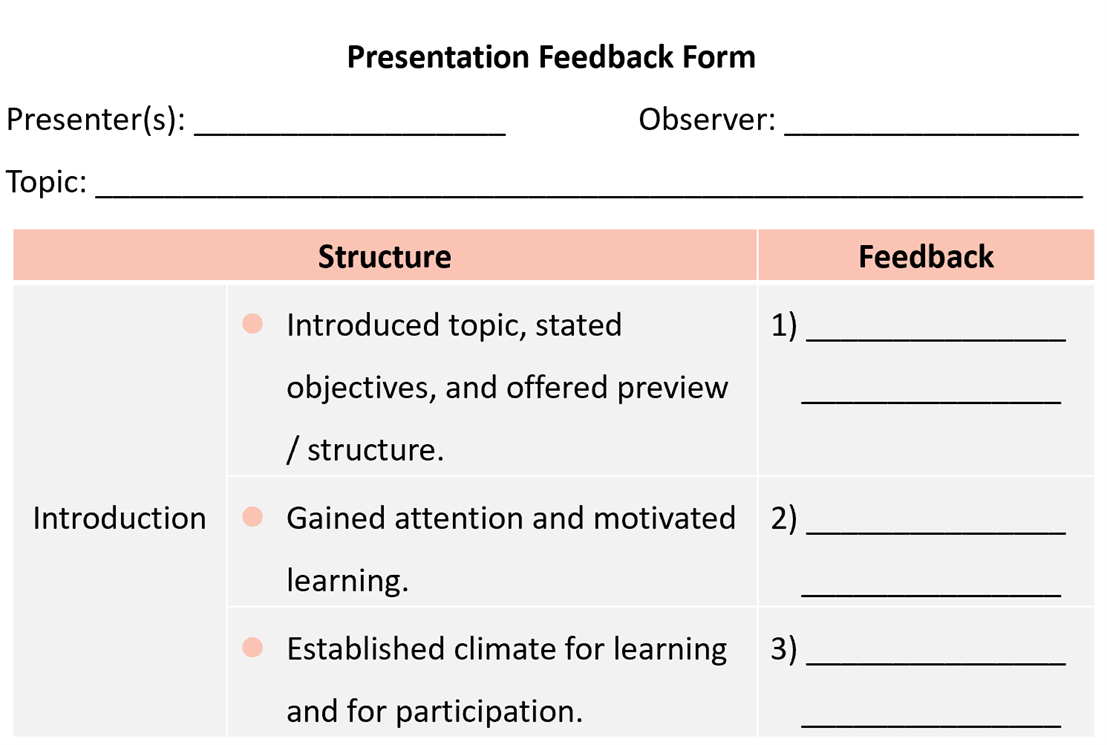
It is common to divide a presentation into three sections: introduction, body and conclusion. The introduction should givea preview of what the presenter is going to discuss and gain the audience’s attention. You need to provide sufficient information for the audience to understand the context of the subject and outline the sequence ofyour presentation material. Generally, objectives should be identified and stated early in the presentation so that the audience can follow the development of the argument. Also make it clear whether you will answer questions during the presentation or at the end.
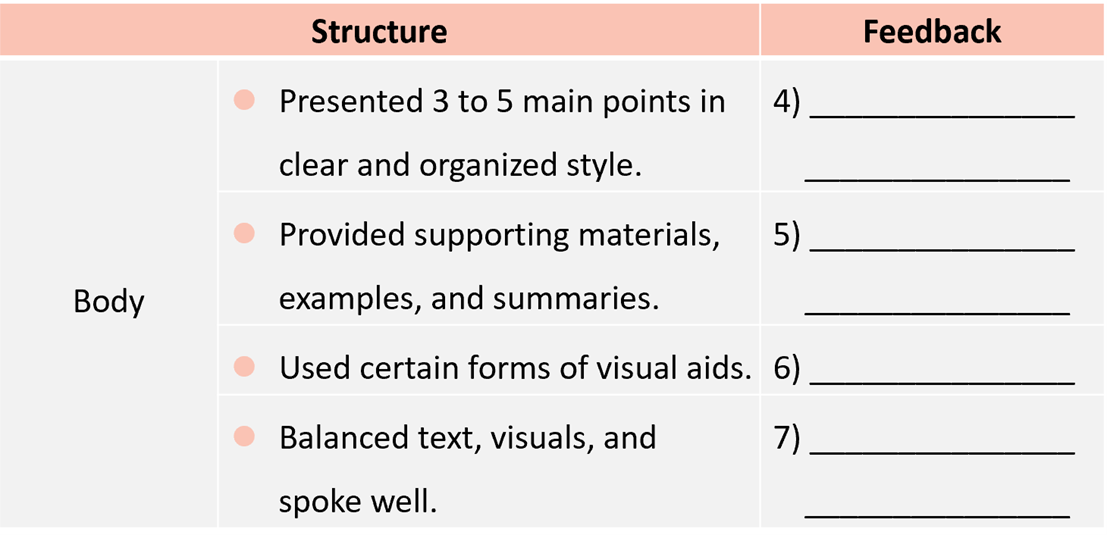
In the body, the presenter discusses the main topic by expanding it in more detail and providing supporting evidence. Content is the most important part of a presentation. Therefore, the topic should be thoroughly researched and the main points be decided selectively. Moreover, a clear and logical structure is critical to the effectiveness of the presentation. Structure your material so that your message is best received and absorbed by your audience.
An effective approach is to start with a main point and then back it up with data and evidence. After you present your main point, the audience can evaluate your reasoning and logic with the progress of your presentation. Provide a short summary before moving on to a new point and use transitional language to link points, so as to make it easierfor the audience to understand the development of your argument. The following signposting language may be used to guide your audience:
In this part of my presentation, I will focus on …
Now let’s look at the next issue about …
Now that we’ve discussed …, I’d like to summarize ...
As we can see from the slide, …
The pie chart shows the figures of …
While visual aids will help to illustrate your point, the effective use of visuals requires planning and preparation. Visual aids commonly take the form of slides, videos, handouts, or something interesting that you show your audience. The visuals should complement and enhance your spoken message but not distract the audience from your presentation. You need to select, edit and proofread all the visuals to construct clear and effective ones that may convince and persuade the audience.
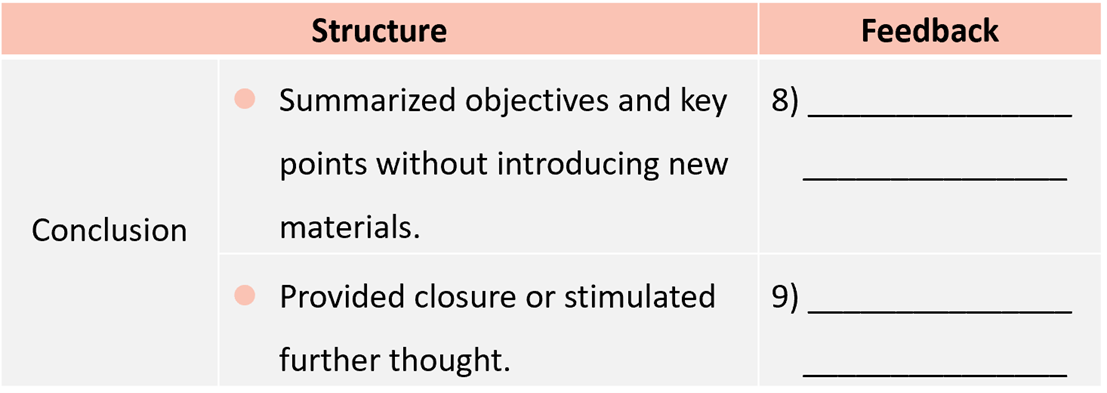
The conclusion is as equally important as the introduction and should not be ignored or underdeveloped. A weak ending will affect what the audience think of the overall presentation. You need to prepare a conclusion that summarizes the objectives and main points of your presentation, offer an overview of what has been achieved and make a lasting impact.
Don’t forget to express your gratitude for the audience’s attendance and cooperation. A brief Question and Answer (Q&A) session is often included at the very end, which provides an opportunity for the presenter to interact with the audience. So end decisively, thank your audience and invite them to ask questions.
Delivering a presentation
Academic presentations can be made on very formal occasions like international conferences, or in less formal settings like in front of small groups of fellow students in classrooms. Whatever the situation, a presentation should be regarded as an important opportunity to communicate the presenter’s knowledge to a live audience. There are some practical issues for a presenter to consider before, during and after delivering a presentation.
Before delivering:
Visual aids can be a very powerful tool to enhance the impact of your presentations. Microsoft PowerPoint is probably the most commonly used form of visual aids, and others include whiteboards, flip charts(活动挂图), handouts and videos. Remember to restrict their use to key moments in your presentation, since overuse of visual aids can be distracting and hard for the audience to follow. You may follow some guidelines for producing high-quality visual images:
●to use one simple idea for each visual image and make it clear and readable;
●to keep the images consistent and make sure they are of high quality;
●to ensure that the audience are able to understand a visual image quickly and easily.
Figures and numbers are solid evidence toback up an argument in a presentation. While many people are uninterested in tables of numbers and may struggle to understand graphs, a pictorial representation of the data in a graph or chart makes the numbers much easier to understand, and trends and proportions more obvious. You need to check that your graph or chart is appropriately used and visually appealing, and that all the labels are simple and clear.
You may have to work out how to manage your presentation notes, deciding whether you are to present the information from your memory, or read it out from detailed notes. Full text notes, notes on cuecards, keywords on cue cards, and mind maps are ways you might choose to manage presentation notes to support your presentation style. Practice your presentation several times before the actual event. Repetition will help you remember actions, timings and crucial sections more easily than just readingthe content on paper or on a screen.
During delivering:
An effective presenter needs to be assertive. It is important to appear confident at all times, and a formal, upright and still posture will create such an impression. Also, establishing links with the audience helps to maintain their interest and encourage them to believe that you are genuinely interested in talking with them. Ways of making contact with your audience include eye contact, gestures, spoken contact and the use of language. Besides, your voice is a flexible and effective tool to convey enthusiasm and energy, and you can use it in many different ways by varying the volume, pace and pitch. Always remember to breathe steadily and deeply, and use pauses after questions or at the end of sections to allow information to sink in.
After delivering:
When you have finished answering questions, you can thank the audience for their questions and then summarize once again the main point(s) that your presentation is designed to communicate. When possible, ask members of your audience for constructive feedback on your presentation. Listen to what they say and focus on areas that need improvement. Try to see any negative points not as a measure of failure but as learning opportunities for future presentations.