In 1625 Charles I, the second son of King James I, succeeded to the English throne. Charles believed in the divine right of kings and thought he ould govern according to his own conscience. He showed his reluctance to reign alongside Parliament and frequently quarreled with Parliament. His religious policies, as well as his marriage to a Roman Catholic, generated hostility and mistrust of Reformed groups. In 1629 he dispensed with Parliament. His style also set him against the Puritans. In 1637, he desired to challenge the autonomy of the Scots lords and attempted to force the Church of Scotland to adopt Anglican practices. Within twelve months, Charles was faced with the ruin of his Scottish religious policies and an increasing challenge to his political authority there. In 1639 and again in 1640 he planned to invade Scotland, ths leading to the Bishops' Wars.
In April 1640 the first Parliament for eleven years came together. Charles I had hoped to use Scotland's threat of invasion to make MPs do his bidding. But having been denied free speech for so long, the Commons was not in the mood for obedience. Charles I would not accept a deal with Parliament, so three weeks later he dismissed what is now known as the Short Parliament and began the Second Bishops' War. Without the money from Parliament to raise an army, the king had to rely on borrowing more money from his friends. The Scots mobilized more quickly and in greater number. The Scots' army camped in the northern English counties. Charles I was eventually forced to make a very expensive truce with the Scots by paying an enormous sum of money. Therefore, he summoned a new Parliament to meet in November 1640. This Parliament would endure for the next 13 years,and hence was called the Long Parliament.
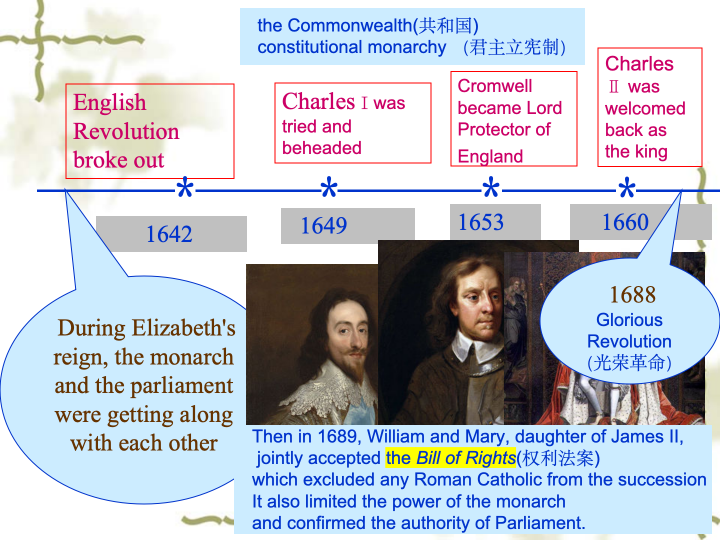
In 1641 Charles I had to agree to a law forbidding him from dissolving Parliament. In 1642 he went with his guards to Parliament to arrest key MPs. His invasion of the Chamber trampled all over the tradition of royal respect for the rights of Parliament's House of Commons. The relations between the king and Parliament broke down entirely and the country plunged into a civil war. Charles I was forced to flee, and traveled to the countryside for support. He raised his army at Nottingham on 22 August 1642. They were called the Cavaliers, a French word, meaning "horsemen" or "knights". Expensively mounted and dressed, the Cavaliers wore their hair long and flowing, in contrast to the severely cropped Roundheads, their enemies.
The English Civil Wars turned into two linked civil wars. The First Civil War took place from 1642 to 1646, which could be described as the king versus the radicals, or in other words, the half of Parliament led by John Pym. The north and the south-west of the country and the more rural parts were for the king, while London, the east and the south-east of the country, where there was a greater concentration of towns and commercial wealth, tended to support the Parliamentarians. In 1645, Oliver Cromwell established a New Model Army of 20,000 troops. They were known as the Ironsides because of the iror breastplates that they wore. They were trained and drilled, and enthused with the justic of the cause. The Parliamentarians won a decisive victory over the Royalists at the Battl of Naseby in June 1645. Charles I was captured and imprisoned. The First English Civil War was over.
In 1647 Charles I negotiated a secret treaty with the Scots, who undertook to invade England on his behalf and restore him to the throne. In addition, he drew most parliament MPs to his side. The Parliamentarians were determined to resist the return of Charles Thus began the Second Civil War in 1648 in which the parliamentary army won the vict On 20 January 1649 Charles I was brought to trial at Westminster Hall. On 31 Janu 1649 Charles I was sentenced to death for high treason as a "tyrant, traitor, murderer, public enemy to the good people of this nation".
Oliver Cromwell and Commonwealth of England
Following the Civil Wars, England was declared to be a republic called the Commonwealth of England. The name suggested a community of interests, ruled not by a king, but by collective considerations of the public good.
® In 1649 the monarchy and the House of Lords were both abolished. Only the House o Commons remained unaltered. From 1649 to 1653, England was governed by the Rum Parliament. Oliver Cromwell was one of the new regime's most important figures. He wa seizing power in a coup and had lost faith in Parliament as an institution. His guidin principle was that England should be ruled by a community of the righteous. On 1December 1653 Cromwell was appointed Lord Protector, and was to rule the country wi the aid of the CounciloStatiokaothexecutive functions of th monarchy. He also had to meet Parliament regularly. He believed God had given him superior knowledge of what was right for the country.
The army's Council of Officers proposed an Instrument of Government. It regulated a 400 seat unicameral Parliament, a new House of Commons to which for the first time M would be also elected from Scotland and Ireland. As Protector, Cromwell had the power call and dissolve Parliament but was obliged under the Instrument to seek the majority v of the Council of State. As soon as Parliament met in September 1654, more extre Cromwell dissolved Parliament.republicans disapproved of the king-like role of Lord Protector. Four months later, Oliver Cromwell dissolved the Parliament.
One of Cromwell's objectives was to restore liberty of conscience and promote both outw and inward godliness throughout England. Cromwell was a Puritan and had ma admirable qualities. He was a magnificent general and an outstanding statesman. The Puritan government puritanized every aspect of everyday life. Sacred images and s the old Catholic cathedrals were destroyed. Theaters, inns, and other ha immorality were closed, and Sunday games and "pagan" festivals were restri invited the Jews to return in 1657, who brought immense wealth, culture an continental contacts for the Cromwellian government, hoping that they would he up the recovery of the country after the Civil Wars.
In 1656, Cromwell tried to restore Parliament again. However, at least a hundre new MPs turned out to hold extreme republican views. As a result, they were barr entering the Commons by Cromwell's soldiers. To protest, another fifty refused t Parliament. Thus the new House of Commons was less representative of the wil people than ever.
In 1657, after a failed assassination attempt on Cromwell, the new Commons atter return to something similar to the English constitution as it had been before the Ci They entreated Cromwell to become the king and asked for the House of Lor revived. Cromwell's old comrades-in-arms dissuaded him from taking the title of in all other aspects he was quite king-like. When Cromwell died of a fever on 3 September 1658, the protectorate passed to his son Richard Cromwell. Richard had no pov iament or the army, nd lacked the ability in carrying on his father's policies.was forced to resign in May 1659, whose protectorate lasted for only eight months.

