
Reading 2 Not All Processed Foods Are Bad for You
Discuss the following questions.
1. Do you know what processed foods are? Give some examples.
2. Which do you prefer, processed foods or raw and fresh foods?
3. In your opinion, are processed foods good for our health?
Complete KWL+worksheet before you read Text B. And then answer the following questions in your own words.(Pay attention to the writing style and use the reading skills you learned in class)
Part 1(paras. 1-2)
1. What is the general understanding of processed food?
2. What does the writer mean by saying “But that sentence really simplifies a more complex story.”?
3. Are processed food all detrimental?
4. What is the main idea of this part?
Part 2(paras. 3-7)
1. What is the relation between a food state and its healthy state?
2. What is the standard of categorize food according to researchers?
3. Explain the four categories and typical foods of them.
Part 3(paras. 8-11)
1. In which way do people usually turn once-healthy food into less nutritious ones?
2. Give examples of some smart forms of preserving and preparing food.
3. Why sprouted grains and beans are more nutritious?
4. Why probiotics are beneficial to humans?
5. Which foods contain more probiotics?
IV Text Study(15mins)
In this section teacher will ask some students interpret the difficult sentences in Reading 2.
1. The term has become a sweeping generalization for anything that comes in a bag or a box. (Para. 1)
The term “processed food” has become a general description for anything that is packaged in a bag or a box. In fact, that generalization may be too simple.
这一名词现在已经成了所有袋装或盒装食品的笼统代名词。
2. … how we process the food matters. (Para. 2)
… what is important is how we preserve, prepare and cook the food.
……我们加工食物的方式很有关系。
3. Some ingredients can undergo changes — like being frozen, fermented or sprouted — that makes them equally or more nutritious than they once were. (Para. 2)
Ways of processing food may affect the nutrition of the food. For example, when the food is frozen, fermented or sprouted, the ingredients in the food remain equally nutritious or change to be more nutritious.
有些成分经过了如冷冻、发酵、发芽等状态改变后,其营养成分并不会减少,甚至会比以前更有营养。
4. Foods that undergo some processing and contain just two or three ingredients fall into this group. (Para. 6)
Group 3 includes foods that have been processed to some extent. These foods contain just two or three ingredients.
经过了一些加工且只包括两到三种成分的食物属于这个类别。
5. Yogurt with added sugar or powdered cheese on deep-fried potatoes are examples of processes that turn once-healthy food into less nutritious fare. (Para. 8)
If you combine yogurt with sugar or have powered cheese on deep-fried potatoes, you have turned those originally healthy food into some less nutritious, though maybe more enjoyable, food.
往酸奶中加糖或者往油炸土豆上撒奶酪粉就是把原本的健康食品变成营养价值较低的食物的例子。
Students read the following 5 questions and discuss in pairs.
1. Think of your own diet. Which category of foods mentioned in the text do you eat most days?
2. The World Health Organization (WHO) makes the following recommendations for a healthy diet:
l eat roughly the same amount of calories that your body is using;
l limit intake of fats, sugar, and salt;
l increase consumption of plant foods, particularly fruits, vegetables, whole grains and nuts.
People all know the importance of keeping a balanced diet to our health. But why are there still so many people who fail to maintain a healthy diet in their lives?
3. Ultra-processed foods are delicious and attractive to most people. What do you think are good ways to reduce the consumption of this group of foods?
4. There is a quotation from Steve Wearne of the UK Food Standards Agency (FSA) in the text: “We’re not saying to people to worry about the occasional meal that’s a bit overcooked. This is about managing risk across your whole lifetime.” Think about the statement. What message does Steve convey?
5. How does the general statement “eat less processed food and choose fresh food instead” simplify a more complex story? Do you agree that general statements will always mislead people? Why or why not?
Preparation for Students Before Class
自学P13.14 单词和短语。
2. 使用Reading 1 中学到的skimming 的技巧 完成P15 练习:Global reading
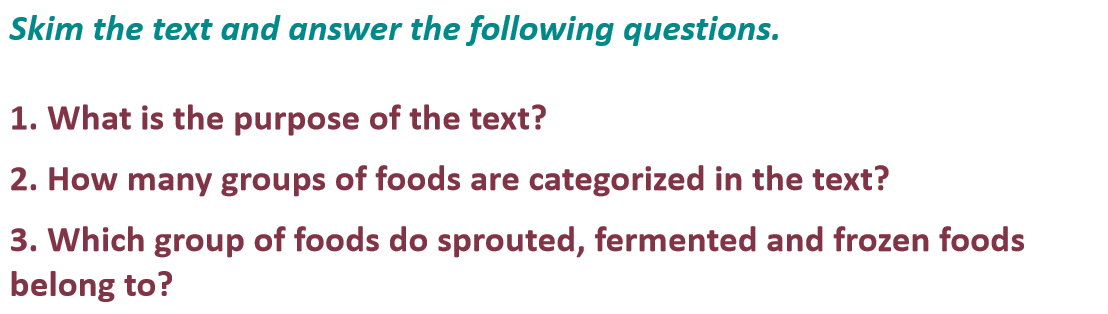
3. 使用Reading 1 中学到的scanning 的技巧 完成P15 练习:Close reading
4. 预习P15 Reading Skill--- Recognizing classification, 完成P15练习 :
Complete the following table according to the classification of food in the text.
5. 学习构词法:p17 Word Building Skill — Prefixes (II): “en-” and “dis-”
6. 找出并记下关于Reading1 的课文和练习中所有你不清楚和有疑问的内容,在课堂上分享和解决。

