The Gram Stain: A Grand Stain
In 1884, Hans Christian Gram discovered a stainingtechnique that could be used to make bacteria in infectious specimens morevisible. His technique consisted of timed, sequential applications of crystalviolet (the primary dye), Gram’s iodine (IKI, the mordant), an alcohol rinse(decolorizer), and a contrasting counterstain. The initial counterstain usedwas yellow or brown and was later replaced by the red dye, safranin. Since thatsubstitution, bacteria that stained purple are called gram-positive, and thosethat stained red are called gram-negative.
Although these staining reactions involve an attractionof the cell to a charged dye, it is important to note that the terms gram-positive and gram-negative are not used toindicate the electrical charge of cells or dyes but whether or not a cellretains the primary dye-iodine complex after decolorization. There is nothingspecific in the reaction of gram-positive cells to the primary dye or in thereaction of gramnegative cells to the counterstain. The different results inthe Gram stain are due to differences in the structure of the cell wall and howit reacts to the series of reagents applied to the cells.
In the first step, crystal violet stains cells in a smearall the same purple color. The second and key differentiating step is themordant—Gram’s iodine. The mordant is a stabilizer that causes the dye to formlarge crystals that get trapped by the thick meshwork of the cell wall. Becausethis layer in gram-positive cells is thicker, the entrapment of the dye is farmore extensive in them than in gram-negative cells. Application of alcohol inthe third step dissolves lipids in the outer membrane and removes the dye fromthe gram-negative cells. By contrast, the crystals of dye tightly embedded inthe gram-positive bacteria are relatively inaccessible and resistant toremoval. Because gram-negative bacteria are colorless after decolorization,their presence is demonstrated by applying the counterstain safranin in thefinal step. This staining method remains an important basis for bacterialclassification and identification. It permits differentiation of four majorcategories based upon color reaction and shape: gram-positive rods,gram-positive cocci, gram-negative rods, and gram-negative cocci. The Gramstain can also be a practical aid in diagnosing infection and in guiding drugtreatment. For example, Gram staining a fresh urine or throat specimen can helppinpoint the possible cause of infection, and in some cases, it is possible tobegin drug therapy on the basis of this stain. Even in this day of elaborateand expensive medical technology, the Gram stain remains an important andunbeatable first tool in diagnosis.
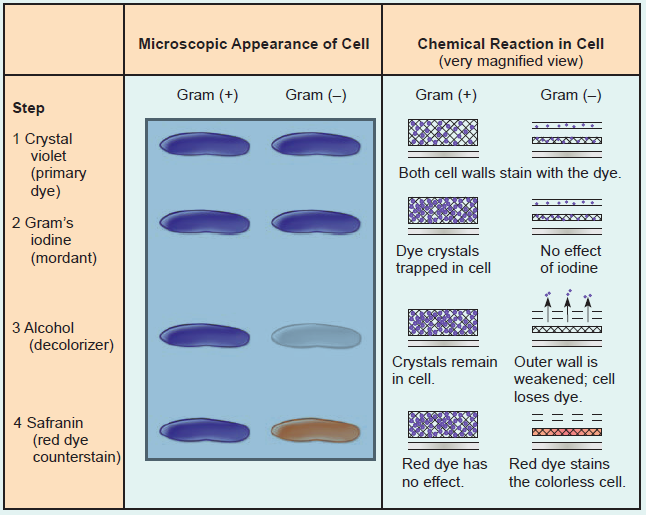
Figure 1 The Gram stain
The acid-fast stain, likethe Gram stain, is an important diagnostic stain that differentiates acid-fastbacteria (pink) from nonacid- fast bacteria (blue). This stain originated as aspecific method to detect Mycobacterium tuberculosis in specimens. It was determined thatthese bacterial cells have a particularly impervious outer wall that holds fast(tightly or tenaciously) to the dye (carbol fuchsin), even when washed with asolution containing acid or acid alcohol. This stain is used for othermedically important mycobacteria such as the Hansen’s disease (leprosy) bacillusand for Nocardia, an agent of lung or skin infections.
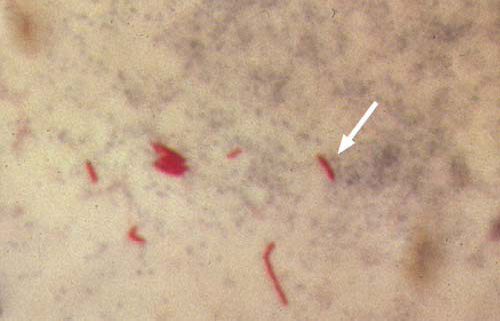
Figure2 The acid-fast stain
Variations on the Optical Microscope
Optical microscopes that use visible light can bedescribed by the nature of their field, meaning the circular area viewed through the ocularlens. With special adaptations in lenses, condensers, and light sources, fourspecial types of microscopes can be described: bright-field, dark-field, phase-contrast,and interference. A fifth type of optical microscope, the fluorescencemicroscope, uses ultraviolet radiation as the illuminating source, and a sixth,the confocal microscope, uses a laser beam.
Bright-Field Microscopy
The bright-field microscope is the most widely used typeof light microscope. Although we ordinarily view objects such as the words onthis page with light reflected off the surface, a bright field microscope formsits image when light is transmitted through the specimen. The specimen, beingdenser and more opaque than its surroundings, absorbs some of this light, andthe rest of the light is transmitted directly up through the ocular into the field.As a result, the specimen will produce an image that is darker than the surroundingbrightly illuminated field. The bright-field microscope is a multipurposeinstrument that can be used for both live, unstained material and preserved,stained material.