Ezra Pound 艾兹拉·庞德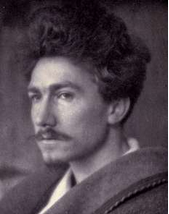
American poet
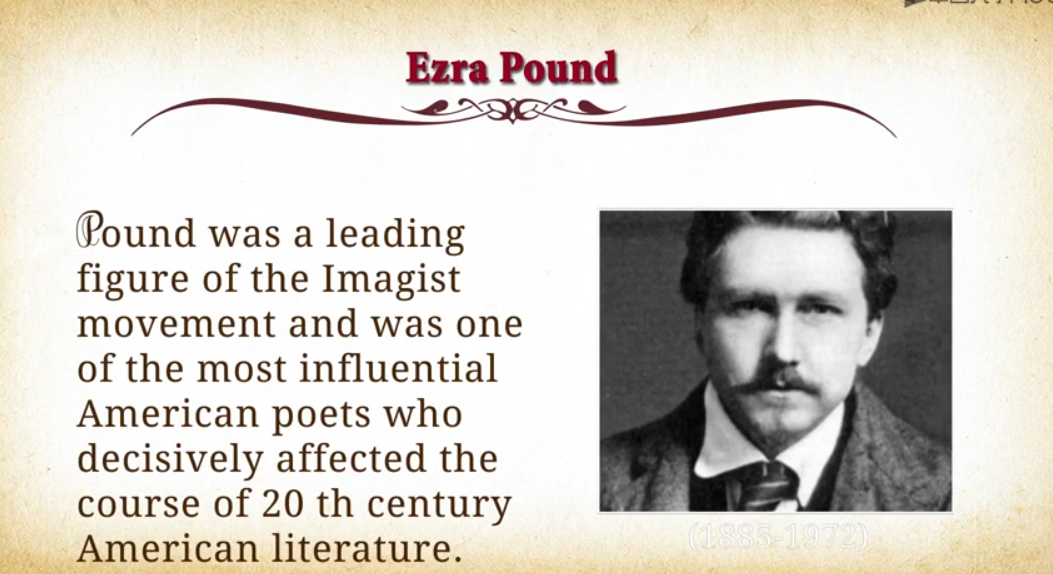
Ezra Pound, in full Ezra Loomis Pound, (born October 30, 1885, Hailey, Idaho, U.S.—died November 1, 1972, Venice, Italy), American poet and critic, a supremely discerning and energetic entrepreneur of the arts who did more than any other single figure to advance a “modern” movement in English and American literature. Pound promoted, and also occasionally helped to shape, the work of such widely different poets and novelists as William Butler Yeats, James Joyce, Ernest Hemingway, Robert Frost, D.H. Lawrence, and T.S. Eliot. His pro-Fascist broadcasts in Italy during World War II led to his postwar arrest and confinement until 1958.
Early life and career
Pound was born in a small mining town in Idaho, the only child of a Federal Land Office official, Homer Loomis Pound of Wisconsin, and Isabel Weston of New York City. About 1887 the family moved to the eastern states, and in June 1889, following Homer Pound’s appointment to the U.S. Mint in Philadelphia, they settled in nearby Wyncote, where Pound lived a typical middle-class childhood.
After two years at Cheltenham Military Academy, which he left without graduating, he attended a local high school. From there he went for two years (1901–03) to the University of Pennsylvania, where he met his lifelong friend, the poet William Carlos Williams. He took a Ph.B. (bachelor of philosophy) degree at Hamilton College, Clinton, New York, in 1905 and returned to the University of Pennsylvania for graduate work. He received an M.A. in June 1906 but withdrew from the university after working one more year toward his doctorate. He left with a knowledge of Latin, Greek, French, Italian, German, Spanish, Provençal, and Anglo-Saxon, as well as of English literature and grammar.
In the autumn of 1907, Pound became professor of Romance languages at Wabash Presbyterian College, Crawfordsville, Indiana. Although his general behaviour fairly reflected his Presbyterian upbringing, he was already writing poetry and was affecting a bohemian manner. His career came quickly to an end, and in February 1908, with light luggage and the manuscript of a book of poems that had been rejected by at least one American publisher, he set sail for Europe.
He had been to Europe three times before, the third time alone in the summer of 1906, when he had gathered the material for his first three published articles: “Raphaelite Latin,” concerning the Latin poets of the Renaissance, and “Interesting French Publications,” concerning the troubadours (both published in the Book News Monthly, Philadelphia, September 1906), and “Burgos, a Dream City of Old Castile” (October issue).
Now, with little money, he sailed to Gibraltar and southern Spain, then on to Venice, where in June 1908 he published, at his own expense, his first book of poems, A lume spento (“With Tapers Quenched’). About September 1908 he went to London, where he was befriended by the writer and editor Ford Madox Ford (who published Pound’s work in his English Review), entered William Butler Yeats’s circle, and joined the “school of images,” a modern group presided over by the philosopher T.E. Hulme.
Success abroad
In England, success came quickly to Pound. A book of poems, Personae, was published in April 1909; a second book, Exultations, followed in October; and a third book, The Spirit of Romance, based on lectures delivered in London (1909–10), was published in 1910.
After a trip home—a last desperate and unsuccessful attempt to make a literary life for himself in Philadelphia or New York City—he returned to Europe in February 1911, visiting Italy, Germany, and France. Toward the end of 1911 he met an English journalist, Alfred R. Orage, editor of the socialist weekly New Age, who opened its pages to him and provided him with a small but regular income during the next nine years.
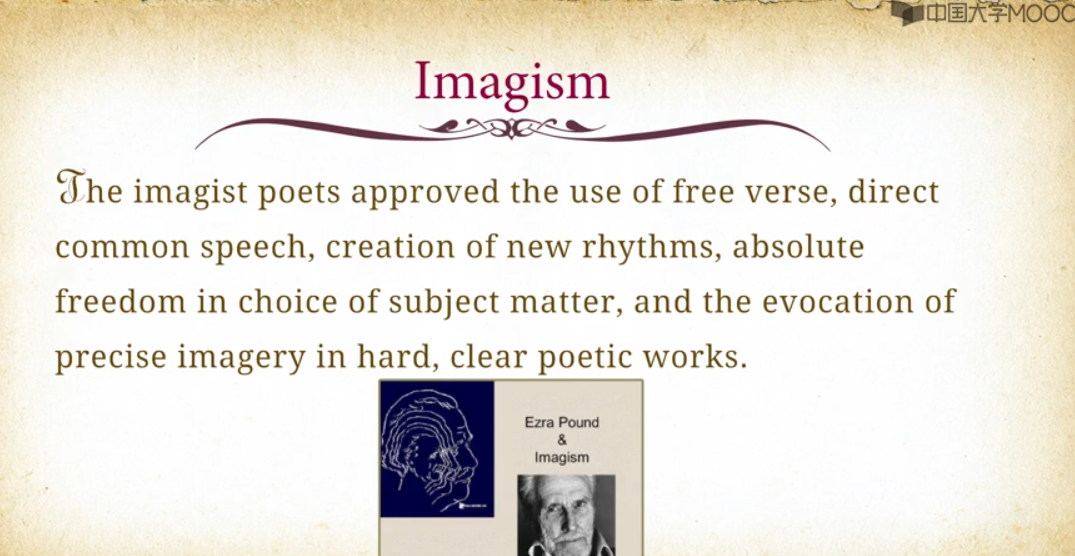
In 1912 Pound became London correspondent for the small magazine Poetry (Chicago); he did much to enhance the magazine’s importance and was soon a dominant figure in Anglo-American verse. He was among the first to recognize and review the poetry of Robert Frost and D.H. Lawrence and to praise the sculpture of the modernists Jacob Epstein and Henri Gaudier-Brzeska. As leader of the Imagist movement of 1912–14, successor of the “school of images,” he drew up the first Imagist manifesto, with its emphasis on direct and sparse language and precise images in poetry, and he edited the first Imagist anthology, Des Imagistes (1914).
A shaper of modern literature
Though his friend Yeats had already become famous, Pound succeeded in persuading him to adopt a new, leaner style of poetic composition. In 1914, the year of his marriage to Dorothy Shakespear, daughter of Yeats’s friend Olivia Shakespear, he began a collaboration with the then-unknown James Joyce. As unofficial editor of The Egoist (London) and later as London editor of The Little Review (New York City), he saw to the publication of Joyce’s novels Portrait of the Artist as a Young Man and Ulysses, thus spreading Joyce’s name and securing financial assistance for him. In that same year he gave T.S. Eliot a similar start in his career as poet and critic.
Pound continued to publish his own poetry (Ripostes, 1912; Lustra, 1916) and prose criticism (Pavannes and Divisions, 1918). From the literary remains of the great Orientalist Ernest Fenollosa, which had been presented to Pound in 1913, he succeeded in publishing highly acclaimed English versions of early Chinese poetry, Cathay (1915), and two volumes of Japanese Noh plays (1916–17) as well.
Development as a poet
Unsettled by the slaughter of World War I and the spirit of hopelessness he felt was pervading England after its conclusion, Pound decided to move to Paris, publishing before he left two of his most important poetical works, “Homage to Sextus Propertius,” in the book Quia Pauper Amavi (1919), and Hugh Selwyn Mauberley (1920). “Propertius” is a comment on the British Empire in 1917, by way of Propertius and the Roman Empire. Mauberley, a finely chiseled “portrait” of one aspect of British literary culture in 1919, was one of the most praised poems of the 20th century.
During his 12 years in London, Pound had completely transformed himself as a poet. He had arrived a Late Victorian for whom love was a matter of “lute strings,” “crushed lips,” and “Dim tales that blind me.” Within five or six years he was writing a new, adult poetry that spoke calmly of current concerns in common speech. In this drier intellectual air, “as clear as metal,” Pound’s verse took on new qualities of economy, brevity, and clarity as he used concrete details and exact visual images to capture concentrated moments of experience. Pound’s search for laconic precision owed much to his constant reading of past literature, including Anglo-Saxon poetry, Greek and Latin classics, Dante, and such 19th-century French works as Théophile Gautier’s Émaux et camées and Gustave Flaubert’s novel Madame Bovary. Like his friend T.S. Eliot, Pound wanted a modernism that brought back to life the highest standards of the past. Modernism for its own sake, untested against the past, drew anathemas from him. His progress may be seen in attempts at informality (1911):
Have tea, damn the Caesars,
Talk of the latest success…
in the gathering strength of his 1911 version of the Anglo-Saxon poem “Seafarer”:
Storms, on the stone-cliffs beaten,
fell on the stern
In icy feathers…
and in the confident free verse of “The Return” (1912):
See, they return; ah, see the tentative
Movements, and the slow feet…
From this struggle there emerged the short, perfectly worded free-verse poems in Lustra. In his poetry Pound was now able to deal efficiently with a whole range of human activities and emotions, without raising his voice. The movement of the words and the images they create are no longer the secondhand borrowings of youth or apprenticeship but seem to belong to the observing intelligence that conjures up the particular work in hand. Many of the Lustra poems are remarkable for perfectly paced endings:
Nor has life in it aught better
Than this hour of clear coolness,
the hour of waking together.
But the culmination of Pound’s years in London was his 18-part long poem Hugh Selwyn Mauberley, which ranged from close observation of the artist and society to the horrors of mass production and World War I; from brilliant echo of the past:
When our two dusts with Waller’s shall be laid,
Siftings on siftings in oblivion,
Till change hath broken down
All things save Beauty alone.
to the syncopation of
With a placid and uneducated mistress
He exercises his talents
And the soil meets his distress.
During his stay in Paris (1921–24) Pound met and helped the young American novelist Ernest Hemingway; wrote an opera, Le Testament, based on poems of François Villon; assisted T.S. Eliot with the editing of his long poem The Waste Land; and acted as correspondent for the New York literary journal The Dial.
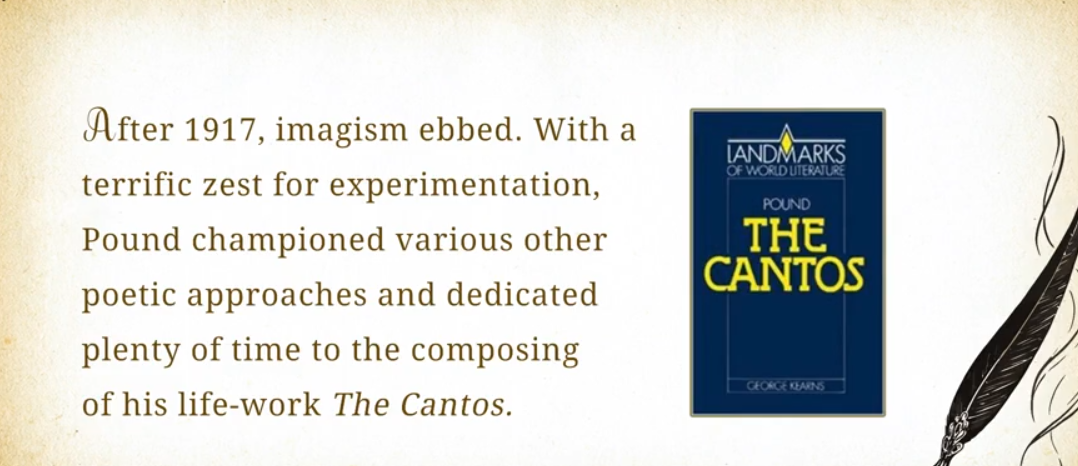
In 1924 Pound tired of Paris and moved to Rapallo, Italy, which was to be his home for the next 20 years. In 1925 he had a daughter, Maria, by the expatriate American violinist Olga Rudge, and in 1926 his wife, Dorothy, gave birth to a son, Omar. The daughter was brought up by a peasant woman in the Italian Tirol, the son by relatives in England. In 1927–28 Pound edited his own magazine, Exile, and in 1930 he brought together, under the title A Draft of XXX Cantos, various segments of his ambitious long poem The Cantos, which he had begun in 1915.
The 1930s saw the publication of further volumes of The Cantos (Eleven New Cantos, 1934; The Fifth Decad of Cantos, 1937; Cantos LII–LXXI, 1940) and a collection of some of his best prose (Make It New, 1934). A growing interest in music caused him to arrange a long series of concerts in Rapallo during the 1930s, and, with the assistance of Olga Rudge, he played a large part in the rediscovery of the 18th-century Italian composer Antonio Vivaldi. The results of his continuing investigation in the areas of culture and history were published in his brilliant but fragmentary prose work Guide to Kulchur (1938).
Following the Great Depression of the 1930s, he turned more and more to history, especially economic history, a subject in which he had been interested since his meeting in London in 1918 with Clifford Douglas, the founder of Social Credit, an economic theory stating that maldistribution of wealth due to insufficient purchasing power is the cause of economic depressions. Pound had come to believe that a misunderstanding of money and banking by governments and the public, as well as the manipulation of money by international bankers, had led the world into a long series of wars. He became obsessed with monetary reform (ABC of Economics, 1933; Social Credit, 1935; What Is Money For?, 1939), involved himself in politics, and declared his admiration for the Italian dictator Benito Mussolini (Jefferson and/or Mussolini, 1935). The obsession affected his Cantos, which even earlier had shown evidence of becoming an uncontrolled series of personal and historical episodes.
Anti-American broadcasts
As war in Europe drew near, Pound returned home (1939) in the hope that he could help keep the peace between Italy and the United States. He went back to Italy a disappointed man, and between 1941 and 1943, after Italy and the United States were at war, he made several hundred broadcasts over Rome Radio on subjects ranging from James Joyce to the control of money and the U.S. government by Jewish bankers and often openly condemned the American war effort. He was arrested by U.S. forces in 1945 and spent six months in a prison camp for army criminals near Pisa. Despite harsh conditions there, he translated Confucius into English (The Great Digest & Unwobbling Pivot, 1951) and wrote The Pisan Cantos (1948), the most moving section of his long poem-in-progress.
Returned to the United States to face trial for treason, he was pronounced “insane and mentally unfit for trial” by a panel of doctors and spent 12 years (1946–58) in Saint Elizabeth’s Hospital for the criminally insane in Washington, D.C. During this time he continued to write The Cantos (Section: Rock-Drill, 1955; Thrones, 1959), translated ancient Chinese poetry (The Classic Anthology, 1954) and Sophocles’ Trachiniai (Women of Trachis, 1956), received visitors regularly, and kept up a voluminous and worldwide correspondence. Controversy surrounding him burst out anew when, in 1949, he was awarded the important Bollingen Prize for his Pisan Cantos. When on April 18, 1958, he was declared unfit to stand trial and the charges against him were dropped, he was released from Saint Elizabeth’s. He returned to Italy, dividing the year between Rapallo and Venice.
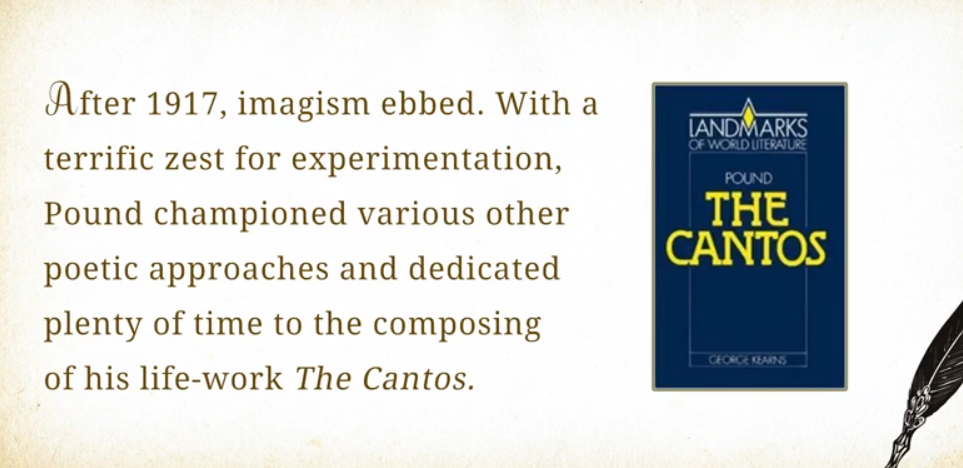
Pound lapsed into silence in 1960, leaving The Cantos unfinished. More than 800 pages long, they are fragmentary and formless despite recurring themes and ideas. The Cantos are the logbook of Pound’s own private voyage through Greek mythology, ancient China and Egypt, Byzantium, Renaissance Italy, the works of John Adams and Thomas Jefferson, and many other periods and subjects, including economics and banking and the nooks and crannies of his own memory and experience. Pound even convinced himself that the poem’s faults and weaknesses, inevitable from the nature of the undertaking, were part of an underlying method. Yet there are numerous passages such as only he could have written that are among the best of the century.
Pound died in Venice in 1972. Out of his 60 years of publishing activity came 70 books of his own, contributions to about 70 others, and more than 1,500 articles. A complete listing of his works is in Donald Gallup, A Bibliography of Ezra Pound (1963; rev. ed 1983). Most of the writing on which Pound’s fame now rests may be found in Personae (The Collected Poems; 1926, new ed. 1949), a selection of poems Pound wished to keep in print in 1926, with a few earlier and later poems added in 1949; The Cantos (1970), cantos 1–117, a collection of all the segments published to date; The Spirit of Romance (1910); Literary Essays (1954), the bulk of his best criticism, ed. with an introduction by T.S. Eliot; Guide to Kulchur (1938); and The Letters of Ezra Pound, 1907–1941, ed. by D.D. Paige (1950), an excellent introduction to Pound’s literary life and inimitable epistolary style.