
目录

  • 1 Unit1
  • 2 Unit2
  • 3 Unit3
  • 4 Unit4 Community Health Nursing
    • 4.1 words & expression
    • 4.2 paragraph 1
    • 4.3 paragraph 2
    • 4.4 paragraph 3
    • 4.5 paragraph 4
    • 4.6 paragraph 5
    • 4.7 paragraph 6
    • 4.8 paragraph 7
    • 4.9 paragraph 8
    • 4.10 paragraph 9
  • 5 Unit5
    • 5.1 words & expression
    • 5.2 listening
    • 5.3 paragraph 1
    • 5.4 paragraph 2
    • 5.5 paragraph 3
    • 5.6 paragraph 4
    • 5.7 paragraph 5
    • 5.8 paragraph 6
    • 5.9 task & practice
  • 6 Unit6 Midwifery and Perinatal Care
    • 6.1 Listening Practice
    • 6.2 Words & Expressions
    • 6.3 paragraph 1
    • 6.4 paragraph 2
    • 6.5 paragraph 3 (孕期母体变化)
    • 6.6 paragraph 4
    • 6.7 paragraph 5
  • 7 Unit7
    • 7.1 PPT
    • 7.2 传染病单词
  • 8 Unit8
    • 8.1 PPT
    • 8.2 拓展视频
    • 8.3 words
  • 9 Unit9
    • 9.1 TCM拓展视频
    • 9.2 TCM单词
  • 10 Unit10Mental-Health psychiatric nursing
    • 10.1 Part I  Vidio-novel corona virus
      • 10.1.1 Words about 2019-novel  corona virus
        • 10.1.1.1 test
      • 10.1.2 The structure of medical words.
      • 10.1.3 Transmission
    • 10.2 Text analysis.  MetaPart Il health Psychiatric nursing.
      • 10.2.1 1th paragraph
      • 10.2.2 2th paragraph
      • 10.2.3 3th paragraph
      • 10.2.4 4th paragraph
      • 10.2.5 5th paragraph
      • 10.2.6 6th paragraph
      • 10.2.7 7th paragraph
      • 10.2.8 8th paragraph
      • 10.2.9 9th paragraph
      • 10.2.10 10th paragraph
      • 10.2.11 11th paragraph
    • 10.3 PartIII Words about text.
      • 10.3.1 Test
  • 11 Unit 11 Rehabilitation nursing
    • 11.1 review
    • 11.2 have  a look:how to test  a virus
    • 11.3 PartI  Listening
    • 11.4 PartII text analysis
      • 11.4.1 1th
      • 11.4.2 2th
      • 11.4.3 3th
      • 11.4.4 4th
      • 11.4.5 5th
      • 11.4.6 6th
      • 11.4.7 7th
      • 11.4.8 8th
      • 11.4.9 9th
      • 11.4.10 10th
      • 11.4.11 5th
    • 11.5 PartIII words and expressions
    • 11.6 Test
  • 12 Unit12  Emergency nursing
    • 12.1 part 1 Warm-up
    • 12.2 Part 2 Text analysis
      • 12.2.1 1TH
      • 12.2.2 2th
      • 12.2.3 3th
      • 12.2.4 4th
      • 12.2.5 5th
      • 12.2.6 6th
      • 12.2.7 7th
      • 12.2.8 8th
      • 12.2.9 9th
      • 12.2.10 10th
      • 12.2.11 11th
      • 12.2.12 12th
    • 12.3 part 3 Words and Expressions
    • 12.4 Test
paragraph 1

Nursing during the postoperative phrase is especially important for the client's recovery. As is known to us that anesthesia impairs the ability of clients to respond to environmental stimuli, although the degree of consciousness of clients will vary. Moreover, surgery itselt traumatizes the body by disrupting protective mechanisms and homeostasis. 

术后护理对患者身体的恢复特别重要。尽管患者的意识程度有所不同,但麻醉还是会削弱患者对周围刺激物的反应能力。另外,患者的免疫功能和内环境平衡在手术中被破坏,因此,身体受损是不可避免的。

单词:postoperative phrase 术后阶段    anesthesia 麻醉     environmental stimuli 环境刺激

degree of consciousness 意识程度  protective mechanism  保护机制  homeostasis 自我平衡

知识扩展:

1. 麻醉方式是我们护理人员需要在准备手术和进行术后护理中最关键的决定因素。那么下面的这些词语将是常规的专业词汇,请大家做好笔记,另外,下面的这个视频也是介绍了麻醉的方式和常用药品。请你们观看视频并尝试做好听写。重复的听写对于提高英语听力是非常有效的办法。

   具体措施如下:

  1.  先读题,看看并猜一猜答案会出现在段落的哪里,答案单词是什么

  2. 做题,至少听两遍,第一遍写题,第二遍听答案

  3. 听写,每句一顿,每句听写,至少写80%的句子,然后看原文,再听一次。每个段落听写至少要用2个小时

  4. 听写做完,你会感觉速度明显慢下来了哦,这样你只需要每天听一下听写过的段落就可以啦,这才是真正的“磨耳朵”开始

Pain control methods can be divided in local anesthesiaconscious sedation, general anesthesia and non-pharmacological methods. 止痛方式可分成局部麻醉、清醒时的镇定、全身麻醉或非药物的方式

2. 病人的意识 consciousness 是我们在临床工作中必须经常来评估的一项内容。那么你知道consciousness分几个等级吗?
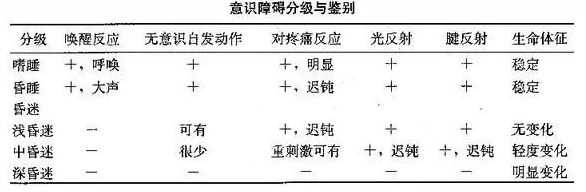

这个就是我们经常在临床上用以区分意识程度的分级。那么接下来的英文consciousness level 就是本节课的重点内容啦!请你们将这些记在笔记本上,下节课我们将抽查同学们的笔记

Clouding of consciousness is a very mild form of altered mental status in which the patient has inattention and reduced wakefulness.

Confusional state is a more profound deficit that includes disorientation, bewilderment, and difficulty following commands.

Lethargy consists of severe drowsiness in which the patient can be aroused by moderate stimuli and then drift back to sleep.

Obtundation is a state similar to lethargy in which the patient has a lessened interest in the environment, slowed responses to stimulation, and tends to sleep more than normal with drowsiness in between sleep states.

Stupor means that only vigorous and repeated stimuli will arouse the individual, and when left undisturbed, the patient will immediately lapse back to the unresponsive state.

Coma is a state of unarousable unresponsiveness.