目录

  • 1 Chapter One Introduction to Business Etiquette
    • 1.1 Introdoction to the Course
    • 1.2 Lead-in
    • 1.3 Main Contents
      • 1.3.1 The Importance of Communication
      • 1.3.2 Etiquette in Business
        • 1.3.2.1 Etiquette
        • 1.3.2.2 Business Etiquette
    • 1.4 Practice
    • 1.5 Summary
    • 1.6 Task Activity
    • 1.7 Exercises
  • 2 Chapter Two Etiquette for Business Greeting
    • 2.1 Lead-in
    • 2.2 Main Contents
      • 2.2.1 Introdution
      • 2.2.2 Greeting
      • 2.2.3 Name Card
      • 2.2.4 Small Talk
      • 2.2.5 Handshake
        • 2.2.5.1 Handshake (Part I)
        • 2.2.5.2 Handshake (Part II)
    • 2.3 Practice
      • 2.3.1 Dialogue Practice
      • 2.3.2 Etiquette Practice
    • 2.4 Summary
    • 2.5 Task Activity
    • 2.6 Exercises
  • 3 Chapter Three Etiquette in Business Talks
    • 3.1 Lead-in
    • 3.2 Main Contents
      • 3.2.1 How to Speak Appropriately
        • 3.2.1.1 How to Speak Appropriately (Part I)
        • 3.2.1.2 How to Speak Appropriately (Part II)
      • 3.2.2 How to Address People
        • 3.2.2.1 How to Address People (Part I)
        • 3.2.2.2 How to Address People (Part II)
        • 3.2.2.3 How to Address People (Part III)
      • 3.2.3 Etiquette for Business Talks
      • 3.2.4 Compliments
        • 3.2.4.1 Compliments (Part I)
        • 3.2.4.2 Compliments (Part II)
      • 3.2.5 Thanks
      • 3.2.6 Congratulation
      • 3.2.7 Apology
    • 3.3 Practice
    • 3.4 Summary
    • 3.5 Task Activity
    • 3.6 Exercises
  • 4 Chapter Four Etiquette for Business Calls
    • 4.1 Lead-in
    • 4.2 Main Contents
      • 4.2.1 The Guidelines for Handling IIncoming & Outgoing Calls
      • 4.2.2 How to Handle Some Problem Situations
    • 4.3 Practice
    • 4.4 Summary
    • 4.5 Task Activity
    • 4.6 Exercises
  • 5 Chapter Five Etiquette for Business Visiting
    • 5.1 Lead-in
    • 5.2 Main Contents
      • 5.2.1 Etiquette Knowledge of Business Visiting
        • 5.2.1.1 Etiquette Knowledge of Business Visiting (Part One)
        • 5.2.1.2 Etiquette Knowledge of Business Visiting (Part Two)
      • 5.2.2 Etiquette of Oral Invitation
      • 5.2.3 Etiquette of Written Invitation - Invitation Letter
    • 5.3 Practice
    • 5.4 Summary
    • 5.5 Task Activity
    • 5.6 Exercises
  • 6 Chapter Six Business Reception Etiquette
    • 6.1 Lead-in
    • 6.2 Main Contents
      • 6.2.1 Basic Principle of Business Reception
      • 6.2.2 Etiquette of Business Reception
        • 6.2.2.1 Etiquette of Business Reception (Part I)
        • 6.2.2.2 Etiquette of Business Reception (Part II)
      • 6.2.3 Etiquette of Guidance
      • 6.2.4 Etiquette in Cars
      • 6.2.5 Etiquette of Recreation
    • 6.3 Practice
    • 6.4 Summary
    • 6.5 Task Activity
    • 6.6 Exercises
  • 7 Chapter Seven Etiquette for Business Dinner
    • 7.1 Lead-in
    • 7.2 Main Contents
      • 7.2.1 Entertainment and Business Entertainment
      • 7.2.2 Seating Protocol
      • 7.2.3 Decoding the Menu
      • 7.2.4 Knowledge of Wine
      • 7.2.5 Table Manners
      • 7.2.6 Formal Place Settings
    • 7.3 Practice
    • 7.4 Summary
    • 7.5 Task Activity
    • 7.6 Exercises
  • 8 Etiquette for Business Dressing
    • 8.1 Lead-in
    • 8.2 Main Contents
      • 8.2.1 Grooming Etiquette
        • 8.2.1.1 Grooming Etiquette (Part I)
        • 8.2.1.2 Grooming Etiquette (Part II)
      • 8.2.2 Posture Etiquette
      • 8.2.3 Dress Etiquette
        • 8.2.3.1 Dress Etiquette (Part I)
        • 8.2.3.2 Dress Etiquette (Part II)
          • 8.2.3.2.1 Dress Etiquette (Part III)
    • 8.3 Practice
    • 8.4 Summary
    • 8.5 Task Activity
    • 8.6 Exercises
Task Activity

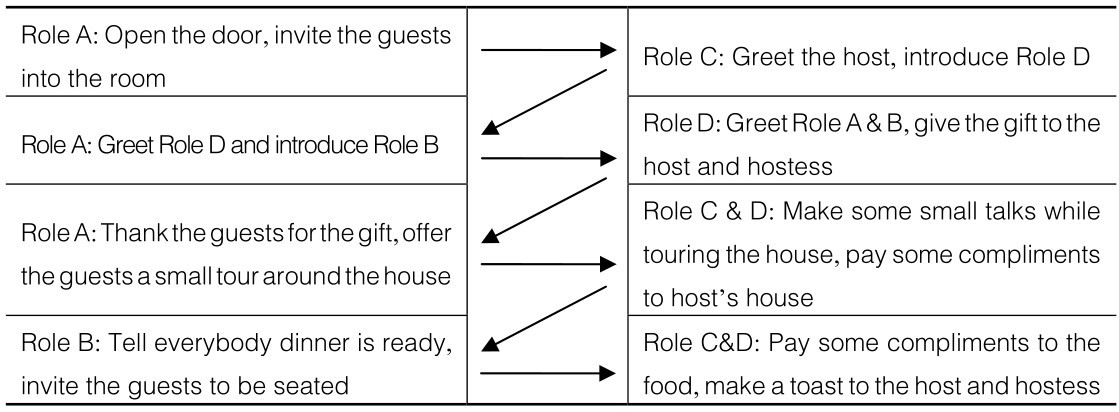
Act out the role-play according to the following situation.

    John Smith, the manager of your department, invited you and your wife to join a family dinner at his home on New Year’s Eve. You and your wife are now at the doorsteps of Mr. Smith’s house, ringing the doorbell.


Role A: Mr. Smith


Role B: Mrs. Smith


Role C: You


Role D: Your wife