金融数据挖掘

冯国锋

目录

  • 1 Introduction 导论
    • 1.1 What is data mining? 什么是数据挖掘?
    • 1.2 How DM works in financial area?数据挖掘在金融领域是如何应用的?
  • 2 Financial big data 金融大数据
    • 2.1 What is data? 什么是数据?
    • 2.2 Data preprocessing 数据预处理
    • 2.3 Similarity and Dissimilarity of financial data 金融数据的相似性与相异性
  • 3 Decision Tree Classifier with financial applications 决策树分类器与金融应用
    • 3.1 Classification in financial scenario-basic concept and idea 分类算法与金融应用——基本概念与思想
    • 3.2 Introduction to Decision Tree Classifier in Financial Scenario 决策树算法与金融应用——算法介绍
    • 3.3 Methods for expressing attribute test conditions 属性测试条件划分方法
    • 3.4 Measures of impurity in Decision Tree Classifier 决策树分类算法中结点纯度度量方法
    • 3.5 A financial example to compute a Decision Tree 决策树分类器的构建案例
  • 4 Rule-Based Classifier with Financial Applications基于规则的分类器与金融应用
    • 4.1 Introduction to Rule-based Classifier in Financial Scenario 基于规则的分类器与金融应用——算法介绍
    • 4.2 Direct Method for Rule Extraction in Rule-based Classifier 规则提取的直接方法
    • 4.3 An Financial Example to Build Rule-based Classifier 基于规则的分类器的构建案例
  • 5 Naive Bayes Classifier with Financial Applications 朴素贝叶斯分类器与金融应用
    • 5.1 Introduction to Naive Bayes Classifier in Financial Scenario 朴素贝叶斯分类器与金融应用——算法介绍
    • 5.2 A Financial Example to Build Naive Bayes Classifier 朴素贝叶斯分类器的构建案例
  • 6 Bayesian Networks with Financial Applications 贝叶斯网络分类器与金融应用
    • 6.1 Introduction to Bayesian Belief Networks in Financial Scenario 贝叶斯信念网络分类器与金融应用——算法介绍
    • 6.2 A Financial Example of BBN 贝叶斯信念网络分类器案例
  • 7 Financial Classification issues-Underfitting and Overfitting 分类算法在金融应用中的可能问题——拟合不足与过拟合
    • 7.1 Underfitting and Overfitting (1) 拟合不足与过拟合(1)
    • 7.2 Underfitting and Overfitting (2) 拟合不足与过拟合(2)
  • 8 Fiancial Classification Evaluation-Model Evaluation and Comparison 分类算法在金融应用中的结果评估——模型评价与对比
    • 8.1 Fiancial Classification Evaluation-Model Evaluation 分类算法在金融应用中的结果评估——模型结果评价
    • 8.2 Fiancial Classification Evaluation-Model comparison 分类算法在金融应用中的结果评估——模型对比分析
  • 9 Association Analysis with Financial Applications-Apriori Algorithm 关联分析与金融应用——Apriori算法
    • 9.1 Association Analysis in Financial Scenario-basic concept and idea 关联分析与金融应用——基本概念与思想
    • 9.2 Apriori Algorithm in Financial Scenario (1)-Introduction Apriori算法与金融应用——算法介绍
    • 9.3 Apriori Algorithm in Financial Scenario (2)-Candidate Generation & Pruning Apriori算法与金融应用——候选生成与剪枝
    • 9.4 Apriori Algorithm in Financial Scenario (3)-Hash Tree Apriori算法与金融应用——哈希树
    • 9.5 Apriori Algorithm in Financial Scenario (4)-Rule Generation and Complexity Apriori算法与金融应用——规则生成与算法复杂度
  • 10 Association Analysis with Financial Applications-FP Tree Algorithm 关联分析与金融应用——FP Tree算法
    • 10.1 FP Tree Algorithm in Financial Scenario-Introduction FP Tree算法与金融应用——算法介绍
    • 10.2 FP Tree Algorithm-A Financial Example FP Tree算法金融实例
  • 11 Financial Association Analysis Evaluation 关联分析在金融应用中的结果评估
    • 11.1 Financial Association Analysis-Evaluation (1) 关联分析在金融应用中的结果评估(1)
    • 11.2 Financial Association Analysis-Evaluation (2) 关联分析在金融应用中的结果评估(2)
  • 12 Cluster Analysis with Financial Applications-K-means Algorithm 聚类分析与金融应用——K-means算法
    • 12.1 Cluster Analysis in Financial Scenario-basic concept and idea 聚类分析与金融应用——基本概念与思想
    • 12.2 Introduction to K-means Algorithm in Financial Scenario K-means算法与金融应用——算法介绍与实例
  • 13 Cluster Analysis with Financial Applications-Basic Hierarchical Clustering Algorithm 聚类分析与金融应用——基本层次聚类算法
    • 13.1 Introduction to Basic Hierarchical Clustering Algorithm in Financial Scenario 基本层次聚类算法算法与金融应用——算法介绍
    • 13.2 A Financial Example of Agglomerative Hierarchical Clustering Algorithm 凝聚层次聚类算法实例
  • 14 Fiancial Cluster Analysis Evaluation 聚类分析在金融应用中的结果评估
    • 14.1 Unsupervised Cluster Evaluation 无监督的聚类结果评估
    • 14.2 Supervised Cluster Evaluation 有监督的聚类结果评估
Classification in financial scenario-basic concept and idea 分类算法与金融应用——基本概念与思想


主要知识点:


  1. 分类的内涵

    分类就是通过从训练集中学习得到一个分类模型,对未标记数据对象进行类别预测的任务。训练集training set,是用来训练的数据对象的集合,训练集里面的数据对象还包含一个特别的属性,就是类别。分类模型就是从训练集里面学习出来的属性集合和类别标签之间的抽象表示关系。在此基础之上,为了验证学习出来模型的准确度,需要测试集对模型的效果进行测度和检验。同时,为了确保测度的公正性,测试集的数据对象是和训练集相互独立的,测试集的数据不能用来构造分类器。

  2. 分类算法应用于金融场景的具体步骤

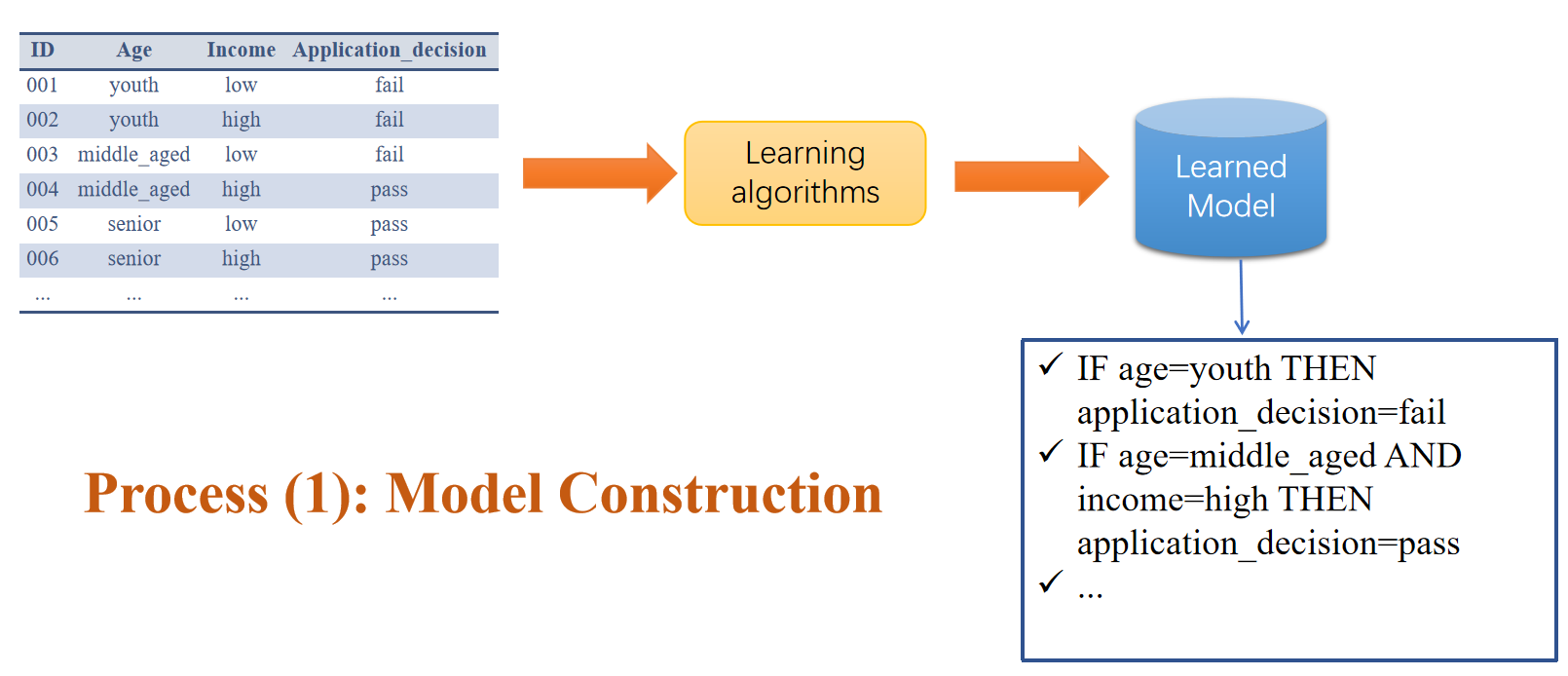
  • 场景:给定金融领域中的贷款申请场景,即金融机构通过申请人的相关信息决定是否通过申请。

  • 步骤一:归纳过程,即使用学习算法(learning  algorithm)对已有的训练集进行归纳和学习,建立起分类模型。从图中可以看出,这一阶段需要训练集,包含数据对象的属性和类别标签,本例中年龄和收入就是属性,通过和失败就是类别标签,还需要相对应的学习算法,另外模型也可以有多种表现形式,如决策树,规则集等,图里面的模型就是用规则的方式去表现的。


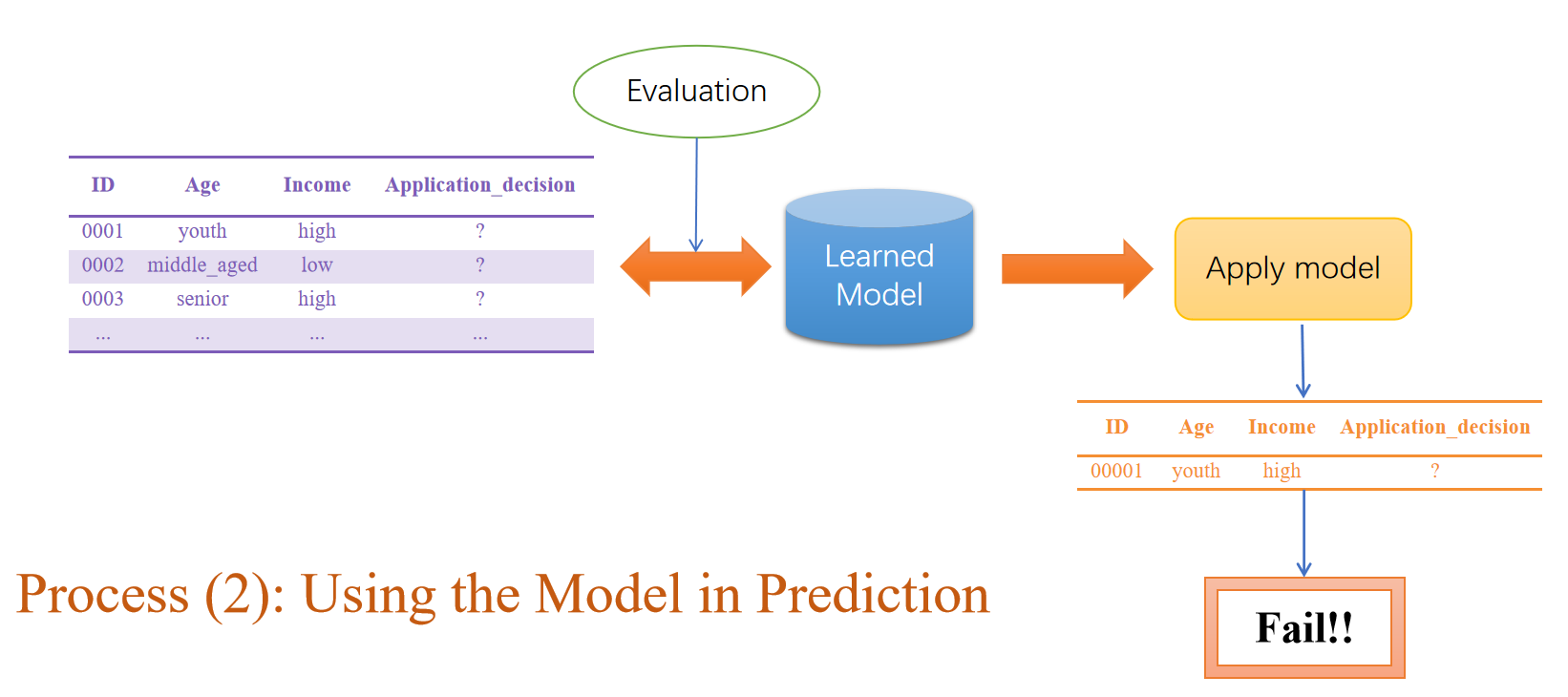
  • 步骤二:演绎和应用的过程。首先,我们需要一个模型评价步骤,即运用独立于训练集的测试集数据对学习出来的模型进行评价,即比较模型对测试集数据对象预测出来的类别标签和测试集真实标签,评价的指标包含准确率等,如果模型的准确度通过了检验,那么就可以使用模型对未知的数据对象进行分类预测,图中运用了一个新的申请对象00001进行应用,最后得出的结论为不通过。