大学英语2

张新斌

目录

  • 1 Before New Class
    • 1.1 The Spring Festival
  • 2 Unit 1 Accommodation
    • 2.1 Section I Talking face to face(2 periods)
      • 2.1.1 Section I--Minitalks
      • 2.1.2 Section I--Studying Hotel Ads
      • 2.1.3 Section I--Dialogues
      • 2.1.4 Section I--Put Language to Use
    • 2.2 Section II Being your ears(1 period)
    • 2.3 Section III Trying your hand(2 periods)
    • 2.4 Section IV Maintaining a sharp Eye (3 periods)
      • 2.4.1 Section IV--Passage I
      • 2.4.2 Section IV--Passage II
    • 2.5 A Quiz of Unit 1
  • 3 Unit 2 Food
    • 3.1 Section I Talking face to face(3 periods)
      • 3.1.1 Section I--Minitalks
      • 3.1.2 Section I--Studying Menus
      • 3.1.3 Section I--Dialogues
      • 3.1.4 Section I--Put Language to Use
    • 3.2 Section II Being your ears
    • 3.3 Section III Trying your hand (2 periods)
    • 3.4 Section IV Maintaining a sharp Eye (3 periods)
      • 3.4.1 Section IV--Passage I
      • 3.4.2 Section IV--Passage II
    • 3.5 A Quiz of Unit 2
  • 4 Unit 4 Invitation Etiquette
    • 4.1 Unit Goals
    • 4.2 Section I Talking Face to Face
      • 4.2.1 Section I--Minitalks
      • 4.2.2 Section I--Studying Invitation Cards and Letters
      • 4.2.3 Section I Dialogues
    • 4.3 Section II Being all Ears
    • 4.4 Section III Trying your hand
    • 4.5 Section IV Maintaining a sharp Eye
      • 4.5.1 Section IV--Passage I
      • 4.5.2 Section IV--Passage II
    • 4.6 English for Teachers of Preschool Education
    • 4.7 A Quiz of Unit 4
  • 5 Unit 5 Cyber
    • 5.1 Unit Goals
    • 5.2 Section I Talking Face to Face
      • 5.2.1 Section I--Minitalks
      • 5.2.2 Section I--Studying Email Information
      • 5.2.3 Section I--Dialogues
    • 5.3 Section II Being all Ears
    • 5.4 Section III Trying your hand
    • 5.5 Section IV Maintaining a sharp Eye
      • 5.5.1 Section IV--Passage I
      • 5.5.2 Section IV--Passage II
    • 5.6 A Quiz of Unit 5
  • 6 Unit 6 Shopping
    • 6.1 Section I Talking face to face
      • 6.1.1 Section I--Minitalks
      • 6.1.2 Section I--Studying Shopping and Travel Ads
      • 6.1.3 Section I--Dialogues
      • 6.1.4 Section I- Put Language to Use.
    • 6.2 Section II Being your ears
    • 6.3 Section III Trying your hand (2 periods)
    • 6.4 Section IV Maintaining a sharp Eye (3 periods)
      • 6.4.1 Section IV--Passage I
      • 6.4.2 Section IV--Passage II
    • 6.5 A Quiz of Unit 6
  • 7 Unit 8 Applying for a Job
    • 7.1 Section I Talking face to face (3 periods)
      • 7.1.1 Section I--Minitalks
      • 7.1.2 Section I--Studying Job Advertisements
      • 7.1.3 Section I--Dialogues
      • 7.1.4 Section I--Put Language to Use
    • 7.2 Section II Being your ears
    • 7.3 Section III Trying your hand (2 periods)
    • 7.4 Section IV Maintaining a sharp Eye (3 periods)
      • 7.4.1 Section IV--Passage I
      • 7.4.2 Section IV--Passage II
Section II Being your ears

1. Listen to ten topic-related sentences for workplace communication and try to remember them.
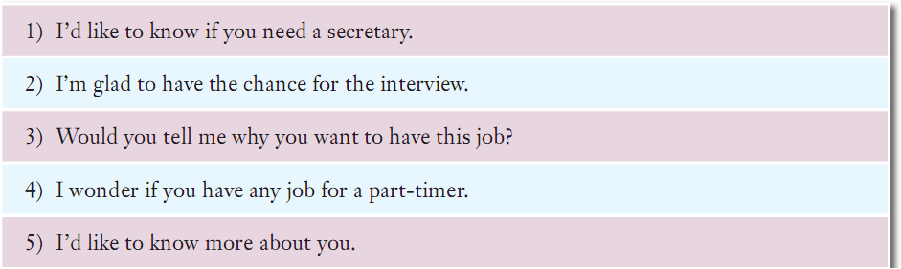
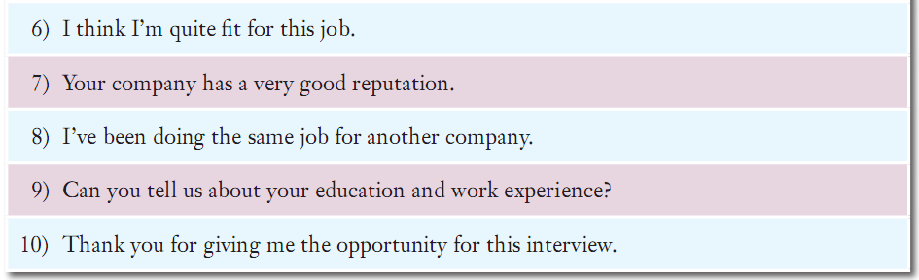


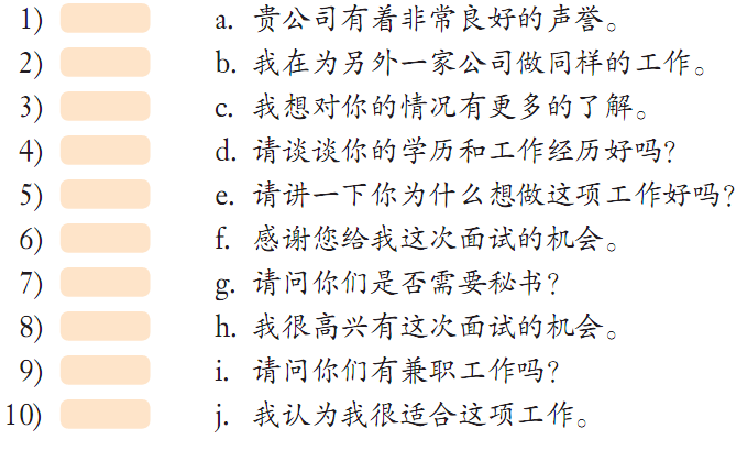
2. Listen again to the above sentences rearranged in sequence, and then match them with their Chinese translation.


3. Listen to ten topic-related English sentences for workplace communication and write them down.


4. Listen to a dialogue and decode the message by finding the correct choices in shade according to what you have heard.


1Mr. Liang, Winston, Walmart  is a job seeker. One day he finds an ad for a shop 2 doorkeeper, manager, assistant in anewspaper. Then he gives a phone call to 3Allison, Mike, Franklin  about it. He says he has 4three, four, five years’ experience in a 5 bookstore, department store, company. He expects to have an interview and his telephone number is 6 3425349, 2425349, 3245349. He also says that he can come to the interview on 7 Tuesday, Monday, Thursday  afternoon.


6. Listen to the dialogue for the last time and fill in the blanks according to what you have heard.


Winston: Hello, this is Mike Winston.

    Liang: Hello. I’m asking about your ad in today’s newspaper for the job in your shop.

Winston: Well, but do you have any experience of working in a shop?

    Liang: I’ve got 4 years’ experience 1 _____________________________.

Winston: Which one, please?

    Liang: 2 ________________.

Winston: Fine. May I have your name? I’ll make an appointment for an interview with you.

    Liang: Yes, my name is Liang Tian, Mr. Liang.

Winston: Will you please spell it, Mr. Liang?

    Liang: OK. L-I-A-N-G T-I-A-N.

Winston: Your phone number?

    Liang: 3 ________________.

Winston: Thank you. Can you come tomorrow afternoon?

    Liang: 4 ________________. But can you make it Thursday afternoon?

Winston: 5 ________________. When you come, ask for Mike Winston, OK?

    Liang: Yes, Mr. Winston. See you then.


7. Listen to a monologue (独白) of a job hunter twice and during the second listening, put back the missing words in the blanks.


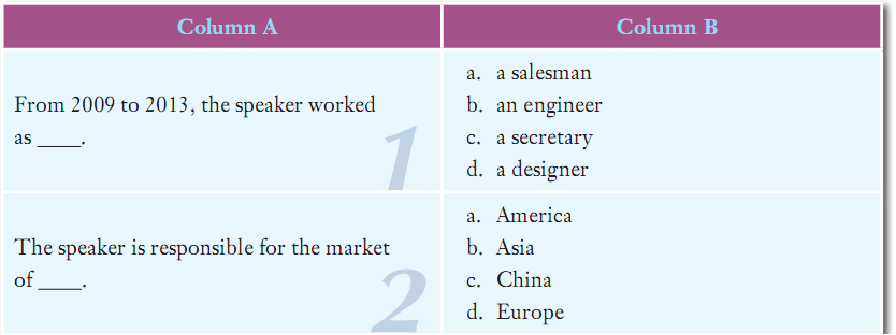
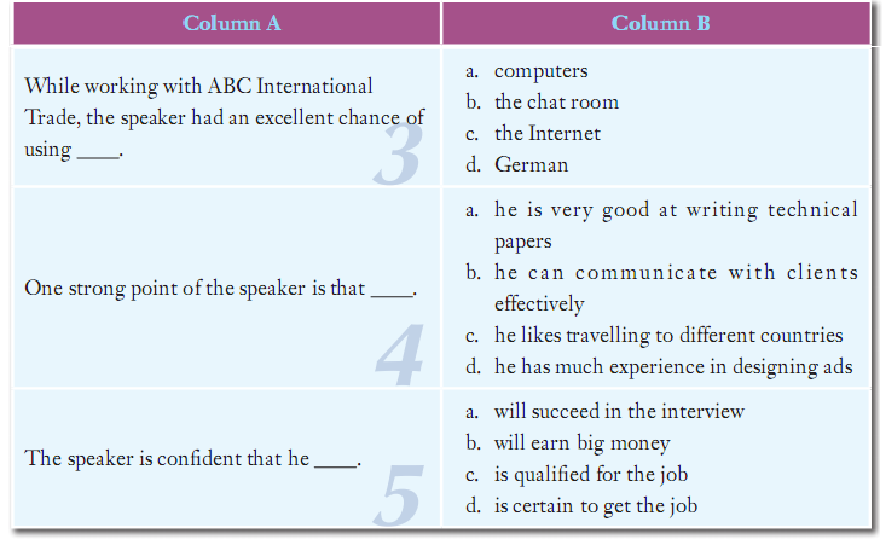
      From 2009 to 2013, I worked as a salesman with ABC International Trade, responsible for the 1 ___________ of Europe. During that period, I got excellent 2 ___________ to use German in writing letters and making phone calls for 3 ___________ business in that country. I also translated some technical 4 ___________ and the Siemens’ operating instructions from 5 ___________ to Chinese.

      Through working in many 6 ___________ countries, I found that my success in work owes 7 ___________ to my effective communication with people, plus my 8 ___________ and strong ability to use the 9 ___________. Therefore I firmly 10 ___________ I am qualified for this job.


8. Listen to the monologue again and match the information in Column A with the choices in Column B.