
跨文化交际(23242英语/翻译专业)

要文静范京晶高安阳

目录

  • 1 Culture
    • 1.1 Course introduction
    • 1.2 Case Study
      • 1.2.1 Shanxi Pasta Culture
    • 1.3 Culture
      • 1.3.1 Cultural Confidence
    • 1.4 Differences between Chinese culture and western culture
  • 2 Communication
    • 2.1 Comunication
      • 2.1.1 10 Barriers to Effective Communication
    • 2.2 Case study
  • 3 Intercultural Communication
    • 3.1 Intercultural Communication
    • 3.2 Case study
  • 4 Hofstede’s Culture
    • 4.1 Individualism and Collectivism
    • 4.2 Power distance
    • 4.3 Uncertainty Avoidance
    • 4.4 Anna and King
    • 4.5 Let's deal with China - Intercultural communication
    • 4.6 masculinity ve femininity
  • 5 Kluckhohn and Strodtbeck’s Model
    • 5.1 Case study
    • 5.2 Man and Nature
  • 6 Cultural Connotation in Language
    • 6.1 作业视频分析与展播
    • 6.2 Language and Culture
    • 6.3 Case study
  • 7 Norms of social Interaction
    • 7.1 Verbal communication
    • 7.2 Addressing
    • 7.3 Gratitude
    • 7.4 Taboos
    • 7.5 Case study
  • 8 Non-verbal Communication
    • 8.1 Case Study
    • 8.2 Nonverbal language
    • 8.3 How to Read Body Language
  • 9 Ethnocentrism and Stereotypes
    • 9.1 Case study
    • 9.2 Ethnocentrism
    • 9.3 Race discrimination
    • 9.4 Stereotypes
  • 10 Acculturation and Identity
    • 10.1 Acculturation
    • 10.2 Identity
    • 10.3 Case study
  • 11 Culture Shock
    • 11.1 Case study
    • 11.2 Culture shock
    • 11.3 Ethnocentrism
    • 11.4 Reverse Culture Shock
  • 12 Education
    • 12.1 Chinese education
    • 12.2 Western education
    • 12.3 Case Study
  • 13 Hall’s Culture Context Model
    • 13.1 Case study
    • 13.2 low context and High context
    • 13.3 Compliment
    • 13.4 Face-Negotiation Theory
  • 14 Family and Gender
    • 14.1 Case study
    • 14.2 Gender
    • 14.3 Wedding and Funeral customs
  • 15 Intercultural business
    • 15.1 Case study
    • 15.2 Business Negotiation
  • 16 Globalization
    • 16.1 Economic Globalization
    • 16.2 Political Globalization
    • 16.3 Cultural Globalization
  • 17 参考章节Customs and Festivals
    • 17.1 Chinese festivals
    • 17.2 Western festivals
    • 17.3 Chinese cuisine
    • 17.4 Western cuisine
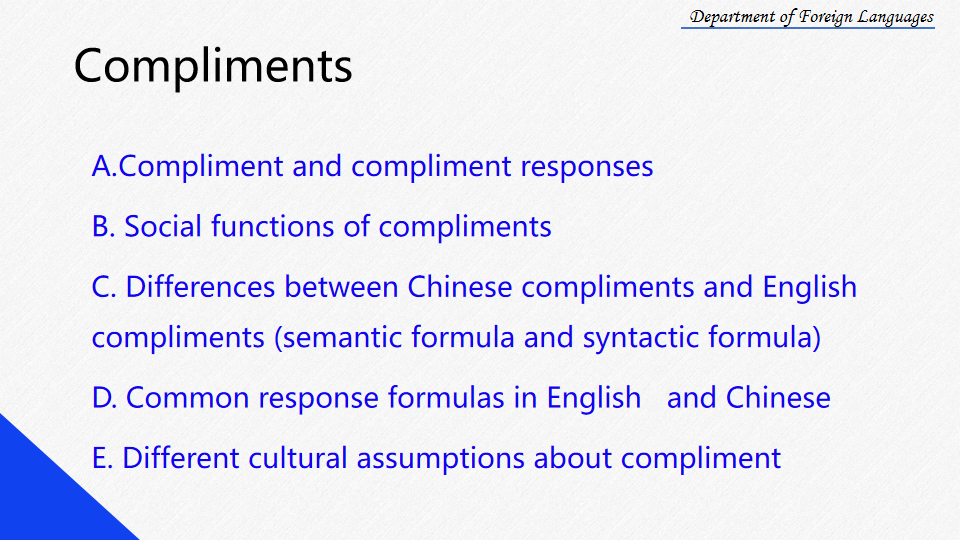
Compliment


Socialfunctionsof compliments


1.To create or reinforce solidarity

2. To greet people

3. To express thanks or congratulations

4. To encourage aging people

5. To soften criticism

6. To start a conversation

7. To overcome embarrassment


Differences betweenChinese and English Compliments

W: It is common for a man to informally give a womancompliments on her looks or clothing.

C: It is taken as a kind of flirtation if a man compliments a woman.


ResponseFormulas of E and C compliments


American English

 A:This is really a nice sweater.

 B:I’m glad you like it.

 A:You did a good job.

 B:Thankyou/Thanks.

Chinese:

 A:Your sweater is very good.

 B:I bought it only for ten yuan.

 A:You did the job very well.

 B:That’sthe result of joint efforts./There’s still much room for improvement.