
Unit Eight
Economic Growth is a Path toPerdition, Not Prosperity
Period 7-8 Exercises
Assignments:
1. Please listen to (watch) the following video/audio clips
 An Inconvenient Truth《难以忽视的真相》(an Oscar-winning documentary)
More on Global Warming (a VOA report on opposing views that global warmingis not a real danger)
2. Work in groups of four:
What is the main idea of the documentary?
Do you find Al Gore's arguments convincing? Anyargument or reasoning you find not valid?
What is the main opposition presented in the secondclip? Are you convinced?
What is your opinion on global warming: is it areal danger? If it is, what should we do to tackle this problem?
3. Picture discription
What can you learn from the graphs? Please describe the following pictures in detail.

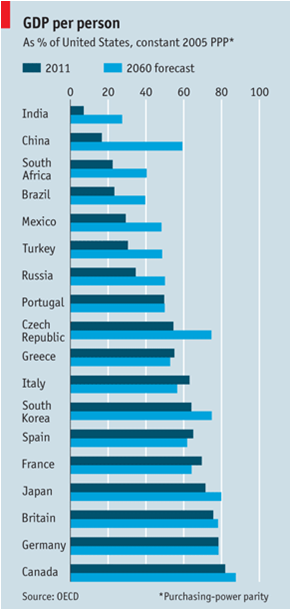
4. Compare this text with the text in Unit 12: Onwards and Upwards. Try to find out where the two texts are related and how they are different.
Theme of Unit 12: Onwards and Upwards
On the surface, the subject of this text is very similar to the text of Unit 8 “Economic Growth Is a Path to Perdition, NotProsperity.” Both seem to be about economic growth, about GDP.
But when we read it carefully again , we will find that this text is really about something more challenging. It is about our future , about human destiny , about whether or not we will be able to move to a world of final bliss.
The article here gives us a historical account of the concept of progress. It tells us how for various reasons people have trusted that our life and society will always change for the better until in the end we succeed in establishing a paradise on Earth. In fact, in the course of history, various ways have been pointed out to us in which this can be done.
In recent times, however, people are no longer so optimistic. They are not so sure about their happy future. Things change more and more quickly, but they do not necessarily change for the better. Progress no longer seems to equal approaching our ideals or happiness, and many traditional magic instruments with which we have been assured to realize our happy destiny seem to have lost their attraction. So what shall we do? The author of this essay is asking us to rethink about the concept of “progress,” and he has given us here some interesting ideas to start with:
1) The word “progress” has to be carefully redefined. To move onward does not always or automatically mean to move upward.
2) Today our techoological and scientific advances seem to be accompanied by moral and spiritual declines.
3) Looking back, it is true that we have changed for the better in many ways. We have progressed in the best sense of the word although serious problems exist. Therefore there is no reason to despair.
4) Today, the most important thing for us is to reject both utopia and degeneracy, refuse to be either blindly optimistic or pessimistic. We must adopt Ms Neiman's proposal to find a moral purpose inlife. We must strive for our moral ideals for their own sake. In this way, we will probably never meet the final goal, but we will still be able to make progress.
Structure
I. Introduction:The popular view in the rich world about material progress and moral advance(para. 1)
II. The idea of progress – the backdrop to society (paras. 2-8)
A. The ideal of progress in the 18th and 19th centuries. (p ara. 2)
B. Supposed agents of progress. (p ara. 3)
C. Importance of the idea of progress. (paras. 4--8)
III. History of theidea of progress (paras. 9-24)
A. Demonstration of the idea in source of progress (para. 9)
B. Rebuttal of the language and community of the source of progress (paras. 10-12)
C. Rebuttal of the modern-age belief in science as the source of progress (p aras. 13-17)
D. Rebuttal of the belief in economic growth as the modern source of progress (paras. 18-21)
E. Moral sensibilty and governance (p aras. 22 - 24)
IV. Conclusion: Susan Neiman's book on moral sensibility (paras. 25-28)
5.Discussion
Review the historical development of the concept of progress with more concrete examples.
Think about how the confusion over the impoverished meaning of progress is reflected in our life today.
The author does not seem to trust any of the traditional ways which promise to secure our happiness: religion, language, market, strong government, anarchy, evolution, education, legislature, GDP, etc. Can we really dismiss all of them? Criticize this opinion and make comments.

