
管理英语

张捷

目录

  • 1 Guide to this course
    • 1.1 About the course
    • 1.2 Textbook (PDF) and audio materials
    • 1.3 Getting ready for your group presentation
      • 1.3.1 How to make a presentation
      • 1.3.2 Oral Assignment: Who's who?
  • 2 Unit 1 Who is who?
    • 2.1 Textbook (Unit 1)
    • 2.2 The story so far
    • 2.3 Business focus
      • 2.3.1 Company organigrams
      • 2.3.2 Organigram of Bergerbild AG
    • 2.4 Business language
      • 2.4.1 Using the phone (Basic)
      • 2.4.2 Using the phone (Level-up)
    • 2.5 Cross-cultural focus
    • 2.6 Revision tasks
    • 2.7 Group presentation
    • 2.8 Design thinking
  • 3 Unit 2 Project finances
    • 3.1 Textbook (Unit 2)
    • 3.2 Prevision tasks
    • 3.3 The story so far and Episode 2
    • 3.4 Business language
      • 3.4.1 Tips on keeping talking
      • 3.4.2 Talking about the past
    • 3.5 Writing your resume
      • 3.5.1 Functional resume
      • 3.5.2 What else goes with resume
      • 3.5.3 Cross-cultural focus
      • 3.5.4 Action verbs used in CVs
      • 3.5.5 Examples of resumes
      • 3.5.6 Examples of cover letters and thank-you notes
      • 3.5.7 Assignment
    • 3.6 Group presentation
    • 3.7 Business Focus
    • 3.8 Revision
  • 4 Unit 3 Project management
    • 4.1 Textbook (Unit 3)
    • 4.2 Prevision tasks
      • 4.2.1 The story so far and Episode 3
      • 4.2.2 Prevision tasks on business vocabulary
      • 4.2.3 Managing a project
    • 4.3 Business language
      • 4.3.1 Vocabulary
      • 4.3.2 One PM skill:CPM
      • 4.3.3 Group presentation
    • 4.4 Cross-cultural focus: Meeting
      • 4.4.1 Templates for meeting minutes
      • 4.4.2 Video clips of meetings
      • 4.4.3 Link to TV program "The Shining Line"
    • 4.5 Assignments
      • 4.5.1 Assignments for meeting minutes
      • 4.5.2 Assignment 1
      • 4.5.3 Assignment 2
    • 4.6 Revision
    • 4.7 Group Presentation
  • 5 Unit 4 Email ego
    • 5.1 Textbook (Unit 4)
    • 5.2 Prevision: The story so far
    • 5.3 Business focus: Email
    • 5.4 Group presentation
    • 5.5 Giving feedback
    • 5.6 Apologising
    • 5.7 Simulation
    • 5.8 Revision
  • 6 Unit 5 Sorting it out
    • 6.1 Textbook (Unit 5)
    • 6.2 Prevision tasks (The story so far)
    • 6.3 Cross-cultural focus: attitudes to time
    • 6.4 Business focus: Writing reports
      • 6.4.1 Prevision tasks
      • 6.4.2 How to write a business report
      • 6.4.3 Feedback to the written practices
    • 6.5 Group presentation
    • 6.6 Self-study:How to use computer
    • 6.7 Revision
  • 7 Unit 6 Negotiations on site
    • 7.1 Textbook (Unit 6)
    • 7.2 Prevision tasks
    • 7.3 The story so far
    • 7.4 Cross-cultual focus
    • 7.5 Group presentation
    • 7.6 Business focus: Negotiation
    • 7.7 Revision
  • 8 Unit 7 Socializing
    • 8.1 Textbook (Unit 7)
    • 8.2 Prevision tasks
    • 8.3 The story so far
    • 8.4 Business focus: Menu ordering
    • 8.5 Cross-cultural focus: Small talk = big business
    • 8.6 Assignments
    • 8.7 Revision
    • 8.8 Group Presentation
  • 9 Unit 8 Dangerous assumptions
    • 9.1 Textbook (Unit 8)
    • 9.2 Prevision tasks
    • 9.3 The story so far
    • 9.4 Business focus: Assumptions
      • 9.4.1 Whistleblower
      • 9.4.2 Risk management:Solution 1
      • 9.4.3 Risk management:Solution 2
    • 9.5 Business language: How to express assumptions
    • 9.6 Advertising
      • 9.6.1 Group presentation
    • 9.7 Revision
  • 10 Unit 9 1 + 1 = ?
    • 10.1 Textbook for Unit 9
    • 10.2 Prevision tasks
    • 10.3 The story so far
    • 10.4 Language focus: Idiomatic expressions
    • 10.5 Revision
  • 11 Unit 10 Finale of the story
    • 11.1 Textbook for Unit 10
    • 11.2 The story so far
    • 11.3 Presentations
  • 12 Course revision
    • 12.1 Revision (Outline)
    • 12.2 Revision (Writing)
    • 12.3 Revision (Storyline)
Apologising

Apologising

Apologizing effectively is a very useful business skill, which students seldom appreciate. For purely mercenary reasons, it makes sense. Research in the US and the UK shows that a sincere apology to an unhappy customer (quickly followed by the relevant corrective measures) often leads to an improved relationship and an increase in business.

1) How to make an apology:

2) Good ways to say "sorry":

3) Scenario One:

4) Scenario Two:

5) Scenario Three:

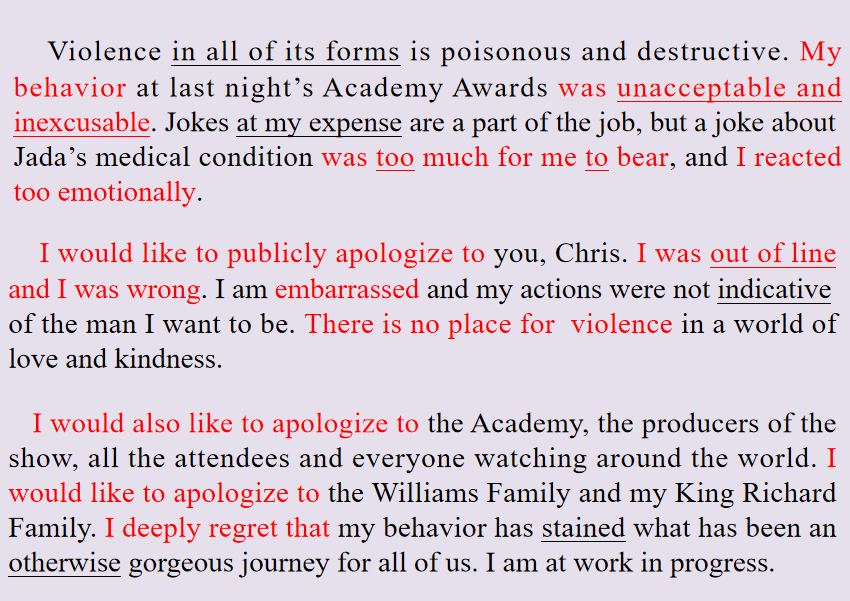
6) An apology from Will Smith:

Practice: Writing a short email of apologising

Practice writing a short email from either Filippo to Emily or Emily to Filippo, apologising for your behaviour in the meeting (page 38) and asking for another appointment.