
Text C Desegregation
1. The National Association for the Advancement of Colored People (NAACP) took the lead in efforts to overturn the judicial doctrine, established in the Supreme Court case Plessy v. Ferguson in 1896,that segregation of African-American and white students was constitutional if facilities were “separate but equal". That decree had been used for decades to sanction rigid segregation in all aspects of Southern life, where facilities were seldom, if ever, equal.
2. African Americans achieved their goal of overturning Plessy in 1954 when the Supreme Court presided over by an Eisenhower appointee, Chief Justice Earl Warren handed down its Brown v. Board of Education ruling. The Court declared unanimously that "separate facilities are inherently unequal," and decreed that the“separate but equal” doctrine could no longer be used in public schools. A year later, the Supreme Court demanded that local school boards move “with all deliberate speed” to implement the decision.
3. Eisenhower, although sympathetic to the needs of the South as it faced a major transition, nonetheless acted to see that the law was upheld in the face of massive resistance from much of the South. He faced a major crisis in Little Rock, Arkansas, in1957, when Governor Orval Faubus attempted to block a desegregation plan calling for the admission of nine black students to the city’s previously all-white Central High School. After futile efforts at negotiation, the president sent federal troops to Little Rock to enforce the plan.
4. Governor Faubus responded by ordering the Little Rock high schools closed down for the 1958 --1959 school year. However, a federal court ordered them reopened the following year. They did so in a tense atmosphere with a tiny number of African-American students. Thus, school desegregation proceeded at a slow and uncertain pace throughout much of the South.
5. Another milestone in the Civil Rights movement occurred in 1955 in Montgomery, Alabama. Rosa Parks, a 42-year-old African-American seamstress who was also secretary of the state chapter of the NAACP, sat down in the front of a bus in a section reserved by law and custom for whites. Ordered to move to the back, she refused. Police came and arrested her for violating the segregation statutes. African-American leaders, who had been waiting for just such a case, organized a boycott of the bus system.
6. Martin Luther King Jr., a young minister of the Baptist church where the African Americans met, became a spokesman for the protest. “There comes a time,” he said, “when people get tired...of being kicked about by the brutal feet of oppression.” King was arrested, as he would be again and again; a bomb damaged the front of his house. But African Americans in Montgomery sustained the boycott. About a year later, the Supreme Court affirmed that bus segregation, like school segregation, was unconstitutional. The boycott ended. The Civil Rights Movement had won an important victory --- and discovered its most powerful, thoughtful, and eloquent leader in Martin Luther King Jr.
7. African Americans also sought to secure their voting rights. Although the 15th Amendment to the U. S. Constitution guaranteed the right to vote, many states had found ways to circumvent the law. The states would impose a poll ("head") tax or a literacy test -- typically much more stringently interpreted for African Americans -- to prevent poor African Americans with little education from voting.
8. Eisenhower, working with Senate majority leader Lyndon B. Johnson, lent his support to a congressional effort to guarantee the vote. The Civil Rights Act of 1957, the first such measure in 82 years, marked a step forward, as it authorized federal intervention in cases where African Americans were denied the chance to vote. Yet loopholes remained, and so activists pushed successfully for the Civil Rights Act of 1960, which provided stiffer penalties for interfering with voting, but still stopped short of authorizing federal officials to register African Americans.
9. Relying on the efforts of African Americans themselves, the civil rights movement gained momentum in the postwar years. Working through the Supreme Court and through Congress, civil rights supporters had created the groundwork for a dramatic yet peaceful “revolution” in American race relations in the 1960s.
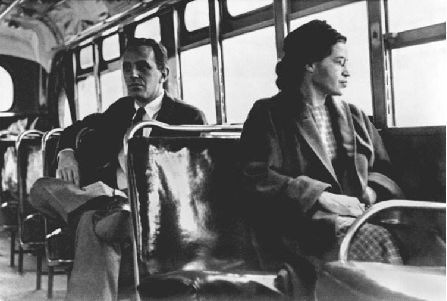
10. The picture on the left shows that Rosa Parks sits in one of the front; of a city bus following the successful seats boycott of the bus system in 1955 --1956 by African-American citizens of Montgomery, Alabama. The boycott was organized to protest the practice of segregation in which African Americans were forced to sit in the back of the bus. The Supreme Court agreed that this practice was a constitutional violation a year after the boycott began. The great leader of the Civil Rights Movement in America, Martin Luther King Jr., gained national prominence through the Montgomery bus boycott.
Questions for Discussion or Reflection
1. What was the situation of African Americans like after the Second
World War? How did their living conditions and political rights
change with the advancement of the Civil Rights Movement?
2. What were the milestones of the Civil Rights Movement that
occurred in 1955? Discuss with your partners and present your
views.
Proper Names
Allen Ginsberg 艾伦·金斯堡
David Riesman 大卫·雷斯曼
Elvis Presley 尔维斯·普雷斯利
gross national product (GNP) 国民生产总值
Harry Truman 哈里·杜鲁门
Jack Kerouac 杰克·凯鲁亚克
Jackie Robinson 杰基·罗宾森
Jackson Pollock 杰克森·波洛克
Martin Luther King, Jr. 马丁·路德·金 (小)
The Beat Generation 垮掉的一代
the Brooklyn Dodgers 布鲁克林道奇棒球队
Notes
1. Allen Ginsberg: He is an American poet. Ginsberg is best known
for the poem "Howl" (1956),celebrating his friends of the Beat
Generation and attacking what he saw as the destructive forces of
materialism and conformity in the United States at the time.
2. The Beat Generation: It is a term used to describe both a group of
American writers who came to prominence in the late 1950s and
the early 1960s and the cultural phenomena that they wrote about
and inspired. “Beat” writers like Allen Ginsberg, Gregory Corso,
Peter Orlovsky, Jack Kerouac, and William S. Burroughs wrote
poetry and novels that were marked by spontaneity, open emotion.
They described gritty worldly experiences, including frank
depictions of sexuality and drug use. The language and topics
(drug use, sexuality and aberrant behavior) pushed the boundaries
of acceptability in the conformist 1950s.
3. David Riesman: He was an American sociologist, best known for
his influential study of post-World War II American society, The
Lonely Crowd. He died on May 10 in Binghamton, NY. For almost
20 years, he taught a popular undergraduate
course,“American Character and Social Structure,” and, through
his voluminous correspondence, continued to exert an influence on
many of his students long after they had left Harvard.
4. Elvis Presley: He was an American singer, musician and actor. A
cultural icon, he is commonly referred to by his first name, and
as the “The King of Rock’ n’ Roll” or ‘The King”.
5. Jack Kerouac: He was an American novelist and poet, leading
figure and spokesman of the Beat Generation. Kerouac's search
for spiritual liberation produced his best known work, the
autobiographical novel On the Road (1957). The first beat novel
was based on Kerouac’s travels across America with his friend
Neal Cassidy. Its importance was compared to Hemingway's
novel The Sun Also Rises, generally seen as the testament of
the “Lost Generation” of the 1920s.
6.Jackson Pollock:He was an influential American painter and a
major force in the abstract expressionist movement. He was d
married to 1 noted abstract painter Lee Krasner.
7. Martin Luther King, Jr.: He was an American clergyman,
activist and prominent leader in the African-American civil
rights movement. His main legacy was to secure progress on
civil rights in the United States and he is frequently referenced as a
human rights icon today.

