
Unit 12
America in World War II
The structure of world peace cannot be the work of one man, or one party, or one nation. It must be a peace which rests on the cooperative effort of the whole world. ——President Roosevelt (1945)
世界和平的构架不可能是一个人、一个政党或者一个国家的作品。和平必须取决于全世界的合作努力。
Unit Goals
● To have a general idea of America in World War II.
● To know the cause and progress of the war.
● To know the aftermath of the war and its impact on America.
● To learn the important words and expressions that describe America in
World War II.
● To improve English language skills.
Before You Read
1. The Second World War was not unfamiliar to most of us. What do you
know about the war? Can you name one or two important figures or
battles during the war? Share what you know with your Classmates.
2. What was the trigger that brought America into the war?
3. How was the world affected by the war? Some say that wars are not
simply destructive forces, and wars bring about advances in many
fields. Do you agree?
4. Form groups of three or four students. Try to find, on the Internet or in
the library, more information about America during World War II
which interests you most: Prepare a 5-minute classroom presentation.
Start to Read
Text A World War II
1. World War II began on September 1, 1939, when Germany, without a declaration of war, invaded Poland. Britain and France declared war on Germany on September 3, and all the members of the Commonwealth of Nations, except Ireland, rapidly followed suit(效仿). The fighting in Poland was brief. The German blitzkrieg, or lightning war, with its use of new techniques of mechanized and air warfare, crushed the Polish defenses, and the conquest was almost complete when Soviet forces entered Poland on September 17.
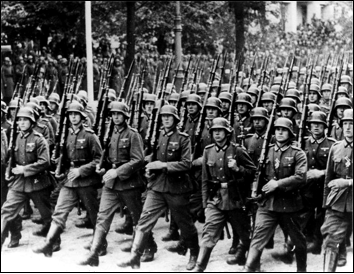
Blitzkrieg [“Lightening War”], 1939
2. Again neutrality was the initial American response to the outbreak of war in Europe. But the bombing of Pearl Harbor naval base in Hawaii by the Japanese in December 1941 brought the United States into the war, first against Japan and then against its allies, Germany and Italy.
The Cause of the War
3. The source of the war in Europe came from Germany. The country had not been destroyed completely and the German people were very unhappy with the unfair Treaty of Versailles. Thus, they kept demanding that it be revised. And it was indeed revised a little during the 1920s. But the world-wide depression caused the failure of the democratic German government.
4. Consequently, a new German nationalist movement arose, led by Adolf Hitler and the Nazi (National Socialist) Party. Hitler was a fascist dictator. He conceived a scheme in which Germany would conquer all of Europe and the world. He advocated that the Germanic race was superior and the Jews and the Slavic people were inferior. He looked on them as the enemies of Germany, and took whatever means necessary to wipe them out of the earth.
5. Hitler and the Nazis broke the Treaty of Versailles when they began to reorganize the German war industry. They also developed a highly efficient army trained in blitzkrieg, a type of a military maneuver.
6. Japan, the fascist nation in Asia, launched war on China in 1931. And within a very short time, Japan occupied the Northeast of China. On July 7th, 1937, Japan began an all-out attack on China, Then Japan joined together with the Axis powers, Germany and Italy. Finally on December 7th 1941, Japan's planes from carriers at sea made a swift and sudden raid on the United States' naval base at Pearl Harbor. Submarines also participated in the “sneak attack”. This attack gave a heavy blow to the United States navy. The incident of the attack on Pearl Harbor shook the whole country of the United States. The next day heard a short address by President Roosevelt, and Congress declared war on Japan. Then the whole world was drawn into the war.
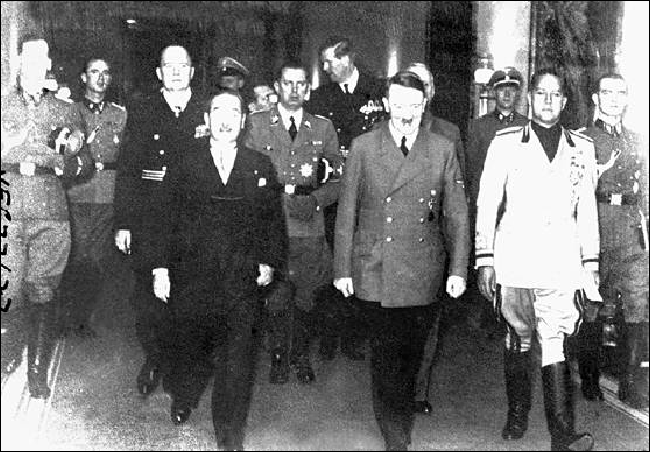
Rome-Berlin-Tokyo Axis, 1940
Progress of the War
7. In 1939, Germany launched a lightning attack on Poland, and both England and France then declared war on Germany for Poland was an ally of the two countries. Throughout the winter, however, the British and French armies remained immobile. So Germany went on invading Denmark, Norway, the Netherlands, Belgium and Luxemburg. Then in June 1940, Germany attacked France, and Italy declared war in support of Germany.
8. Britain, under the leadership of Winston Churchill, defeated Germany's attempt to destroy its air force and air defenses in the Battle of Britain and escaped invasion. Then Germany began to look eastward towards the Soviet Union. In June, 1941, Nazi forces made an overall sudden attack upon the Soviet Union. The Soviet army and people, headed by Stalin, rose to resist. Neither side could thoroughly defeat the other until the decisive Battle of Stalingrad in 1943, which marked the turning point of the Second World War.

9. After the Pacific War broke out, there were two war arenas in the world. One was the European arena; the other was the Pacific arena. In the European arena, the war on land was proceeding on mainly between Germany and the Soviet Union, together with the African arena. While in the Pacific arena, the war went on between Japan and the U.S. A., Britain, China and some other countries. The Japanese captured a large part of China and rapidly overran the Philippines, Hong Kong, Malaya, Singapore, Burma, Indonesia and many of the British islands. It was not until June 1942 that their advance was checked when the main force of the Japanese United Fleet was destroyed in the Midway Island Battle, which was the turning point of the Pacific War.
10. After the Battle of Midway Island and the Battle of Stalingrad, the armies of the Allies began their large offensive operations. At last, the Nazi troops began to be driven back. The British attacked the Germans in North Africa. The Chinese, French and the people in other occupied countries carried on active guerilla warfare against the enemy. The Americans began to take the offensive in the Pacific. The Russians, after having liberated their own territory, pursued the Germans across Eastern Europe. In 1944, the second European battlefield was opened. The Allied armies of Britain and the U.S. landed on the beaches of Normandy. Then the Allied armies began to move across France and into Germany. The Soviet counter-offensive was under way, thus the German troops were caught in a pincer movement(钳制运动) from both East and West. On May 8th, Germany surrendered. Hitler and some members of his government committed suicide.
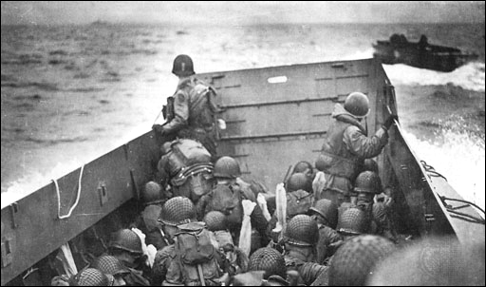
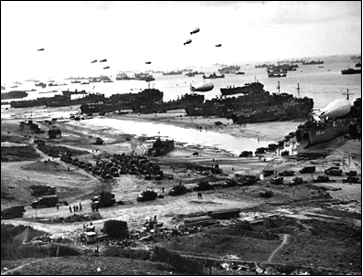
Normandy Landing (June 6, 1944)
11. The Japanese, however, still fought, refusing to surrender. On August 6th and 9th, 1945, the U.S. dropped two atom bombs on the cities of Hiroshima and Nagasaki, killing over 200,000 Japanese people. On August 8th in the same year, the Soviet Union declared war on Japan. More than one million Soviet troops entered the Northeast of China by four routes, destroying the main force of the Japanese army there, while all the Chinese armed forces began an all-out counter attack. Japan had to surrender unconditionally on August 14th, 1945. The Second World War thus came to an end.
Aftermath of the War
12. World War II was very destructive. It claimed more than 36 million lives. It killed more people, cost more money, damaged more property, affected more people, and caused more far-reaching changes in nearly every country than any other war in history. More than 50 countries took part in the war, and the whole world felt its effects. Men fought in almost every part of the world, on every continent except Antarctica. Chief battlegrounds included Asia, Europe, North Africa, the Atlantic and Pacific oceans, and the Mediterranean Sea.
13. The number of people killed, wounded, or missing between September 1939 and September 1945 can never be calculated, but it is estimated that more than 55 million people perished. Eastern Europe and East Asia suffered the heaviest losses.
14. World War II was the most expensive war in history. It has been estimated that the cost of the war totaled between $1 and $2 trillion, and the property damage amounted to more than $239 billion.
15. The Allies were determined not to repeat the mistakes of World War I, in which Allies had failed to set up an organization to enforce the peace until after World War I ended. In June 1941, nine European
governments-in-exile joined with Great Britain and the Commonwealth countries in signing the Inter-Allied Declaration, which called for nations to cooperate and work for lasting peace. In 1944, an idea emerged to create a postwar international organization. As the war was nearing its end, on April 25, 1945, representatives of 50 nations met at San Francisco to erect the framework for the United Nations and to draft its constitution. China was granted membership of the Security Council as one of the five permanent member states.
16. The conferences attended by the United States and the Soviet Union to solve the postwar issues at the close of World War II ended on an apparent note of harmony. Beneath the surface, however, the bitter antagonism of the Cold War was already festering(愈益恶化). The United States and the Soviet Union, each distrustful of the other, were preparing for a long and bitter confrontation. A cold war between the two major world powers ensued(接着发生) right after the end of World War II.
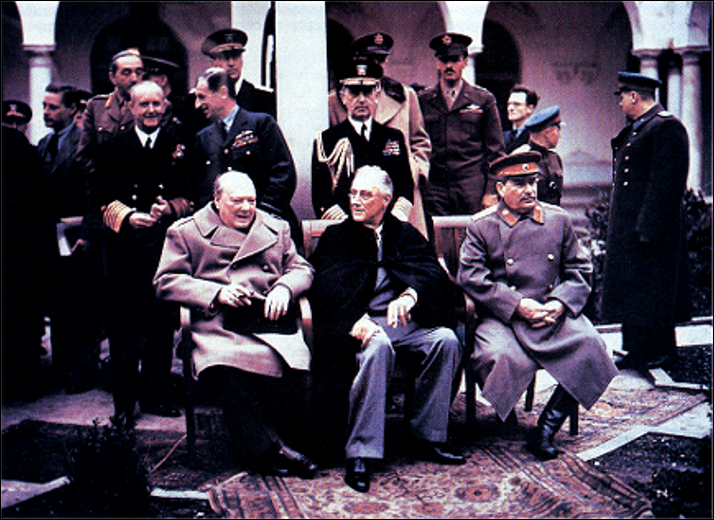
The “Big Three” ——
Winston Churchill, Franklin Roosevelt, Joseph Stalin
After You Read
Knowledge Focus
1. Pair Work: Discuss the following questions with your partner.
(1) How did the U.S. respond to the outbreak of World War II?
(2) What was the major cause of World War II?
(3) What do you know about the attack on Pearl Harbor?
(4) What countries were invaded by Germany by 1940?
(5) How did Britain escape the invasion by Germany?
(6) What was the turning point of the Second World War?
(7) What do you know about the two war arenas in the world after the
Pacific War broke out?
(8) What caused the surrender of Germany on May 8th, 1945?
(9) How did the Second World War come to an end?
(10) What lessons do you think we should learn from this war?
2. Solo Work : Tell whether the following are true or false according to
the knowledge you have learned. Consider why.
(1) Germany's invasion of Poland without a declaration preluded the
World War II. ( )
(2) It took a long time for Germany to conquer Poland though lots of new
techniques of mechanized and air warfare used. ( )
(3) The America's initial response to the outbreak of war in Europe was
neutrality. But after the bombing of the Pearl Harbor, their attitude
changed. ( )
(4) In June, 1941, Nazi forces made an overall sudden attack upon France
and Italy. ( )
(5) There were all together two war arenas in the world. One was the
Pacific arenas, and the other was the African arenas. ( )
(6) After Germany surrendered, Japanese still refused to surrender until
August 6th and 9th, 1945. ( )
(7) The whole world can feel the effects of World War II, and men fought
on every continent. ( )
(8) Europe and Asia suffered the heaviest losses during World War I. ( )
(9) The effect of the Inter-Allied Declaration was to call for nations to
cooperate and work for lasting peace. ( )
(10) The United States and the Soviet Union attended conferences to
solve the postwar issues at the close of World War II. ( )
3. Finish the multiple-choice questions based on what you have read in
Text A.
(1) Which of the following was NOT the cause of the war?
A. German people did not agree with the unfair Treaty of Versailles.
B. A new German nationalist movement arose.
C. Japan launched war in China and raid on the United States',naval
base at Pearl Harbor.
D. America adopted neutrality attitude towards the war.
(2) Which of the following countries escaped the invasion of Germany?
A. Denmark B. France C. Belgium D. Britain
(3) The turning point of the Pacific War was
A. The Japanese United Fleet was destroyed in the Midway Island
Battle.
B. The Japanese captured a late part of China and rapidly overran the
Philippines, and other countries.
C. The Nazi troops began to be driven back.
D. The Chinese, the French and the people in other occupied
countries carried on active guerilla warfare against their enemy.
(4) Which is NOT the immediate cause of Japanese surrender?
A. U.S. dropped two atom bombs on the cities of Hiroshima and
Nagasaki.
B. Soviet Union declared war on Japan.
C. All the Chinese armed forces began an all-out counter attack.
D. Germany defeated France.
Language Focus
1. Fill in the blanks with the following words or expressions from the
text.
perish under way confrontation enforce surrender
distrustful offensive emerge far-reaching decisive
(1)A national announcement has been made to _______ military
discipline.
(2) He was convicted of carrying a (n) _________ weapon and got a
28-day suspended sentence and £200 fine.
(3) Plans are well ________ for a new shopping centre.
(4) The inspector made ________ remarks after listening to the
official's report.
(5) However well you try to equip yourself, qualifications are unlikely
to be the ________ factor.
(6) Poor countries fear that _________ will upset their relations with
the West.
(7) The court's decision will have _________ implications for the
health care industry.
(8) Everyone aboard the ship _________ when it sank off the coast of
Maine.
(9) All three gunmen ___________ by the end of the day.
(10) At the airport, people stood behind a metal fence, waiting for
passengers to ________ from customs.
2. Find the appropriate prepositions or adverbs that collocate with the
neighboring words.
(1) The bombing of Pearl Harbor naval base __________ Hawaii by the
Japanese in December 1941 brought the United States into the war,
first _______ Japan and then against its allies, Germany and Italy.
(2) The country had not been destroyed completely and the German people
were very unhappy ________ the unfair Treaty of Versailles.
(3) He looked on them as the enemies of Germany, and took whatever
means necessary to wipe them ___________.
(4) The war on land was proceeding __________ mainly between
Germany and the Soviet Union, together with the African arena.
(5) The Chinese, the French and the people in other occupied countries
carried _________ active guerilla warfare _________ the enemy.
(6) The Allied armies began to move _________ France and into
Germany at the end of World War II.
(7) The United States and the Soviet Union, each distrustful _______ the
other, were preparing for a long and bitter confrontation.
(8) __________ the surface, the bitter antagonism of the Cold War was
already festering.
(9) Allies had failed to set _________ an organization to enforce the
peace until after World War I ended.
(10) The property damage amounted _________ more than $239
billion.
Comprehensive Work
Group Work
Was the dropping of the atomic bomb justified?
Supporters believe that the atomic bomb helped to end the war more quickly. They argue that, without the atomic bomb, the United States would have had to invade the home islands of Japan, resulting in hundreds of thousands of additional American and Japanese casualties. Opponents argue that Japan would have surrendered without the use of an atomic bomb on a civilian target. They say that Japan was a beaten nation in August of 1945 and was only looking for a way to surrender while preserving the role of their emperor.
You are expected to join one of four teams. Each team will research the decision to drop the bomb from a different perspective. These are the four perspectives: 1) a scientist involved with the Manhattan Project; 2) a senior civilian diplomatic/ political/ military advisor to President Truman; 3) a senior U. S. military leader; and 4) a Japanese survivor of the bombing.
You are supposed to write a short individual report to answer the question. The individual report is a short persuasive essay that must incorporate both pro and con arguments.
Solo Work
How was the world affected by World War II? Some say that wars are not simply destructive forces, and wars bring about advances in many fields. What's your opinion on wars? Write an essay of about 300 words to illustrate your point.

