
Unit 11 The Great Depression
No one can possibly have lived through the Great Depression without being scarred by it. No amount of experience since the depression can convince someone who has lived through it that the world is safe economically. - Isaac Asimov

Unit Goals
● To know the causes and consequences of the Great Depression.
● To understand Roosevelt's New Deal policies.
● To learn the impact of the Depression on society.
● To learn the useful words and expressions that describe the Great
Depression.
● To improve English language skills.
Before You Read
1. Would you rather have been a child during the 1920s or during the 1930s?
2. What's your impression of the Great Depression?
3. Form groups of three or four students. Try to find, on the Internet or in
the library, more information about Great Depression which
interests you most. Prepare a 5 - minute classroom presentation.
Start to Read
Text A The Great Depression in America
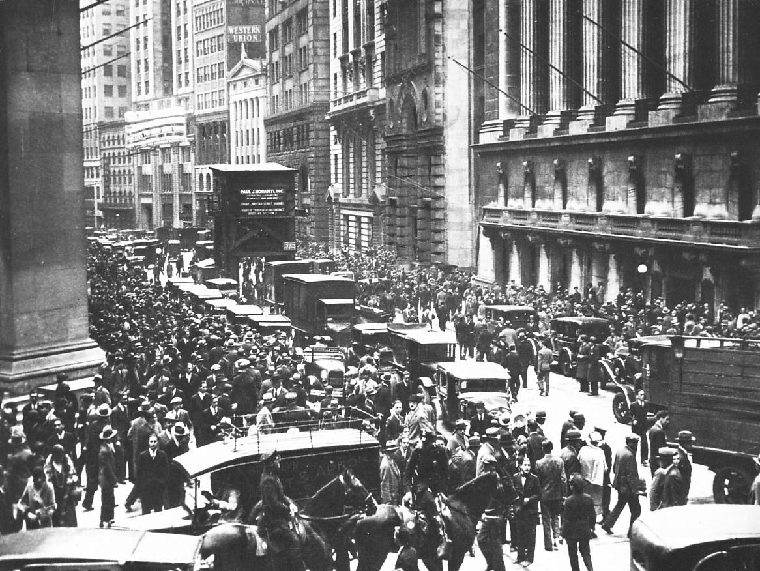
Black Tuesday
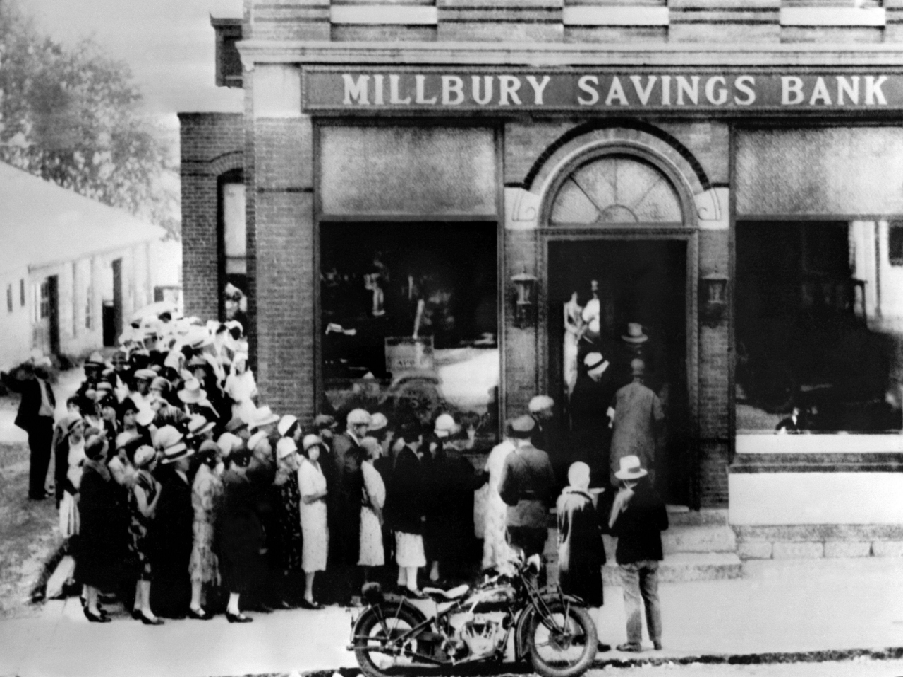
1. The Great Depression of 1929 was one of the worst time periods in American history. In October 1929, the booming stock market crashed, wiping out many investors. It aggravated(加剧) fragile economy in Europe that had relied heavily on American loans. Over the next three years, an initial American recession became part of a worldwide depression. Business houses closed their doors, factories shut down, banks failed with the loss of savings. Farm income fell some 50 percent. By November 1932, approximately one of every five American workers was unemployed.
2. The impact of the Depression would be felt on economic reform, family structures and employment structures within the United States. The New Deal introduced by President Franklin Roosevelt would play a significant role in United States history. Although President Roosevelt managed to bring forth an economic recovery to the Great Depression of 1929, there were flaws in the new policies that irritated business owners and prohibited substantial growth for the common worker.
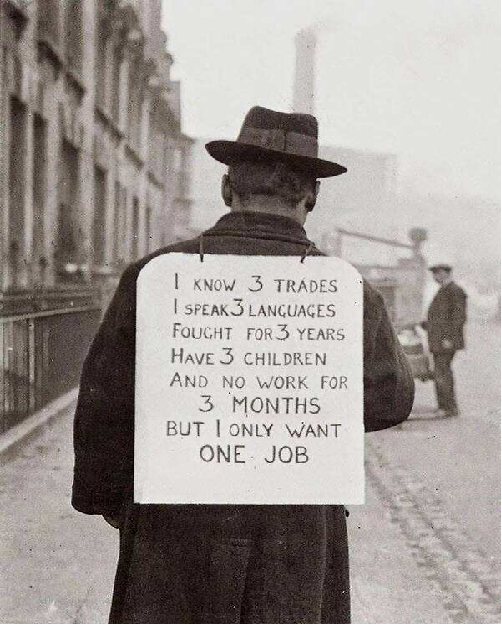
3. Economic and social hardship fell upon Americans like a dark blanket of total despair. Suddenly many workers were jobless in the market place. Companies had lower production demands and began to decrease wages to control financial burdens. As a result, there began a rise in child labor within the United States. Families were forced to rely on older children within the family to obtain jobs to help with the financial perils(危害). Jobs included “newspaper carrier, baby sitter and store clerk.” It is not surprising that the role of women changed within the family structure as they sought out employment to replace their husbands’ previous earnings. To maintain the household while the mother was out seeking employment required that “the eldest child generally had greater responsibility in the household.” Eventually the jobs for both women and children began to disappear, in the major cities as production demands were met and economic purchasing power declined. To handle financial hardships, families sent children to other cities in hopes of finding employment.
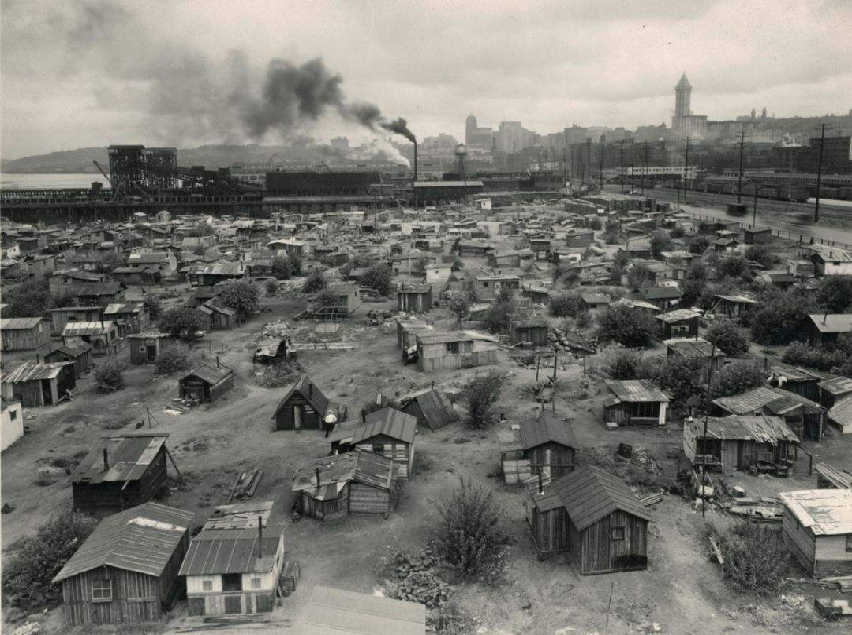
A Hooverville (a slum, shanty town)
胡佛村,贫民窟---因美国总统胡佛任期内发生经济大萧条,
失业者流落棚户区(shanty town)而得名
4. With the crisis of the 1929 Great Depression, President Roosevelt implemented(实施)a New Deal policy to reform the United States. The intention of the New Deal was to put the purchasing power back in the hands of the general laborer and to create new jobs for renewed stable economic growth within the United States.
5. In 1933 the new president, Franklin D. Roosevelt, brought an air of confidence and optimism that quickly organized the people to the banner of his program, known as the New Deal. “The only thing we have to fear is fear itself,” the president declared in his inaugural address to the nation.
6. In one sense, the New Deal merely introduced social and economic reforms familiar to many Europeans for more than a generation. Moreover, the New Deal represented a long-range trend toward abandoning “laissez-faire” capitalism, going back to the regulation of the railroads in the 1880s, and the flood of state and national reform legislation introduced in the Progressive era of Theodore Roosevelt and Woodrow Wilson.
7. What was truly novel about the New Deal, however, was the speed with which it accomplished what previously had taken generations. Many of its reforms were hastily succeeded in restoring prosperity. Yet its actions provided help for millions of Americans, laid the basis for a powerful new political coalition(联盟), and brought to the individual citizen a sharp revival of interest in government.
8. Roosevelt’s New Deal policies were a short-term fix to the economic problems that faced both businesses and workers. A major trend emerged from the New Deal policies that manufacturers were forced to develop and use new technologies. The birth of a technological society resulted in less dependence on manual labor. “Thus when production levels were maintained or improved, workers suffered technological unemployment.”
9. On the surface, it appeared that Roosevelt’s New Deal was having a significant impact on restoring the economy and increasing production needs and consumption of products. As time progressed, Roosevelt was challenged because the “New Deal’s failure to end the Depression or significantly reduce unemployment.”
10. The Great Depression of 1929 was a major turning point within United States history. Some believe the Great Depression was strictly the result of the stock market crash in 1929 while others believe that under-consumption led to the fall of the economy during the time period. Out of the Great Depression rose a new attitude among youth who were forced to join the labor force and even migrate to other communities to assist in financially supporting their families. Eventually, through the New Deal policies manufacturers developed new technologies to depend less upon the manual labor and the labor force requirements greatly changed. Even though the New Deal reform policies was originally established to rebuild the working force and lessen financial burdens on the common laborer, President Roosevelt had not anticipated the resistance that he faced by business. Unfortunately, the negative effects of the depression would continue to be felt by Americans until the emergence of World War II.

