
Unit 6
The Civil War
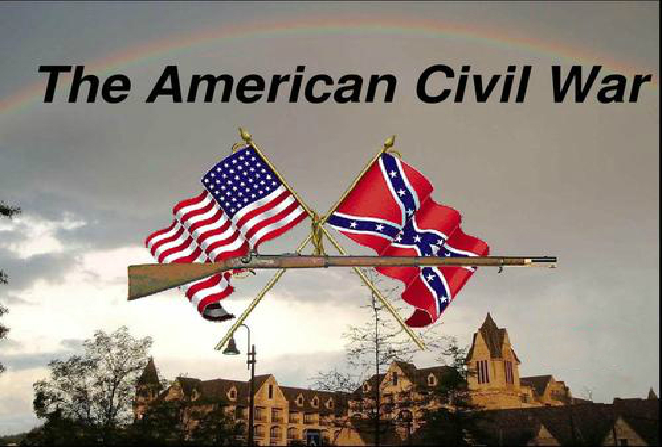
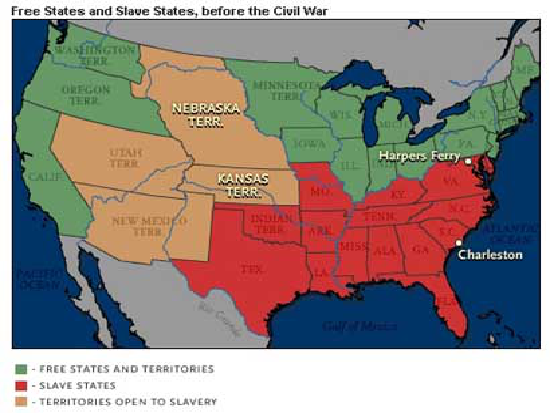
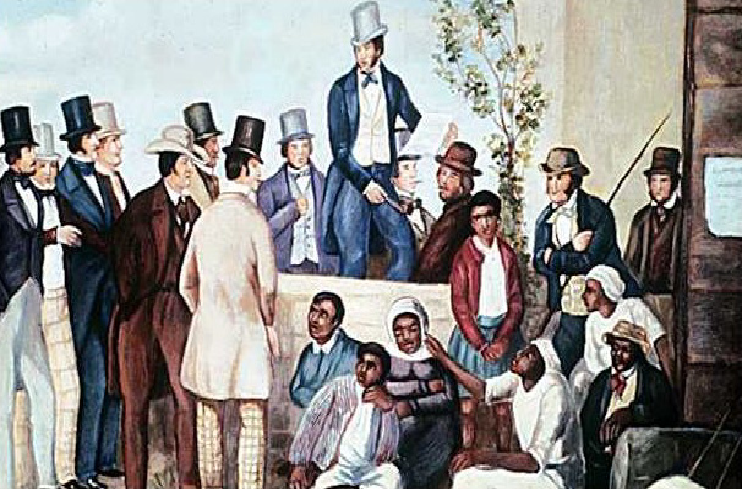
…that this nation, under God, shall have a new birth of freedom; and that government of the people, by the people, for the people, shall not perish from the earth.
--The Gettysburg Address
Unit Goals
● To understand the causes of the Civil War.
● To know the significance of the Civil War.
● To be familiar with Lincoln and his key role in the Civil War.
● To learn the useful words and expressions that describe the Civil War.
● To improve English language skills.
Before You Read
1. Do you know the 16th president of the U.S.A? Share what you know about Abraham Lincoln with your classmates.
2. Compare the South and the North of the United States before the Civil War.
the South the North
3. What do “freedom” and “equality" mean? Do they have one unchanging meaning over time, or do they change over time?
4. Form groups of three or four students. Try to find, on the Internet or in the library, more information about the Civil War which interests you most. Prepare a 5-minute classroom presentation.
Start to read
Text A Causes of the Civil War
1. The American Civil War is sometimes called the War Between the States, the War of Rebellion, or the War for Southern Independence. It began on April 12, 1861, when Confederate General opened fire on Fort Sumter, South Carolina, and lasted until May 26, 1865, when the last Confederate army surrendered. The war took more than 600,000 lives, destroyed property valued at $5 billion, brought freedom to 4 million black slaves, and opened wounds that have not yet completely healed more than 125 years later.
2. The chief and immediate cause of the war was slavery. Southern states, including the 11 states that formed the Confederacy, depended on slavery to support their economy. Southerners used slave labor to produce crops, especially cotton. Although slavery was illegal in the Northern states, only a small proportion of Northerners actively opposed it. The main debate between the North and the South on the eve of the war was whether slavery should be permitted in the Western territories recently acquired during the Mexican War (1846-1848), including New Mexico, part of California, and Utah. Opponents of slavery were concerned about its expansion, in part because they did not want to compete against slave labor.
Economic and Social Factors
3. By 1860, the North and the South had developed into two very different regions. Divergent social, economic, and political points of view, dating from colonial times, gradually drove the two sections farther and farther apart. Each tried to impose its point of view on the country as a whole. Although compromises had kept the Union together for many years, the situation was explosive in 1860. The election of Abraham Lincoln as president was viewed by the South as a threat to slavery and ignited the war.
4. During the first half of the 19th century, economic differences between the regions also increased. By 1860, cotton was the chief crop of the South, and it represented 57 percent of all U.S. exports. The profitability of cotton, known as King Cotton, completed the South’s dependence on the plantation system and its essential component, slavery.
5. The North was by then firmly established as an industrial society. Labor was needed, but not slave labor. Immigration was encouraged. Immigrants from Europe worked in factories, built the railroads of the North, and settled the West. Very few settled in the South.
6. The South, resisting industrialization, manufactured little. Almost all manufactured goods had to be imported. Southerners, therefore, opposed high tariffs, or taxes that were placed on imported goods and increased the price of manufactured articles. The manufacturing economy of the North, on the other hand, demanded high tariffs to protect its own products from cheap foreign competition.
7. The expanding Northwest Territory, which was made up of the present-day states of Ohio, Indiana, Illinois, Michigan, Wisconsin, and part of Minnesota, was far from the markets for its grain and cattle. It needed such internal improvements for survival, and so supported the Northeast’s demands for high tariffs. In return, the Northeast supported most federally financed improvements in the Northwest Territory.
8. As a result, the West allied itself with the Northern, rather than the Southern, point of view although both the South and the West were agricultural. Economic needs sharpened sectional differences, adding to the interregional hostility.
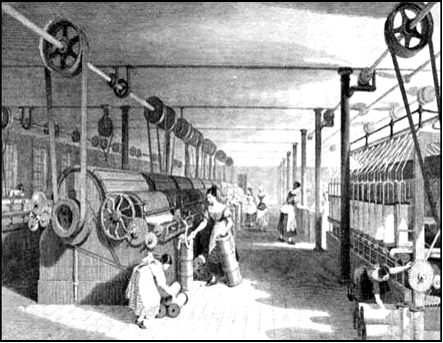
Northern capitalist Industrial and Commercial economy

Southern plantation slavery economy
Political Factors
9. In the early days of the United States, loyalty to one’s state often took precedence over loyalty to one’s country. A New Yorker or a Virginian would refer to his state as “my country”. The Union was considered a “voluntary compact” entered into by independent, sovereign states for as long as it served their purpose to be so joined. In the nation’s early years, neither North nor South had any strong sense of the permanence of the Union. New England, for example, once thought of seceding, or leaving the Union, because the War of 1812 cut off trade with England.
10. As Northern and Southern patterns of living diverged, their political ideas also developed marked differences. The North needed a central government to build an infrastructure of roads and railways, protect its complex trading and financial interests, and control the national currency. The South depended much less on the federal government than did other regions, and Southerners, therefore, felt no need to strengthen it. In addition, Southern patriots feared that a strong central government might interfere with slavery.

