
Multiple-Choice Questions
Directions: In this part, you will discover some unsual things about the history of Thanksgiving, and you can take a little quiz to find out how you know. Take the quiz first and then read about the history of Thanksgiving to find out the answers you missed.
1.When did the Pilgrims have their first Thanksgiving Feast?
A. In 1619 B. In 1620
C. In 1621 D. In 1935
2.What food was probably NOT on the Pilgrims' Thanksgiving menu?
A. Potatoes B. Corn
C. Fish D. Dried Fruit
3.The Horn of Plenty or Cornucopia symbolizes abundance. In what country did it originate?
A. Holland B. Greece
C. America D. Turkey
4. During which month was a day of Thanksgiving proclaimed in 1676?
A. May B. June
C. October D. November
5. Which president did not like the idea of having a national Thanksgiving Day?
A. Washington B. Nixon
C. Truman D. Jefferson
6. Who is credited with leading the crusade in establishing Thanksgiving Day?
A. Sarah Jessica Parker B. Sarah Lee
C. Sarah Josepha Hale D. Sarah Ferguson
7. Which president first established the date of Thanksgiving as a national celebration?
A. Jefferson B. Adams
C. Lincoln D. Wilson
8. Which president moved the date of Thanksgiving twice?
A. Lincoln B. T. Roosevelt
C. F. D. Roosevelt D. Eisenhower
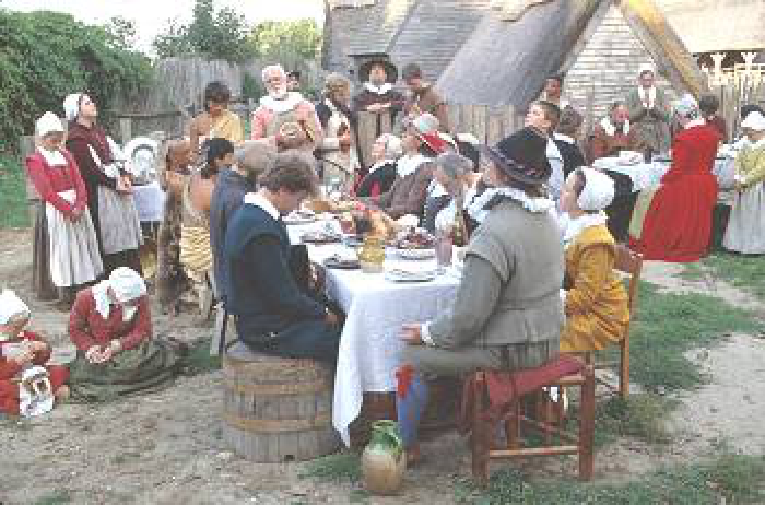
1. The Pilgrims who sailed to this country aboard the Mayflower were originally members of the English Separatist (a Puritan sect). They had earlier fled their home in England and sailed to Holland (The Netherlands) to escape religious persecution. There, they enjoyed more religious tolerance, but they eventually became disenchanted(不再抱幻想的) with the Dutch way of life, thinking it ungodly. Seeking a better life, the Separatists negotiated with a London stock company to finance a pilgrimage(朝圣之旅)to America.
2. The Pilgrims set ground at Plymouth Rock on December 11, 1620. Their first winter was devastating. At the beginning of the following fall, they had lost 46 of the original 102 who sailed on the Mayflower. But the harvest of 1621 was a bountiful(慷慨的) one. And the remaining colonists decided to celebrate with a feast—including 91 Indians who had helped the Pilgrims survive their first year. It is believed that the Pilgrims would not have made it through the year without the help of the natives. The feast was more of a traditional English harvest festival than a true “thanksgiving” observance(宗教仪式). It lasted three days.
3. It is not certain that wild turkey was part of their feast. However, it is certain that they had venison(鹿肉). The term “turkey” was used by the Pilgrims to mean any sort of wild fowl.
4. Another modern staple(主食) at almost every Thanksgiving table is pumpkin pie. But it is unlikely that the first feast included that treat. The supply of flour had been long diminished, so there was no bread or pastries(面粉糕饼) of any kind. However, they did eat boiled pumpkin, and they produced a type of fried bread from their corn crop. There was also no milk, cider(苹果酒), potatoes, or butter. There was no domestic cattle for dairy products, and the newly-discovered potato was still considered by many Europeans to be poisonous. But the feast did include fish, berries, lobster, dried fruit, clams(蛤蜊), venison, and plums.
5. This “thanksgiving” feast was not repeated the following year. But in 1623, during a severe drought, the pilgrims gathered in a prayer service, praying for rain. When a long, steady rain followed the very next day, Governor Bradford proclaimed another day of Thanksgiving, again inviting their Indian friends. It wasn’t until June of 1676 that another Day of Thanksgiving was proclaimed.
6. On June 20, 1676, the governing council of Charlestown, Massachusetts, held a meeting to determine how best to express thanks for the good fortune that had seen their community securely established. By unanimous(一致的) vote they instructed Edward Rawson, the clerk, to proclaim June 29 as a day of thanksgiving. It is notable that this thanksgiving celebration probably did not include the Indians. October of 1777 marked the first time that all 13 colonies joined in a thanksgiving celebration. It also commemorated the patriotic victory over the British at Saratoga. But it was a one-time affair.
7. George Washington proclaimed a National Day of Thanksgiving in 1789, although some were opposed to it. There was discord(不一致) among the colonies, many feeling the hardships of a few Pilgrims did not warrant(有必要成为) a national holiday. And later, President Thomas Jefferson scoffed(讥讽) at the idea of having a day of thanksgiving.
8. It was Sarah Josepha Hale, a magazine editor, whose efforts eventually led to what we recognize as Thanksgiving. Hale wrote many editorials(社论) championing(为......而斗争) her cause in her Boston Ladies’ Magazine, and later, in Godey’s Lady’s Book. Finally, after a 40-year campaign of writing editorials and letters to governors and presidents, Hale’s obsession(痴迷) became a reality when, in 1863, President Lincoln proclaimed the last Thursday in November as a national day of Thanksgiving.
9. Thanksgiving was proclaimed by every president after Lincoln. The date was changed a couple of times, most recently by Franklin Roosevelt, who set it one week to the next-to-last Thursday in order to create a longer Christmas shopping season. Public uproar(怨愤) against this decision caused the president to move Thanksgiving back to its original date two years later. And in 1941, Thanksgiving was finally sanctioned(批准) by Congress as a legal holiday, as the fourth Thursday in November.
Proper Names
Amerigo Vespucci 阿美利哥·韦斯浦奇(1454-1512 )
Christopher Columbus 克里斯托夫·哥伦布(1451-1506)
the Cornucopia 丰饶羊角
The Mayflower Compact 《五月花号公约》
the Protestants 新教徒
the Puritans 清教徒
the Reformation 宗教改革
Notes
1. Amerigo Vespucci: He was an Italian explorer who claimed to have
explored what is now the American mainland in 1497 and believed that he
had reached a “New World”. Since he was the first person to refer to the
lands he had visited as a “New World”, a German geographer suggested
in 1507 that the land should be named “America”.
2. Christopher Columbus: He was an Italian explorer in the service of Spain.
Columbus was determined that the earth was round and attempted to
reach Asia by sailing west from Europe, thereby discovering America. When
he finally arrived at the land in October, 1492, he believed that he arrived in
the Far East, a part of Asia known as “Indies”. So he gave the natives a
name “Indians”. He made three subsequent voyages to the Caribbean in
his quest for a sea route to China.
3. The cornucopia (Cornu Copiae): It means, literally, the horn of plenty. The
cornucopia is a goat’s horn overflowing with fruit, flowers and grain,
signifying prosperity. The word has its origin in Greek mythology. When
Zeus was playing with the goat Amalthea he accidentally broke off one of
her horns.To make up for this, Zeus promised Amalthea that the horn
would always be full of whatever fruits she desired. This became the
cornucopia of the Roman goddess Copia, the personification of plenty.
4. The Puritans: A group of English Protestants who advocated strict
religious discipline along with simplification of the ceremonies and creeds
of the Church of England in the 16th and 17th centuries.

