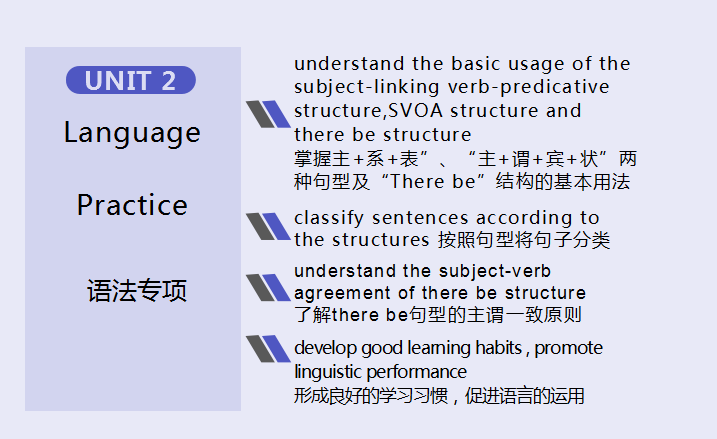
Grammar 语法内容

Subject-Link verb-Predicative Structure 主系表句型
主系表结构是指英语句子中的主要成分是主语、系动词和表语。主语是一句话的中心,系动词本身有一定的意义,不能单独使用,表语是用来修饰的。主系表结构的语义功能是对主语进行定义,描述主语的特征“是什么,怎么样”。
主语( Subject ):主语是一句话的中心,表示所说的是谁或是什么,其位置一般放在句首。
系动词,又称连系动词(Linking Verb),是用来辅助主语的动词。它本身有词义,但不能单独用作谓语,其后必须跟表语,构成系表结构说明主语的状况、性质、特征等情况。
表语( Predicative ):表语是用来修饰主语的,说明主语的身份、性质、品性、特征和状态的,表语位于系动词之后,与系动词联系十分紧密,有系动词就有表语,有表语就有系动词。
例句:Li Lei is a Chinese boy.
This flower is beautiful.
I am fine.
My hobby is reading
You look worried.
肯定句
| 主+系+表. Tom is in the office.
|
否定句
| 主+系+not+表. Tom is not in the office.
|
一般疑问句
| 系+主+表? Is Tom in the office?
|
特殊疑问句
| 疑问词+系+表? Who is in the office?
疑问词+系+主? Where is Tom?
|
SVOA Structure主谓宾状句型
1、S+V(主谓)
2、S+V+O(主谓宾)
3、S+V+P(主系表)
4、S+V+O+O(主谓间宾直宾)
5、S+V+O+C(主谓宾补)
SVOA不属于5大基本句型,而是属于其中的一种句型SVO的变化。
SVOA:subject(主语)+verb(动词作谓语)+object(宾语)+ adverbial(状语),其中状语通常由副词或介词短语构成。
例句: You can make an appointment with your smart phone.
Bill recovered from the cold very quickly.
There be 句型
There be 句型的构成形式一般为“There is/are + 某物/人 +某地/时”,表示某地/时有某物/人。其中,there 是一个引导词,没有具体实际词义,be是谓语动词,人或物才是这个句型的主语,属倒装结构,地点在句中作状语。
例如:
There are fifty-two students in our class.
There is a pencil in my pencil-case.
There was an old house by the river five years ago.
当动词be后所接的名词是单数可数名词或不可数名词时,be 应该取单数is(考虑句子时态);当其后所接的名词是复数的可数名词时,be用复数are(考虑句子时态)。
There's a man at the door.门口有个人。
There is some apple juice in the bottle.瓶子里有些苹果汁。
There are some strangers in the street.大街上有一些陌生人。
如果There be 后面是几个并列名词做补语时,动词be的形式和最靠近它的那个名词保持数的一致(就近原则)。
There is an orange and some bananas in the basket.
There are some bananas and an orange in the basket.
There be句型否定句式的构成和含有be动词的其它句型一样,在be后加上“not”。(名词)= not a\an\any + n.(名词)。注意: not a\an + n.(可数名词单数); not any + n.(可数名词复数);not any + n.(不可数名词)。例如:
There is an orange in her bag.
→There isn't an orange in her bag.
There are some oranges in her bag.
→There aren't any oranges in her bag.
There is some juice in the bottle.
→There isn't any juice in the bottle.
There be结构的一般疑问句变化只需把be动词移到句首,再在句尾加上问号即可。
例如:
There is some money in her handbag.
→ Is there any money in her handbag? (疑问句和否定句中,some改为any, something改为anything.)
There is something new in today's newspaper.
→There isn't anything new in today's newspaper.
→Is there anything new in today's newspaper?