英语课程与教学论-2023秋

曾必好,鲍秀梅,叶潇潇,高瑞阔,王京京

目录

  • 1 Course introduction
    • 1.1 Course introduction
    • 1.2 Your expectation
  • 2 Unit 1 language and language learning
    • 2.1 Course PPT
    • 2.2 Views of language
    • 2.3 Behaviorist theory- video checking
    • 2.4 Audiolingual method and cognitive method
    • 2.5 Constructivist theory and socio-contructivist theory
    • 2.6 What can make a good language teacher?
    • 2.7 Summary of Unit 1
    • 2.8 单元测验
  • 3 Unit 2 Communicative Principles and Task-based Language Teaching
    • 3.1 For preview and review: course PPT
    • 3.2 Communicative competence
    • 3.3 For autonomous study: principles of CLT and the teaching of language skills
    • 3.4 Communicative activities
    • 3.5 Task, exercise, exercise-task
    • 3.6 For review and consolidation: PPP and TBL
    • 3.7 Extra reading: about TBLT
    • 3.8 Summary of Unit 2
    • 3.9 单元测验
  • 4 Unit 3 The national English Curriculum
    • 4.1 For preview and review: Course PPT
    • 4.2 For autonomous study: 核心素养
    • 4.3 Extra reading: 新老课程标准对比解读
    • 4.4 Summary of Unit 3
    • 4.5 单元测验
  • 5 Unit 4 Lesson plan
    • 5.1 For review: course PPT
    • 5.2 For autonomous study: lesson plan
    • 5.3 For consolidation: sample lesson plans
    • 5.4 For extra reading: recommended book
    • 5.5 Summary of Unit 4
    • 5.6 单元测验
  • 6 Unit 5 Classroom management
    • 6.1 course PPT
    • 6.2 autonomous learning
    • 6.3 Students' presentation--- how to deal with errors
    • 6.4 Summary of Unit 5
    • 6.5 单元测验
  • 7 Unit 6 Teaching pronunciation
    • 7.1 course PPT
    • 7.2 Principles for teaching pronunciation
    • 7.3 Design tasks for teaching pronunciation
    • 7.4 Summary of Unit 6
    • 7.5 单元测验
  • 8 Unit 7 Teaching grammar
    • 8.1 course PPT
    • 8.2 Grammar presentation method
    • 8.3 Grammar practice
    • 8.4 Students' presentation-grammar mini lesson
    • 8.5 Summary of Unit 7
    • 8.6 单元测验
  • 9 Unit 8 Teaching vocabulary
    • 9.1 course PPT
    • 9.2 Teaching procedure of a vocabulary lesson
    • 9.3 Students' presentation of teaching vocabulary
    • 9.4 Summary of Unit 8
    • 9.5 单元测验
  • 10 Unit 9 Teaching listening
    • 10.1 course PPT
    • 10.2 Pre-learning: Introduction to listening
    • 10.3 Pre-learning: What do we listen to in everyday life?
    • 10.4 Pre-learning: Characteristics of the listening process
    • 10.5 Teaching procedures
    • 10.6 Summary of Unit 9
    • 10.7 单元测验
  • 11 Unit 10 Teaching speakIng
    • 11.1 course PPT
    • 11.2 characteristics of spoken language
    • 11.3 features of successful speaking activities
    • 11.4 Type of speaking activities
    • 11.5 课后讨论
    • 11.6 Summary of Unit 10
    • 11.7 单元测验
  • 12 Unit 11 Teaching reading
    • 12.1 course PPT
    • 12.2 Three models
    • 12.3 pre-reading activities
    • 12.4 while-reading and post-reading
    • 12.5 课后讨论
    • 12.6 Summary of Unit 11
    • 12.7 单元测验
  • 13 问卷调查
Task, exercise, exercise-task

Exercises, Exercise-tasks and Task

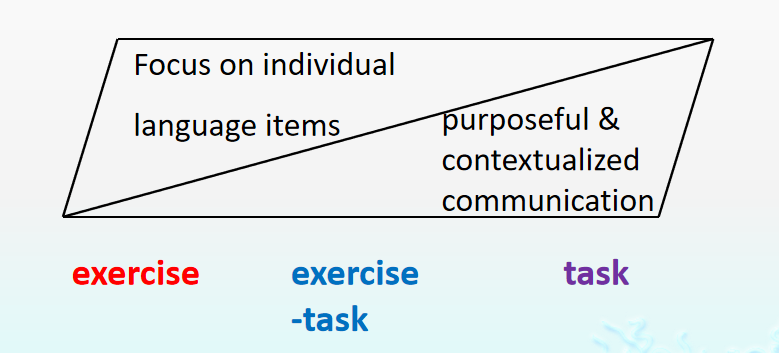

The figure may show the relationship between the three terms.

1. Exercise

Teachers wish to focus students' attention on individual aspects of language, such as vocabulary, grammar, or individual skills.

For example, "re-write the sentence by chaning the present tense into the past tense", "fill in the blanks with the appropriate form of given words", or some multiple choice questions focusing on specific language forms (grammar or vocabulary).

2. Task

Teachers wish to focus students' attention on the complete act of communication

For example, "students work in groups and then propose some suggestions for the school's newly-built playground (no language form restriction and students need to present their suggestions to the whole class in some way after discussion)"

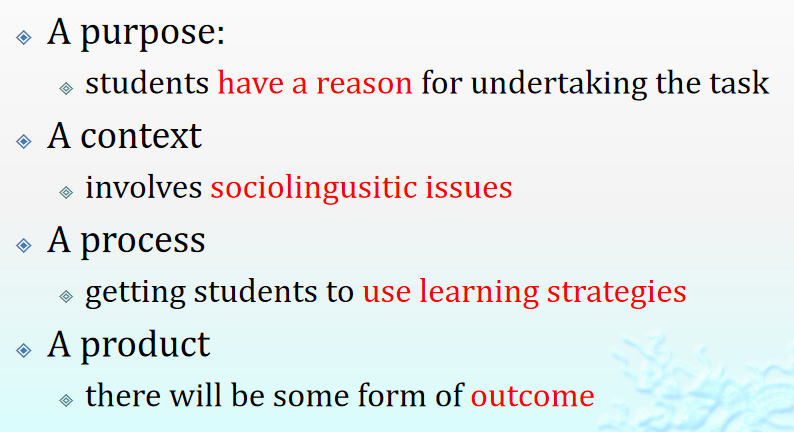
P.S: Think about the four components of a task:
3. Exercise-task

This kind of activity comes halfway between tasks and exercises. It consists of a contextualized practice of language items.

For example, "an activity helps the students to master the present continuous tense by getting them to describe what is happening in a pictures"