英语课程与教学论-2023秋

曾必好,鲍秀梅,叶潇潇,高瑞阔,王京京

目录

  • 1 Course introduction
    • 1.1 Course introduction
    • 1.2 Your expectation
  • 2 Unit 1 language and language learning
    • 2.1 Course PPT
    • 2.2 Views of language
    • 2.3 Behaviorist theory- video checking
    • 2.4 Audiolingual method and cognitive method
    • 2.5 Constructivist theory and socio-contructivist theory
    • 2.6 What can make a good language teacher?
    • 2.7 Summary of Unit 1
    • 2.8 单元测验
  • 3 Unit 2 Communicative Principles and Task-based Language Teaching
    • 3.1 For preview and review: course PPT
    • 3.2 Communicative competence
    • 3.3 For autonomous study: principles of CLT and the teaching of language skills
    • 3.4 Communicative activities
    • 3.5 Task, exercise, exercise-task
    • 3.6 For review and consolidation: PPP and TBL
    • 3.7 Extra reading: about TBLT
    • 3.8 Summary of Unit 2
    • 3.9 单元测验
  • 4 Unit 3 The national English Curriculum
    • 4.1 For preview and review: Course PPT
    • 4.2 For autonomous study: 核心素养
    • 4.3 Extra reading: 新老课程标准对比解读
    • 4.4 Summary of Unit 3
    • 4.5 单元测验
  • 5 Unit 4 Lesson plan
    • 5.1 For review: course PPT
    • 5.2 For autonomous study: lesson plan
    • 5.3 For consolidation: sample lesson plans
    • 5.4 For extra reading: recommended book
    • 5.5 Summary of Unit 4
    • 5.6 单元测验
  • 6 Unit 5 Classroom management
    • 6.1 course PPT
    • 6.2 autonomous learning
    • 6.3 Students' presentation--- how to deal with errors
    • 6.4 Summary of Unit 5
    • 6.5 单元测验
  • 7 Unit 6 Teaching pronunciation
    • 7.1 course PPT
    • 7.2 Principles for teaching pronunciation
    • 7.3 Design tasks for teaching pronunciation
    • 7.4 Summary of Unit 6
    • 7.5 单元测验
  • 8 Unit 7 Teaching grammar
    • 8.1 course PPT
    • 8.2 Grammar presentation method
    • 8.3 Grammar practice
    • 8.4 Students' presentation-grammar mini lesson
    • 8.5 Summary of Unit 7
    • 8.6 单元测验
  • 9 Unit 8 Teaching vocabulary
    • 9.1 course PPT
    • 9.2 Teaching procedure of a vocabulary lesson
    • 9.3 Students' presentation of teaching vocabulary
    • 9.4 Summary of Unit 8
    • 9.5 单元测验
  • 10 Unit 9 Teaching listening
    • 10.1 course PPT
    • 10.2 Pre-learning: Introduction to listening
    • 10.3 Pre-learning: What do we listen to in everyday life?
    • 10.4 Pre-learning: Characteristics of the listening process
    • 10.5 Teaching procedures
    • 10.6 Summary of Unit 9
    • 10.7 单元测验
  • 11 Unit 10 Teaching speakIng
    • 11.1 course PPT
    • 11.2 characteristics of spoken language
    • 11.3 features of successful speaking activities
    • 11.4 Type of speaking activities
    • 11.5 课后讨论
    • 11.6 Summary of Unit 10
    • 11.7 单元测验
  • 12 Unit 11 Teaching reading
    • 12.1 course PPT
    • 12.2 Three models
    • 12.3 pre-reading activities
    • 12.4 while-reading and post-reading
    • 12.5 课后讨论
    • 12.6 Summary of Unit 11
    • 12.7 单元测验
  • 13 问卷调查
Communicative competence

1. Why CLT?

The ultimate goal of foreign language teaching is to enable students to use the foreign language in work or life when necessary. However, we may find there are some differences between language used in real life and language learned under the traditional pedagogy:

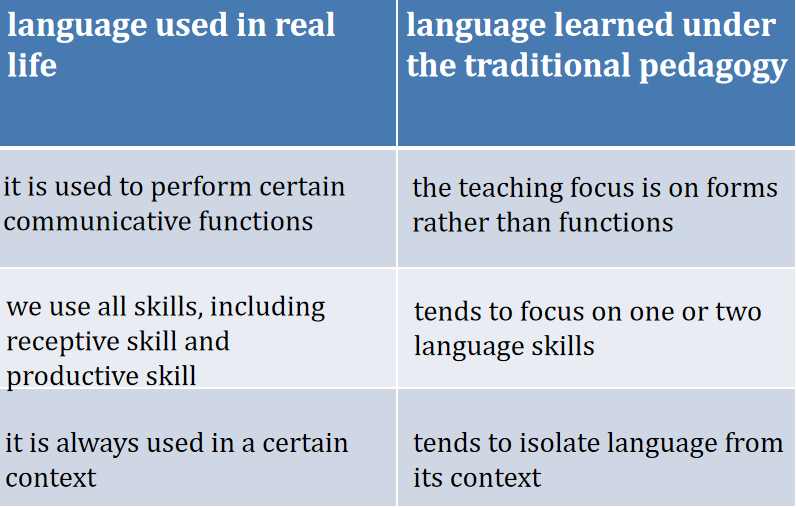
In order to bridge the gap between language used in real life and language learned under the traditional pedagogy, teachers are suggested to adopt the communicative language teaching.

2. Communicative competence

The goal of CLT is to develop students' communicative competence, including both the knowledge about the language and the knowledge about how to use the language appropriately in communicative situations.

Hedge discussed five components of communicative competence. They are linguistic competence, pragmatic competence, discourse competence, strategic competence and fluency.

  • Linguistic competence: it is concerned with knowledge of the language itself, its form and meaning. Linguistic competence is an integral part of communicative competence. It is wrong to think that communicative language teaching does not aim for high standard of linguistic correctness.

  • Pragmatic competence: it is concerned with the appropriate use of the language in social context. That is to say, the choice of vocabulary and structure (language forms) depends on the social context.

  • Discourse competence: it refers to one's ability to create coherent written text (in written language) or conversation (in spoken language) and the  ability to understand them. In other words, language learners should be able to effectively employ or comprehend the cohesive markers (first, second, at last, etc.) and reference words (it, they, that) in the context.

  • Strategic competence: it refers to communication strategies, one employs when there is communication breakdown  due to lack of resources. For example, using a similar phrase, gestures, a longer explanation.

  • Fluency: it means one's ability to 'link units of speech together with  facility and without strain or inappropriate slowness or undue hesitation'. Teaching learners lexical phrases or chunks of language can help learners produce the language more fluently, for the reason that lexical phrases or chunks can reduce processing difficulty in people's mind.

3. Implications

Importantly, you, as pre-service teachers are expected to make some implications for language teaching and learning based on your understanding of the five components. Here are some examples:
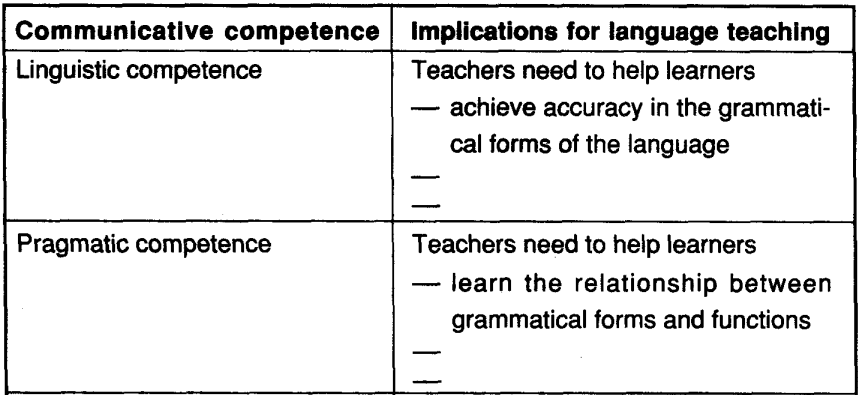

You can join the discussion below and make implications for language teaching especially from the perspective of a teacher: