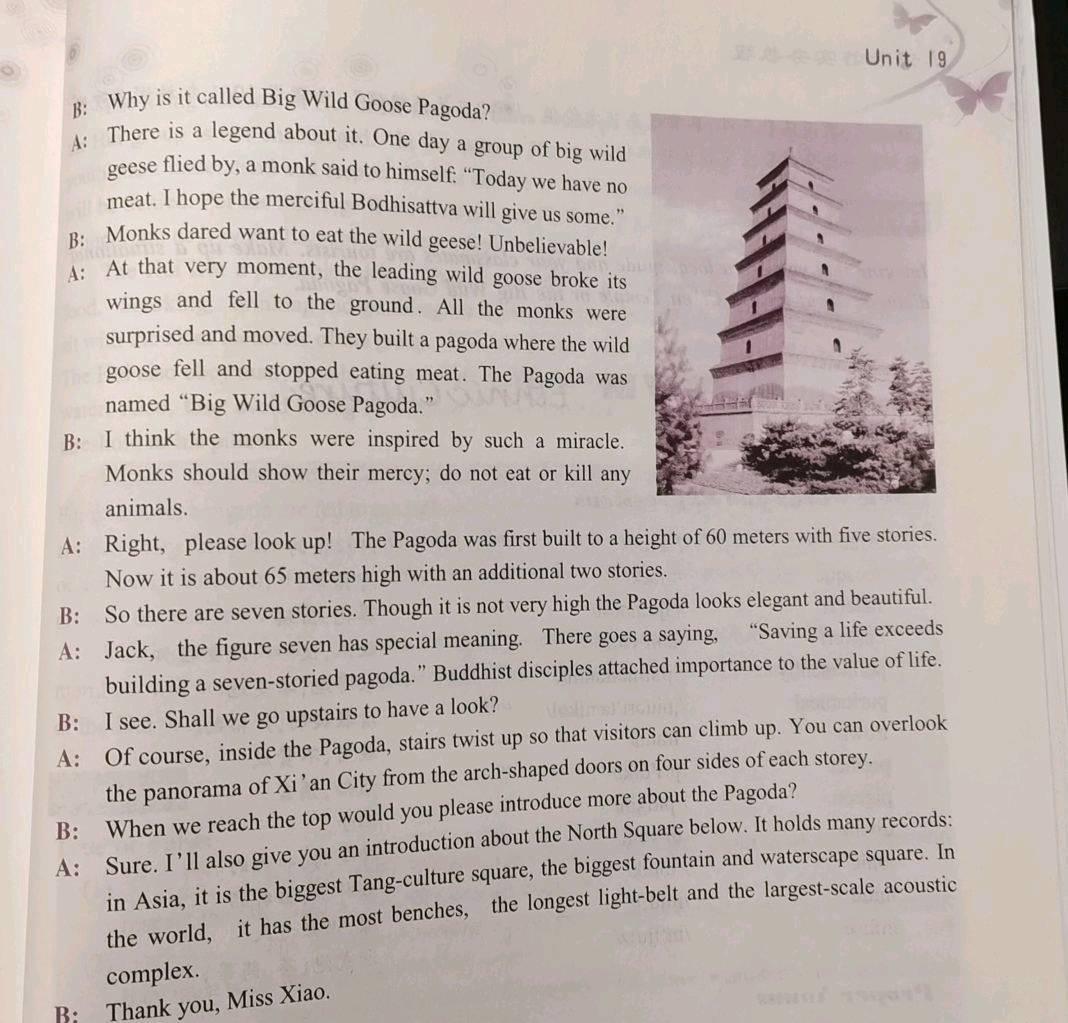
Located in Xi’an, Shaanxi Province, China, the Giant Wild Goose Pagoda, or Big Wild Goose Pagoda (大雁塔) is a five-story tall pagoda constructed during the Middle Ages.
The Giant Wild Goose PagodaThe Giant Wild Goose Pagoda
The pagoda sits in the Da Ci’en Temple complex. Originally built in 652 CE, during the reign of the Tang dynasty, rebuilt again in 704, and refurbished during the Ming Dynasty and in the 20th century. It holds sutras and Buddhist figurines.
Quick Facts
Entrance Fee: 50 CNY to enter to the Da Ci’en Termple Complex; 30 CNY to enter Giant Wild Goose Pagoda
Open Hours: 08:00-17:00 Every Day
Suggested Visiting Time: 2-4 Hours for the pagoda itself and the nearby attractions
Location: within the larger Da Ci’en Temple (大慈恩寺) complex, Yanta District, Xi’an
History: Who Built the Pagoda and Why?
Originally built in 652 CE by emperor Gaozong of the Tang Dynasty (617-907), the Big Wild Goose Pagoda was constructed to collect Buddhist works and relics brought from India by the scholar, monk, traveler, and translater Xuanzang (玄奘, 602-664).
A golden statue of XuanzangA golden statue of Xuanzang
Xuanzang travelled China collecting Buddhist sacred works. He became famous for his 17-year journey to India, and religious sites in what are now the countries of Nepal, Pakistan, and Bangladesh. He traveled these countries, collecting Buddhist scriptures and artifacts because he was concerned that the nature of Buddhism that had reached China was neither complete nor correctly interpreted. His journey became the influence for the famous Chinese story Journey to the West.
Presently, the Giant Wild Goose Pagoda holds sutras (Indian religious writings/aphorisms; the word sutra translates to “thread”) and Gautama Buddha figurines.
Construction and Reconstruction
The 60 meter (177 feet) tall Pagoda was typical of Chinese buildings in the Middle Ages: rammed earth with an exterior of stone brick.