目录

  • 1 课程资料
    • 1.1 教学大纲
    • 1.2 授课计划
    • 1.3 授课教案
    • 1.4 课件
  • 2 开学第一课
    • 2.1 Content 内容
  • 3 项目一 武汉二日游
    • 3.1 团前业务提升: Incidents while Escorting Tour Group
    • 3.2 团前业务提升2:Introduction  with a Focus on Key Events  突出重点法
    • 3.3 突出重点的几个方面
    • 3.4 突出重点的运用技巧及三孔景区导游讲解训练
    • 3.5 Day 1 Yellow Crane Tower
    • 3.6 Day 2 East Lake
  • 4 项目二 安徽二日游
    • 4.1 团前业务提升1:Documents and Luggage Lost
    • 4.2 团前业务提升2:Yi Culture
    • 4.3 Day 1 Tunxi Ancient Street
    • 4.4 Day 2 Tangyue Memorial Archways
  • 5 项目三 四川二日游
    • 5.1 团前业务提升:Suspense-Creating Introduction
    • 5.2 制造悬念法的场景运用技巧及三孔景区导游讲解训练
    • 5.3 Day 1 (morning) Wuhou Temple
    • 5.4 Day 1(afternoon) Sanxingdui Museum
    • 5.5 途中问题处理:Tourist Missing
    • 5.6 实训内容:三星堆博物馆
  • 6 项目四 山西二日游
    • 6.1 团前业务提升2:Qiang Culture
    • 6.2 团前业务提升1:Illness and Care
    • 6.3 Day 1 Rishengchang Exchange Shop
    • 6.4 Day 2 Wang'  s Compound
  • 7 项目五 重庆二日游
    • 7.1 团前业务提升1:First Aid
    • 7.2 First Aid
    • 7.3 团前业务提升2:Giving a Crucial Touch to the Picture
    • 7.4 画龙点睛法的运用技巧
    • 7.5 画龙点睛法的场景运用
    • 7.6 画龙点睛法的运用技巧及兖州兴隆文化园景区导游词讲解训练
    • 7.7 Day 1 Ciqikou
    • 7.8 Day 2 White Emperor City
    • 7.9 实训内容:白帝城
  • 8 项目六 三亚二日游
    • 8.1 团前业务提升:Traffic Accidents
    • 8.2 团前业务提升:Li Culture
    • 8.3 Day 1 Tianya Haijao
    • 8.4 Day 2 Yalong Bay
  • 9 项目七 山东二日游
    • 9.1 团前业务提升:Section-by-Section Introduction
    • 9.2 分段讲解法的运用技巧
    • 9.3 Day 1 Mount Taishan
    • 9.4 Day 2 Qufu
  • 10 项目八 西安一日游
    • 10.1 团前业务提升:Regulations
    • 10.2 Day 1 (morning) Da Ci en Temple
    • 10.3 Day 1(afternoon) Big Wild Goose Pagoda
  • 11 项目九 西藏之旅
    • 11.1 Tibet 资源
    • 11.2 团前业务提升1:Quitting Tour and Extending Travel Time
    • 11.3 团前业务提升2:Descriptive Introduction
    • 11.4 概述法的场景运用技巧
    • 11.5 团前业务提升3:Tibetan Culture
    • 11.6 Day 1 Lhasa - Potala Palace
  • 12 项目十 走进客家文化
    • 12.1 团前业务提升1:Complaints
    • 12.2 Handling Complaints
    • 12.3 团前业务提升2:Farewell Speech
    • 12.4 Farewell
    • 12.5 The Hakka Culture
    • 12.6 Farewell Speech 课本原文
    • 12.7 Wolong Nature Reserve
    • 12.8 引人入胜讲解方法
  • 13 英文讲解范例
    • 13.1 英文讲解
  • 14 讲解方法(复习上学期内容)
    • 14.1 制造悬念法(分段讲解法、设疑法、问答法)运用技巧
    • 14.2 突出重点法的运用技巧
    • 14.3 虚实结合法的运用技巧
    • 14.4 类比法的运用技巧
    • 14.5 导游词创作技巧
    • 14.6 问答法的场景运用技巧
    • 14.7 虚实结合法的使用方法
    • 14.8 虚实结合法的运用技巧及汶上宝相寺导游讲解训练
    • 14.9 类比法的使用方法
    • 14.10 类比法的运用技巧及学院天工园导游讲解训练
    • 14.11 常见旅游团团型特点
    • 14.12 自然风光类(风景名胜区)导游词讲解训练
    • 14.13 宗教类(佛教、道观)导游词撰写讲解训练
    • 14.14 建筑类(故宫、孔府、孔庙)导游词讲解训练
    • 14.15 非遗技艺技能类(山东非遗景点)导游词讲解训练
Day 1 (morning) Wuhou Temple

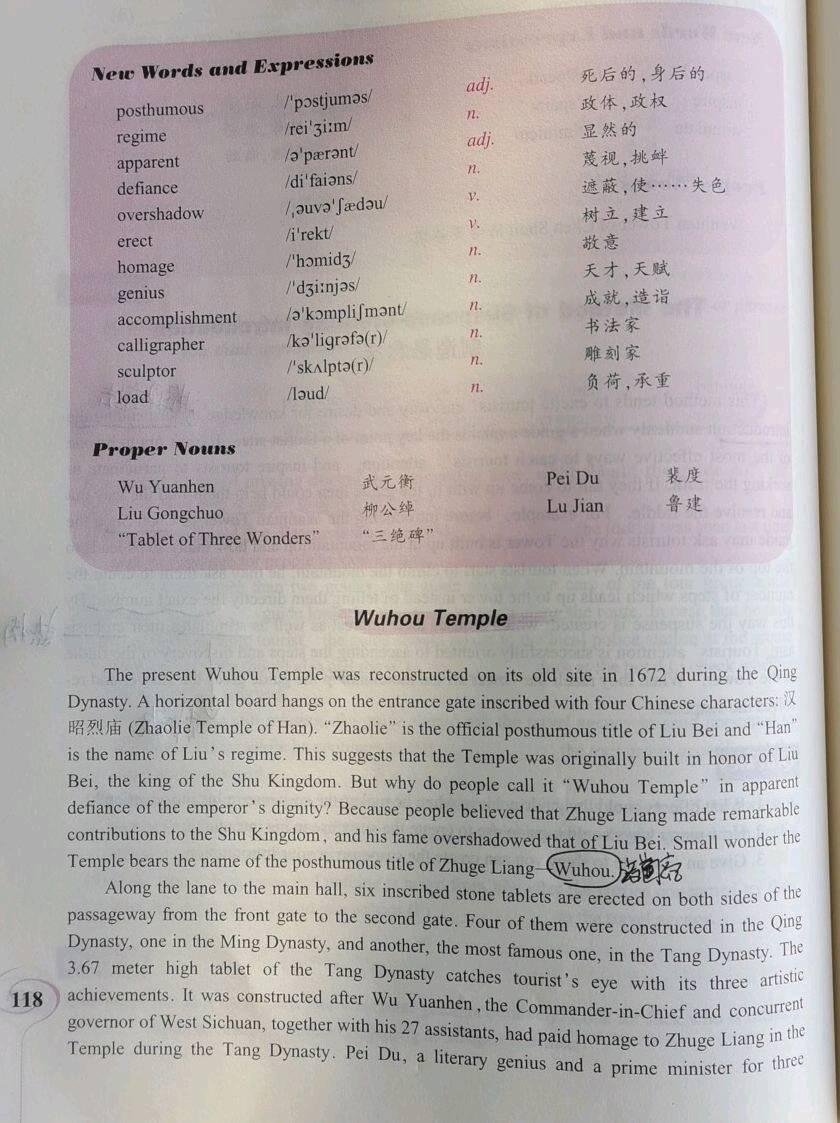
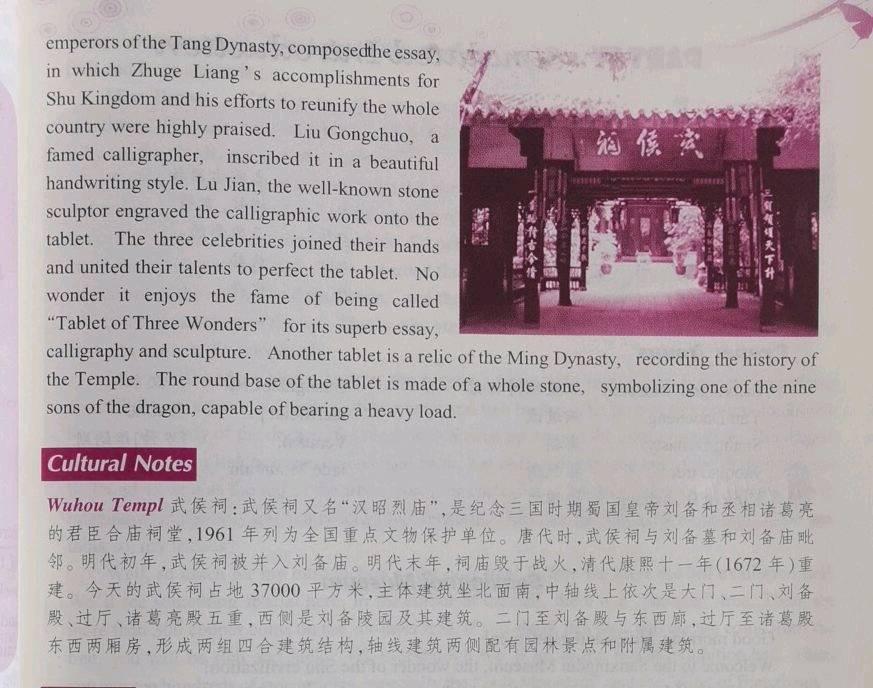
Wuhou Temple, also known as Wuhou Shrine Temple of Marquis, is dedicated to Zhuge Liang, the Marquis Wu (Wuhou) of the Kingdom of Shu in the Three Kingdoms Period (220 - 280). Zhuge Liang was an excellent politician, militarist, diplomat and astronomer. In addition, the Temple of Liu Bei, the emperor of Shuhan, and his mausoleum are well-known historical sites inside this big scenic spot. 


Wuhou Temple is located in the southwestern part of downtown Chengdu. The date of its establishment is unclear. We know only that it was built next to the Temple of Liu Bei. Consequently, the entrance plaque reads “Zhaolie Temple of Shuhan Kingdom”. Zhaolie is the posthumous title of Liu Bei. The current Wuhou Temple was rebuilt in 1672. 


武侯祠(汉昭烈庙),全国重点文物保护单位,国家AAAA级旅游景区,国家一级博物馆。


武侯祠(汉昭烈庙)位于四川省成都市武侯区,肇始于公元223年修建刘备惠陵时,它是中国唯一的一座君臣合祀祠庙和最负盛名的诸葛亮、刘备及蜀汉英雄纪念地,也是全国影响最大的三国遗迹博物馆。


1961年国务院公布武侯祠为首批全国重点文物保护单位,2008年评选为首批国家一级博物馆。成都武侯祠现占地15万平方米,由三国历史遗迹区(文物区)、西区(三国文化体验区)以及锦里民俗区(锦里)三部分组成,享有"三国圣地"的美誉。

【导游词片段】

Good evening, Ladies and gentlemen, it’s my great honor to be your local guide. Today, we are going to visit the Chengdu Wuhou Temple. before we get in I should give you some information about China’s history , which makes you have a better understanding about the temple. China experienced a lot of dynasties .But there is a period which is very famous .that is the Three kingdoms Period .Ok, ladies and gentlemen I will ask you a question first before telling you what happened in that period .Did you read a famous Chinese classic novel named the Romance of the Three Kingdoms? Maybe someone did but some didn’t . Actually , this book is about what happened at that time.