
韧皮部运输
中方课件
phloem transport.PPT(下载附件 3.45 MB)
Translocation
The solutes not only need to get into or out of cells, but they need to be moved from one area of a plant to another. We have already seen how water moves through the plant in the xylem: by transpiration! For soil mineral solutes, this is the pathway to get into the plant and up the xylem too. These solutes are dissolved in the water that we have seen passing through that pathway.
Organic solutes are translocated in phloem
No, indeed there must be ways for the solutes from photosynthesis and other biochemical pathways to depart from the leaf and go both down to the root and up to flowers, fruits, and apical meristems to provide fuel for respiration carried out in these non-photosynthetic areas. So leaves are the likely source of small organic molecules, and the rest of the plant organs are sinks for those molecules. The flow of these solutes then must be able to be both upward and downward in the plant. The solutes could be any of the subunits of the macromolecules; examples include sugars, amino acids, nucleotides, and fatty acids.
The flow of these organic molecules is called translocation and this process occurs mostly through the phloem. While phloem lies alongside the xylem in veins in leaves, vascular bundles in stems, and the vascular cylinder of roots, it is a completely different tissue conducting in different directions and by different mechanisms!

How do solutes get into the phloem?
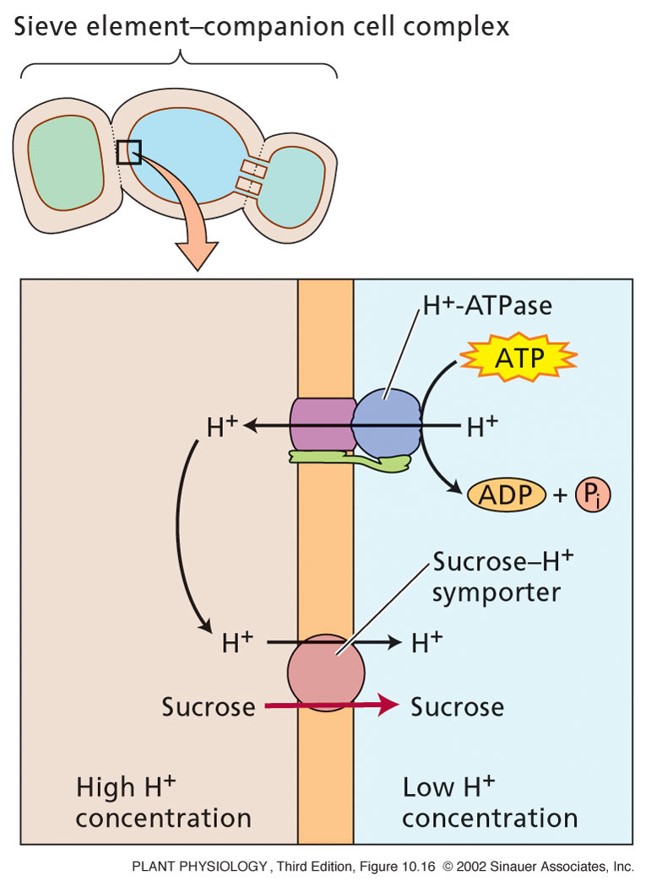
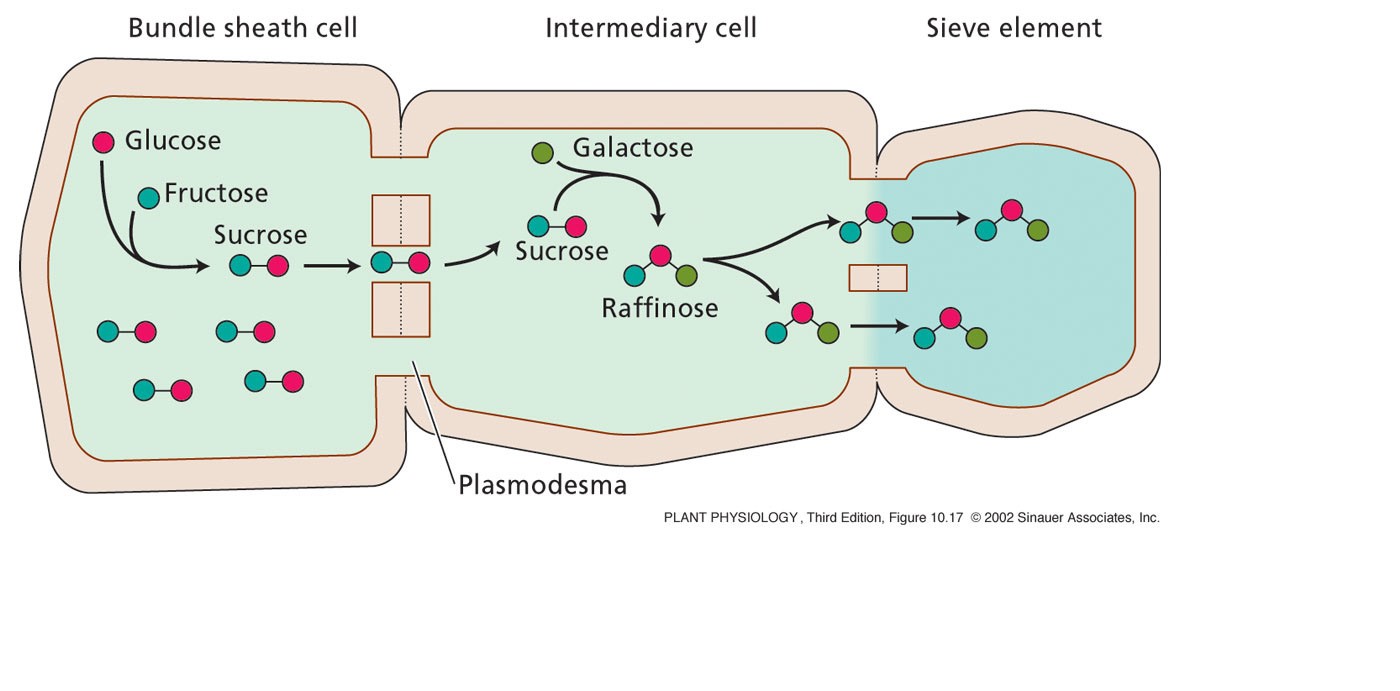
THE PRESSURE-FLOW MODEL OF PHLOEM TRANSLOCATION
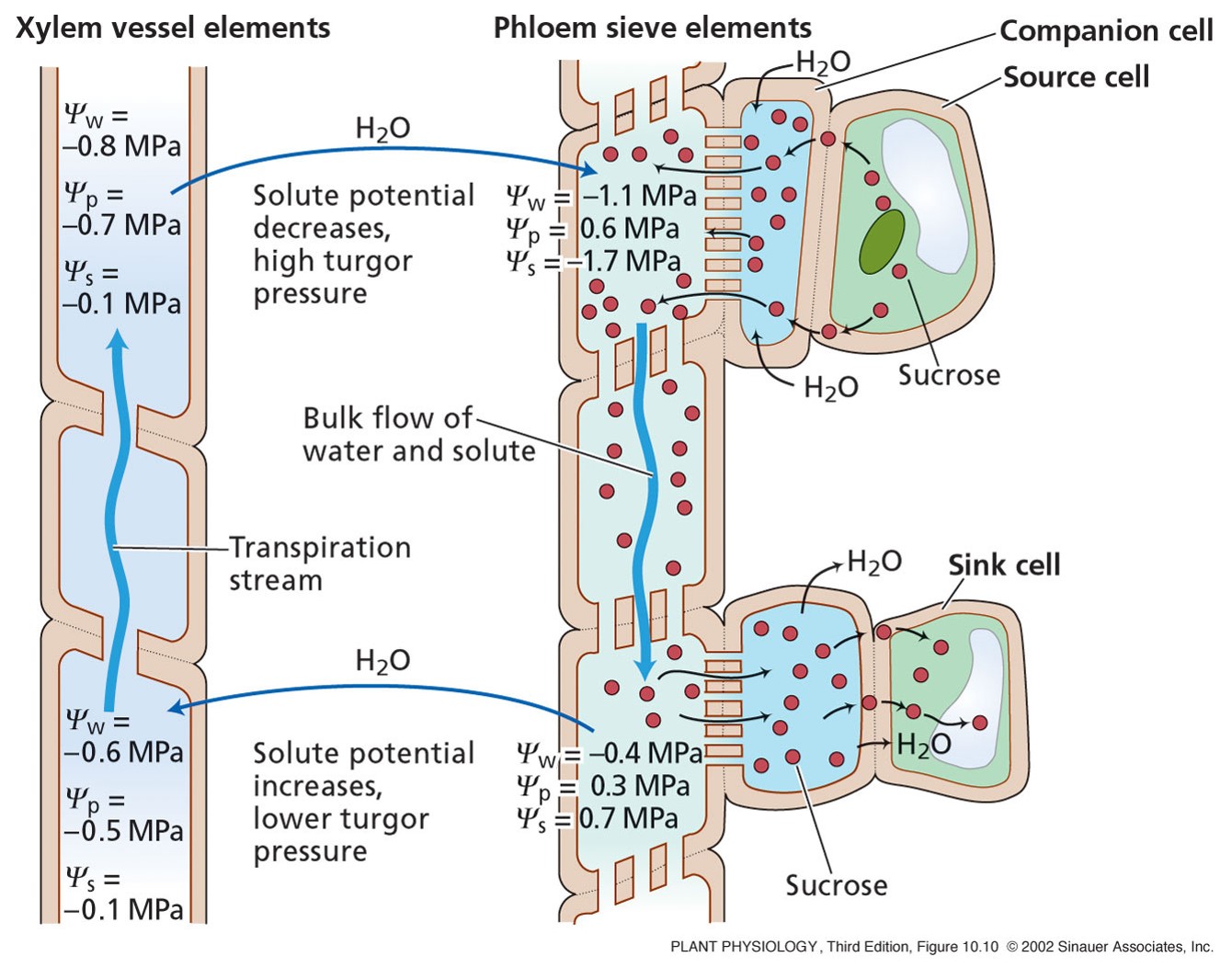
Theory of pressure flow, alsocalled mass flow theory, was put forward by Münch in 1930,suggests the mass flow is driven bypressure gradient.
In the phloem of a source leaf, the water potential is typically more negativethan it is in the phloem of the sink. In this case, water transport is drivenby a difference in hydrostatic pressure, and water moves up a gradient in waterpotential.
Phloem unloading
symplastic pathway: To young growing tissues such as young root. Sufficient plasmodesmata exist in these pathways to support symplastic unloading.
apoplatic pathway: Mainly to story organs such asearthnut and tuber. Also to developing seeds which is symplastically isolated (An apoplastic step is required in developing seeds because there are no symplastic connections between the maternal tissues and the tissues of the embryo).

