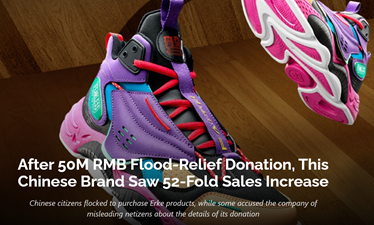
On July 21, 2021, Chinese company Hongxing Erke donated 3 million yuan cash and 47 million yuan worth of materials to Henan Province to help flood victims, making the little-known brand go viral on the internet. The donation sparked a shopping frenzy for the domestic brand. Overall sales from July 22 to 23 were 280 percent higher than the previous year. Not only Hongxing Erke, but also Anta, 361 degrees, Peak and other Chinese fashion sports brands have seen their sales surge, ranking at the forefront of the sales. Behind this explosive growth,what methods should Chinese brands use to attract consumers in the longer term? CGTN seeks answers from consumers.
ERKE ad

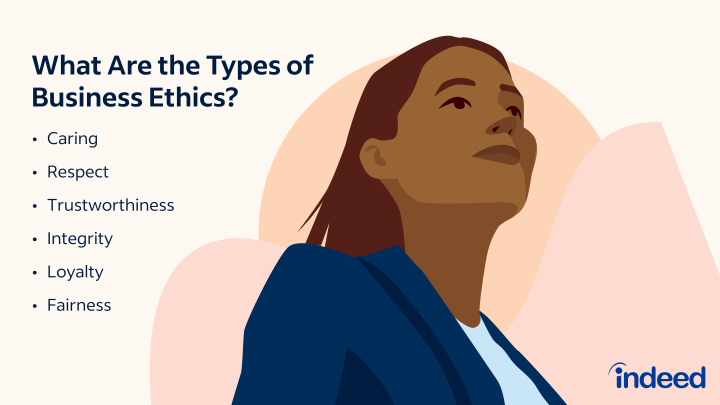
Business Ethics across culture
1 ---Many scholars indicate that the people in group-oriented collectivist cultures may be more critical of illegal, immoral, or illegitimate practices if these practices represent potential threats to the collective.
2--we are happy to listen to what you have to say about ethics and values in the workplace. But this is India, and we are entrepreneurs — we can’t even get a driver’s license without paying a bribe.”
3---How can the purchase of a pair of sneakers be seen as an ethical act? Throughout the 1990s, the U.S. shoe and sportswear manufacturer Nike was widely criticized for subcontracting with factories in China and Southeast Asia that were little more than sweatshops with deplorable working conditions. After responding to the criticisms and demanding that its suppliers improve their workplaces, the company began to redeem itself in the eyes of many and has become a model of business ethics and sustainability.
4--- Dutch-based Royal DSM—the $8 billion global company in health, nutrition, and materials science—has shifted from a male-run organization to a gender-balanced leadership team
5--- one study compared Russian and American subjects on their reactions to ethics scenarios. Americans viewed scenarios such as an auditing company sharing information regarding one client with another client as more unethical compared to how Russian subjects viewed the same scenarios (Beekun et al., 2003).
6---A study comparing U.S., Korean, and Indian managers found differences in attitudes toward business ethics, particularly with Koreans thinking that being ethical was against the goal of being profitable. Indian and Korean subjects viewed questionable practices such as software piracy, nepotism, or the sharing of insider information as relatively more ethical compared to subjects in the United States. At the same time, Korean and Indian subjects viewed injury to the environment as more unethical compared to the U.S. subjects (Christie et al., 2003). In other words, the ethical standards held in different societies may emphasize different behaviors as ethical or unethical.
(from 2.4 The Role of Ethics and National Culture – Organizational Behavior (umn.edu) )
10 Great Examples of Ethical Decision Making In Business (greatworklife.com)
--In countries like Japan, people believe that 20 days of paid leave annually helps achieve a delicate work-life balance. These days increase to 30 per year in France and Finland. Americans are okay with a paltry 13 days of paid leave, and workers can stay available to colleagues throughout the vacation period.
France enacted laws compelling companies to set hours when employees must avoid doing any work-related things like sending and replying to emails. The bill aims to ensure that workers have an optimal work-life balance.
---Many non-Americans find such a work ethic unsustainable, yet it’s normal throughout the United States. It’s not unheard of for full-time working adults to spend up to 47 hours weekly in the workplace. This figure is higher than what you find in other parts of the world, including Europe.
German and Swedish workers often work roughly 35 hours per week
--- Hierarchy in India is Very Important
In India, there is a firm belief in paying the highest amount of respect to elders. That belief is not different in the workplace. A clear division exists between management and the rest of the employees. Upper management does not socialize with subordinate employees. A meeting must be agreed upon for any communication to exist during the workday.
---Be Prepared to Dress Sharply for Business Meetings in Brazil
A USA Today article details that clothing worn is almost as important as the context of the actual business meeting in Brazil. Men are expected to wear their best suit with a tie. Preferably dark gray or navy, and polished dress shoes. In many large Brazilian organizations, executives are expected to wear three-piece suits. Women are expected to wear either dress pants or an appropriate length dress. They are also required to look elegant in any business setting. Referred to as “dressing like a clown,” it’s strongly recommended to never enter a business meeting wearing the Brazilian national colors of green and yellow
---In South Korea Expect to Work Long Hours
---Employees are Required to Disconnect from Work After Hours in France
In France, employees notoriously enjoy a 35-hour work week and a minimum of five weeks of vacation. The Government recently passed a new policy which allows employees the right to disconnect from work-related email and other methods of communication when they are not present in the office.
---Mid-Day Napping is Encouraged in Japan
New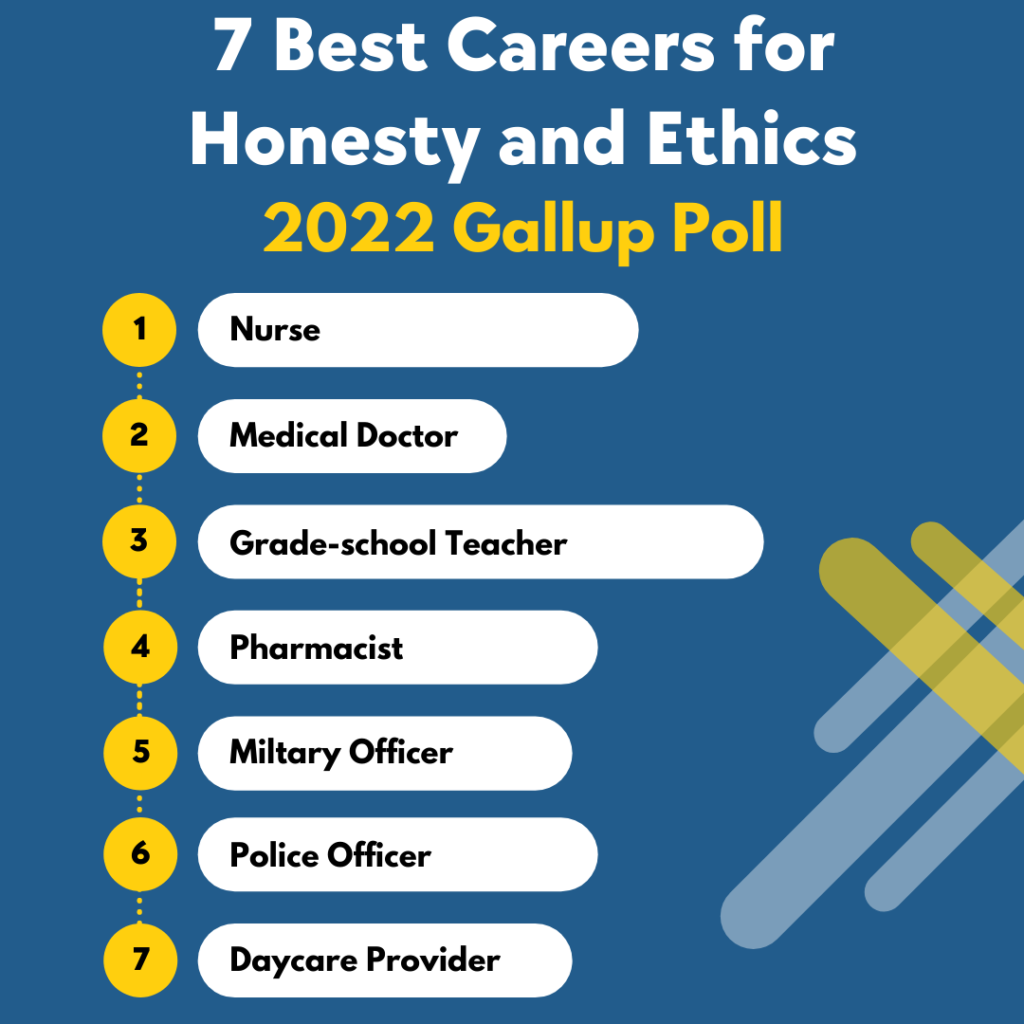
News item 1 (2023)
the Central Commission for Discipline Inspection of the Communist Party of China
中国共产党中央纪律检查委员会
and the National Commission of Supervision
国家监察委员会
The number of hospital heads and Party secretaries being put under investigation has risen rapidly since July, and the total so far this year has topped 180, according to figures compiled by media outlet Shangyou News.
The commission said that acts of corruption in the medical sector have offset the outcomes of healthcare reforms and eroded the rights and interests of the public.
Typical cases involve personnel in key positions accepting kickbacks and bribes and conducting rent-seeking — an illegal behavior of growing one's wealth without any productivity contribution.
"Such practices have not only hampered the development of medical, healthcare insurance and pharmaceutical industries, but have also tarnished the image of these industries and hurt the interests of the majority involved," said the commission.
In addition to irregular practices such as selling drugs at higher prices and bribing doctors, the commission said it will also investigate issues related to the use of healthcare insurance and the integrity of medical workers.
The drive has stirred up discussions on the legitimacy and practices surrounding academic conferences as a number of them have been delayed or canceled citing the anticorruption efforts.
"Academic conferences and activities that abide by the regulations should be supported and encouraged, but practices that use fake academic meetings to cover up illegal transferring of benefits and divvying up sponsorship fees should be rectified," it said.
News item 2 (2023)
Xinhua | Updated: 2023-09-27
Since its accession to the WTO more than 20 years ago, China has become the world's largest trader for goods and a major trading partner for over 140 countries and regions, contributing an average of nearly 30 percent to the world's annual economic growth, Xi said.
As for participation in the WTO reform, Xi called for firmly upholding the authority and efficacy of multilateral trading system with the WTO at the core, and actively promoting the restoration of the normal operation of the WTO dispute settlement mechanism.
He stressed the need to stick to the overall trend of economic globalization, champion free trade and true multilateralism, oppose unilateralism and protectionism, oppose politicizing, weaponizing and overstretching the concept of national security on economic and trade issues, and build an open world economy.
He also stressed improving the Chinese solutions in the country's extensive and in-depth participation in WTO reform while upholding the concept of a global community of shared future, as well as firmly protecting the legitimate interests of developing countries including China.