China---an innovator
Until only a few years ago, talk of China as an innovator would have elicited scorn from most Western business and government leaders. The country was widely derided as a haven for copycats and pirates, or grudgingly acknowledged as an efficient manufacturing platform whose factories depended on the uneasy union of cheap Chinese labor and foreign technology.
Business in China today, however, is being led by innovation-obsessed execs like Ren Zhengfei, founder of Huawei Technologies, which last year filed more patent applications than any other company in the world. And Allen Zhang, who led the team that developed Tencent’s WeChat, the smartphone app that allows its 900 million users to chat, shop, pay, play, and do just about anything else. And Robin Li, CEO of Baidu, the Beijing-based search company, who has vowed to have autonomous vehicles ready for sale in China by next year.
Their success is fueling a virtuous cycle of innovative activity. The country’s two largest Internet companies, Alibaba Group (BABA) and Tencent Holdings (TCEHY), lead the world in e-commerce, mobile payments, social media, and online gaming. They and other Chinese tech giants are investing aggressively in new businesses, helping to transform China into a massive market for venture capital investments. Those ventures, in turn, are nourished by China’s huge and growing market and its unique ecosystem of suppliers, logistics specialists, and manufacturers. The result: China has spawned a new generation of homegrown entrepreneurs who are creating world-class products, developing their own technologies, and rolling out new business models on a scale and with a speed the global economy has never seen. “The copycat era is behind us,” says Kai-Fu Lee, CEO of Sinovation Ventures and the former head of Google China. “We are way beyond that.”
Consider that between 2014 and 2016, China attracted $77 billion in venture capital investment, compared with just $12 billion in the preceding two years. China is now among the world’s top three markets globally for venture capital in digital technologies including virtual reality, autonomous vehicles, 3D printing, drones, and artificial intelligence. And about a third of the world’s 262 “unicorns” (startups valued at more than a billion dollars) hail from China, according to McKinsey & Co., and account for 43% of the global value of such companies.
Discussion:
1. Collect more information on China's innovation in recent years with tables and figures.
2. Try to compare China's innovation with that of other countries like America and Japan.
Shenzhen--- a vanguard in innovation
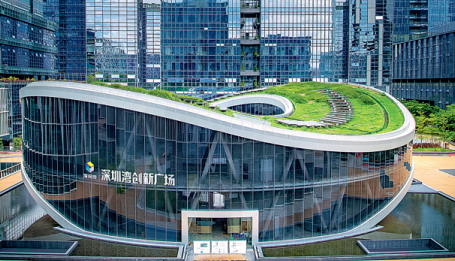
An innovation center near Shenzhen Bay has become a magnet for innovators from around the world to start up their businesses.
Shenzhen, a Chinese vanguard in reform and opening-up located in South China's Guangdong province, has set a goal to become a city of innovation and creativity with global influence, according to Wang Weizhong, Party secretary of the city.
The city is home to a group of world-leading high-tech companies such as telecommunications giant Huawei Technology, internet company Tencent, medical device provider Mindray, new energy vehicle manufacturer BYD and commercial and civilian drone developer DJI.
Research, industry and talent should be interactively connected and supported in the systematic project of innovation, Economic Daily quoted Wang as saying.
He noted the city has advantages in its industrial system and innovation environment, but the integrity and synergy of the industry must be improved.
To enhance innovational capability from the very beginning would be a decisive move that could lead to an apparent advantage in the competition, Wang said, adding that the city will develop fundamental research and applied basic research.
"We have learned from experience that only by embracing key and core technologies can we take control of the initiative of innovation and development," Wang said when addressing the root technical problems.
The city government has allocated at least 30 percent of the city-level scientific development and research funds to fundamental and applied basic research since 2018, Wang said. The proportion was fixed through a local law in 2020.
As a result, the city's fiscal inputs in these types of research reached 2.8 billion yuan ($433.4 million) and 4.8 billion yuan in 2018 and 2019 respectively, accounting for 30 percent and 37.2 percent of the city-level funds that went to the research and development sector. In 2020, the amount increased to nearly 5 billion yuan, representing 42.7 percent of the city-level expenditure on R&D, official data show.
The total investment in R&D from all channels in Shenzhen surged from 73.2 billion yuan in 2015 to 136 billion yuan last year. The figure in 2020 accounted for 4.9 percent of its GDP, a level equal to or even better than some developed countries.
According to a government mid-to-long-term plan for 2025-35, issued on June 9, the R&D investment in Shenzhen is projected to be further raised to 200 billion yuan in 2025, accounting for 5 percent of its GDP.
"The dynamic innovation system and generous financial inputs of Shenzhen allow scientists to explore freely to their hearts' content," said Hu Xiaojun, Party secretary of SZBL.
More than 60 high-level laboratories and R&D institutes as well as more than 2,700 innovational platforms and entities have been set up in Shenzhen, according to official statistics.

目前海信8K AI画质芯片已经用于整机。搭载这一芯片的海信85U9H电视,凭借极致控光和精准色彩还原能力,在刚刚结束的世界消费电子展上,成功摘得CES 2022 家用音视频终端品类创新大奖。2022年,海信8K AI画质芯片将全面覆盖海信、东芝两大品牌在内的多系列显示产品。
DJI

When it comes to the consumer drone industry, China’s DJI(深圳大疆科技创新有限公司) came, saw, and conquered. Just ask companies like 3D Robotics, Parrot(法国派诺特公司), Yuneec, and GoPro what happened to their drone programs after DJI devices like the Phantom 4 and Mavic Pro came along. Now, DJI is hoping torepeat its success with the enterprise and industrial side of the drone market.
Already, DJI had offered mobile and onboard software development tools that allowed third-party developers to build software solutions on top of DJI drones. Now, it’s adding hardware to themix–and that is likely to substantially broaden the number of ways businesses use the company’s drones, making it ever harder for its competition to keep up.
Today, it unveiled what it calls Payload SDK, a tool that, in conjunction with DJI’s new Skyport gimbal adapter,allows third party sensors, cameras, and things like air-to-groundcommunication tools and devices to integrate directly with its M200 seriesdrones. It may seem like an incremental move, but the company is hoping that PSDK will allow it to grab a stranglehold on the lucrative enterprise andindustrial drone business–things like agricultural and infrastructure inspection, construction, emergency-management, and much more–by making it easy for third parties to plug their sensors, and the data they generate, directly into DJI’s already robust end-to-end system.
And while many enterprise users were already deploying DJI drones with third-party sensors and applications, they had to jerry-rig them, and it would be difficult to get real-time data from the systems without adding substantial weight in the form of extra batteries and communications equipment. Now, it can all be integrated, streamlining the process and giving these users easy access to real-time data from a wide range of external cameras and sensors.
Discussion:
Figure out how the breeding ground in China, in Shenzhen for technological innovation has contributed to the success of DJI.
What is DJI' s development path? What has distinguished DJI from other companies? How do you look at its innovation?