
Interactive Map: Tracking World Hunger and Food Insecurity
Interactive Map: Tracking World Hunger and Food Insecurity
Hunger is still one the biggest—and most solvable—problems in the world.
Every day, more than 700 million people (8.8% of the world’s population) go to bed on an empty stomach, according to the UN World Food Programme (WFP).
The WFP’s HungerMap LIVE displayed here tracks core indicators of acute hunger like household food consumption, livelihoods, child nutritional status, mortality, and access to clean water in order to rank countries.
But whereas acute hunger measures short-term inability to meet food consumption requirements, often related to crises, many people in the world also suffer from chronic hunger. This is the persistent inability to meet food consumption requirements, usually lasting for at least six months.
After sitting closer to 600 million from 2014 to 2019, the number of people in the world affected by hunger increased during the COVID-19 pandemic.
In 2020, 155 million people (2% of the world’s population) experienced acute hunger, requiring urgent assistance.
The Fight to Feed the World
The problem of world hunger isn’t new and attempts to solve it have made headlines for decades.
On July 13, 1985, at Wembley Stadium in London, Prince Charles and Princess Diana officially opened Live Aid, a worldwide rock concert organized to raise money for the relief of famine-stricken Africans.
The event was followed by similar concerts at other arenas around the world, globally linked by satellite to more than a billion viewers in 110 nations, raising more than $125 million ($309 million in today’s dollars) in famine relief for Africa.
But 35+ years later, the continent still struggles. According to the UN, from 12 countries with the highest prevalence of insufficient food consumption in the world, nine are in Africa.
| Country | % Population Affected by Hunger | Population (millions) | Region |
|---|---|---|---|
| Afghanistan | 93% | 40.4 | Asia |
| Somalia | 68% | 12.3 | Africa |
| Burkina Faso | 61% | 19.8 | Africa |
| South Sudan | 60% | 11.0 | Africa |
| Mali | 60% | 19.1 | Africa |
| Sierra Leone | 55% | 8.2 | Africa |
| Syria | 55% | 18.0 | Middle East |
| Niger | 55% | 22.4 | Africa |
| Lesotho | 50% | 2.1 | Africa |
| Guinea | 48% | 12.2 | Africa |
| Benin | 47% | 11.5 | Africa |
| Yemen | 44% | 30.0 | Middle East |
Approximately 30 million people in Africa face the effects of severe food insecurity, including malnutrition, starvation, and poverty.
Wasted Leftovers
Although many of the reasons for the food crisis around the globe involve conflicts or environmental challenges, one of the big contributors is food waste.
According to the United Nations, one-third of food produced for human consumption is lost or wasted globally. This amounts to about 1.3 billion tons of wasted food per year, worth approximately $1 trillion.
All the food produced but never eaten would be sufficient to feed two billion people. That’s more than twice the number of undernourished people across the globe. Consumers in rich countries waste almost as much food as the entire net food production of sub-Saharan Africa each year.
Solving World Hunger
While many people may not be “hungry” in the sense that they are suffering physical discomfort, they may still be food insecure, lacking regular access to enough safe and nutritious food for normal growth and development.
Estimates of how much money it would take to end world hunger range from $7 billion to $265 billion per year.
But to tackle the problem, investments must be utilized in the right places. Specialists say that governments and organizations need to provide food and humanitarian relief to the most at-risk regions, increase agricultural productivity, and invest in more efficient supply chains.
10 Things Investors Should Know about the Plant-Based Foods Market
What Investors Should Know about the Plant-Based Foods Market
Plant-based foods are gaining traction—and fast.
By 2030, the global plant-based food market is expected to reach $161.9 billion in value. That’s a 355% increase compared to 2021.
Interested in investing in this rapidly expanding industry? This graphic from The Very Good Food Company (VGFC) highlights what you should know on the future of the plant-based food market.
1. Consumers are Becoming More Health Conscious
As plant-based foods grow in popularity and more product options become available, consumers have started to become more selective about the types of products they’re willing to purchase.
For many consumers, health is a key consideration when making purchasing decisions. A global survey revealed that, out of 8,500 respondents, over 50% were vegan for health reasons.
But not just any plant-based product will cut it. Consumers are starting to hold businesses to a higher standard, with an expectation that plant-based products have high nutritional value, low salt content, and good quality protein.
2. Consumers are Becoming More Socially Conscious
Consumers are also becoming more educated on environmental issues, and how plant-based diets can help reduce greenhouse gas emissions. According to the same survey as above, almost two-thirds (64%) of respondents were vegan for environmental and sustainability reasons.
Some experts believe this figure will only increase, as the impacts of climate change become more apparent across the globe.
3. An Influx in Plant-Based Tech Innovation
With consumer demand growing and expectations for the plant-based food industry evolving, new technological advancements in this space are rapidly emerging.
For instance, the cell-cultured meat market is gaining traction fast. Cell-culture meat is meat that’s grown in a lab from the cells of animals. It’s biologically identical to traditional meat.
While cell-cultured meat has yet to hit the commercial market on a mass scale, several start-ups have gone public, such as MeaTech3D, Mosa Meat, and UPSIDE Foods. Recently, MeaTech announced its plans to start pre-production of cell-cultured chicken fat by 2022.
In the next 20 years, cell-cultured meat usage is expected to skyrocket. In fact, it could make up 35% of the global meat market by 2040, which would cause conventional meat’s market share to decrease drastically.
4. Diversifying Plant-Based Market
In addition to meat alternatives, other plant-based alternatives are gaining popularity as well, especially egg substitutes and spreads. In 2020, plant-based egg sales in the U.S. reached $27 million, a 167.8% increase compared to the year prior.
| Category | 2020 Sales | YoY growth |
|---|---|---|
| Plant-based eggs | $27 million | 167.80% |
| Plant-based milk | $2.5 billion | 20.40% |
| Plant-based cheese | $270 million | 42.50% |
| Plant-based spreads, dips, sauces | $61 million | 83.40% |
While egg substitutes and spreads are growing fast, plant-based milk remains the most popular product category when it comes to overall sales, making up 35% of the total plant-based foods market.
5. Retailers Push Plant-Based
Retailers are starting to take note of the rising popularity of plant-based products, and are integrating plant-based foods into their offerings as a result.
For example, Tesco, the UK’s biggest grocery store brand, expects to see sales of plant-based products grow 300% by 2025. And Unilever, one of the world’s largest food and beverage manufacturers, expects to generate $1.2 billion from plant-based meat and dairy sales in the next five to seven years—around 5x more than their 2020 sales revenue for alternatives.
6. Plant-Based Companies are Growing Fast
Since the market is booming, many plant-based food companies are experiencing significant growth. For instance, The Very Good Food Company, a Canadian plant-based food company, saw its revenue increase by 680% from Q1 2020 to Q1 2021.
In that same timeframe, VGFC’s product sales increased by 77%, and its eCommerce sales increased by 1744%. More growth is on the horizon since the company recently closed a $70 million loan agreement with Waygar Capital and Ninepoint Partners to help expand operations.
7. More Consumers are Becoming Flexitarians
Not everyone is transitioning to a fully plant-based lifestyle.
As the benefits of plant-based diets become more apparent, more people are starting to limit their meat intake, or have become flexitarians—people who primarily eat a plant-based diet, but occasionally eat meat or fish.
In fact, almost one-third of Americans have reduced their meat and dairy consumption, and consider themselves flexitarians.
| Category | % of Survey Respondents |
|---|---|
| Omnivore | 65% |
| Flexitarian | 29% |
| Vegetarian | 4% |
| Vegan | 2% |
Being a flexitarian is becoming easier than ever, as plant-based products become more accessible, and the taste of meat alternatives improves.
8. Restaurants are Adopting More Plant-Based Options
Because of consumer demand, restaurants are adjusting and creating more inclusive menus with diverse vegan, vegetarian, and dairy-free options for their guests.
A&W, a popular Canadian fast-food chain, launched its plant-based burger back in 2018. Because of its popularity, the restaurant is expanding its plant-based menu options by adding Beyond Meat nuggets to the menu.
9. Younger Generations are Prioritizing Plant-Based Eating
The plant-based movement has been largely driven by younger generations.
In a survey of over 1,200 respondents, 22% of Millennials said they’d adopted a vegetarian lifestyle at some point in their lives, compared to just 13% of Gen Xers, and 11% of Baby Boomers.
And many Millennials, even if they haven’t gone full plant-based, were attempting to limit their meat intake—45% of Millennial respondents claimed they were actively trying to reduce their meat consumption.
Gen Z however are the driving force behind the plant-based movement with 79% of them claiming to eat plant-based once or twice per week.
10. Governments Are Supporting the Plant-Based Industry
Independent businesses aren’t the only players getting behind the plant-based boom—governments are stepping up to support this rapidly growing industry as well.
For example, the Canadian government recently announced plans to invest $150 million in the plant-based foods industry, signing a deal with Protein Industries Canada. This funding will go towards plant-based food manufacturing, research and development, and tech innovation.
The Future is Plant-Based
There are multiple drivers supporting the rapidly growing plant-based food industry, and because of this, more growth is expected in the near future.
Companies like VGFC are at the forefront of this movement, providing products that don’t sacrifice taste and aren’t highly processed.
Hunger Pandemic: The COVID-19 Effect
on Global Food Insecurity
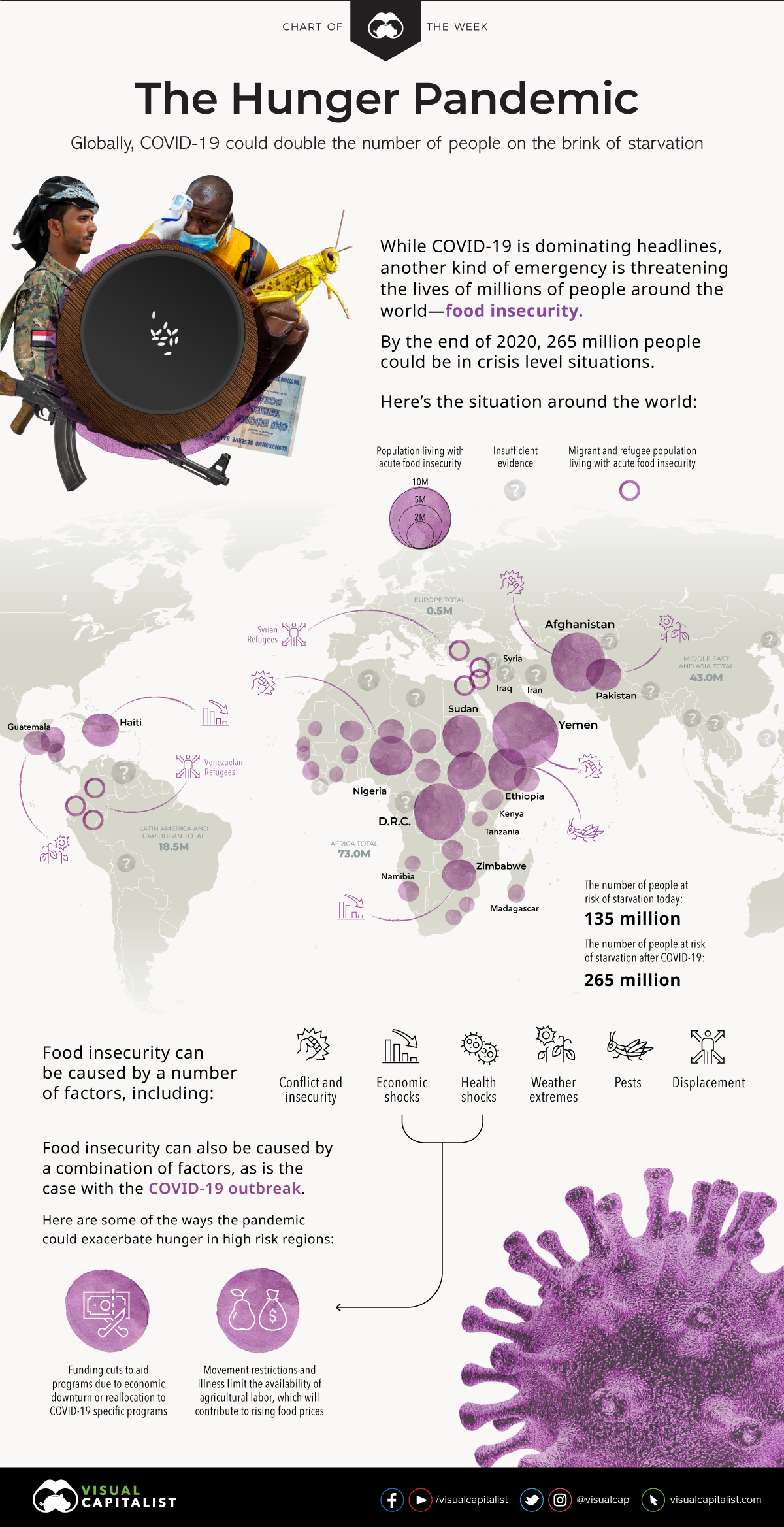
How COVID-19 Could Worsen Global Food Insecurity
While COVID-19 is dominating headlines, another kind of emergency is threatening the lives of millions of people around the world—food insecurity.
The two are very much intertwined, however. By the end of 2020, authorities estimate that upwards of 265 million people could be on the brink of starvation globally, almost double the current rate of crisis-level food insecurity.
Today’s visualizations use data from the fourth annual Global Report on Food Crises (GRFC 2020) to demonstrate the growing scale of the current situation, as well as its intense concentration in just 55 countries around the globe.
Global Overview
The report looks at the prevalence of acute food insecurity, which has severe impacts on lives, livelihoods, or both. How does the Integrated Food Security Phase Classification (IPC) classify the different phases of acute food insecurity?
Phase 1: Minimal/None
Phase 2: Stressed
Phase 3: Crisis
Phase 4: Emergency
Phase 5: Catastrophe/Famine
According to the IPC, urgent action must be taken to mitigate these effects from Phase 3 onwards. Already, 135 million people experience critical food insecurity (Phase 3 or higher). Here’s how that breaks down by country:
| Country/ Territory | Total Population Analyzed (Millions) | Population in Crisis (Phase 3+, Millions) | Share of Analyzed Population in Crisis |
|---|---|---|---|
| Afghanistan¹ | 30.7 | 11.3 | 37% |
| Angola¹ (24 communes in 3 provinces) | 0.9 | 0.6 | 62% |
| Bangladesh (Cox's Bazar and host populations) | 3.5 | 1.3 | 37% |
| Burkina Faso¹ | 21.4 | 1.2 | 6% |
| Burundi | 11.5 | 0.2 | 2% |
| Cabo Verde | 0.5 | 0.01 | 2% |
| Cameroon¹ (7 regions) | 16.1 | 1.4 | 8% |
| Central African Republic¹ (excluding Lobaye) | 4.4 | 1.8 | 41% |
| Chad¹ | 14.3 | 0.6 | 4% |
| Colombia¹ (Venezuelan migrants) | 1.6 | 0.9 | 55% |
| Côte d'Ivoire | 19.8 | 0.06 | 0% |
| Total populations | 825.1 million | 134.99 million |
Showing 1 to 11 of 55 entries
Source: GRFC 2020, Table 5 – Peak numbers of acutely food-insecure people in countries with food crises, 2019
¹ Include populations classified in Emergency (IPC/CH Phase 4)
² Include populations classified in Emergency (IPC/CH Phase 4) and in Catastrophe (IPC/CH Phase 5)
While starvation is a pressing global issue even at the best of times, the ongoing impact of the COVID-19 pandemic is projected to almost double these numbers by an additional 130 million people—a total of 265 million by the end of 2020.
To put that into perspective, that’s roughly equal to the population of every city and town in the United States combined.
A Continent in Crisis
Food insecurity impacts populations around the world, but Africa faces bigger hurdles than any other continent. The below map provides a deeper dive:
Over half of populations analyzed by the report – 73 million people – are found in Sub-Saharan Africa. Main drivers of acute food insecurity found all over the continent include:
Conflict/Insecurity
Examples: Interstate conflicts, internal violence, regional/global instability, or political crises.
In many instances, these result in people being displaced as refugees.Weather extremes
Examples: Droughts and floodsEconomic shocks
Macroeconomic examples: Hyperinflation and currency depreciation
Microeconomic examples: Rising food prices, reduced purchasing powerPests
Examples: Desert locusts, armywormsHealth shocks
Examples: Disease outbreaks, which can be worsened by poor quality of water, sanitation, or airDisplacement
A major side-effect of conflict, food insecurity, and weather shocks.
One severely impacted country is the Democratic Republic of Congo, where over 15 million people are experiencing acute food insecurity. DRC’s eastern region is experiencing intense armed conflict, and as of March 2020, the country is also at high risk of Ebola re-emergence.
Meanwhile, in Eastern Africa, a new generation of locusts has descended on croplands, wiping out vital food supplies for millions of people. Weather conditions have pushed this growing swarm of trillions of locusts into countries that aren’t normally accustomed to dealing with the pest. Swarms have the potential to grow exponentially in just a few months, so this could continue to cause big problems in the region in 2020.
Insecurity in Middle East and Asia
In the Middle East, 43 million more people are dealing with similar challenges. Yemen is the most food-insecure country in the world, with 15.9 million (53% of its analyzed population) in crisis. It’s also the only area where food insecurity is at a Catastrophe (IPC/CH Phase 5) level, a result of almost three years of civil war.
Another troubled spot in the Middle East is Afghanistan, where 11.3 million people find themselves in a critical state of acute food insecurity. Over 138,000 refugees returned to the country from Iran and Pakistan between January-March 2020, putting a strain on food resources.
Over half (51%) of the analyzed population of Pakistan also faces acute food insecurity, the highest in all of Asia. These numbers have been worsened by extreme weather conditions such as below-average monsoon rains.
An Incomplete Analysis
As COVID-19 deteriorates economic conditions, it could also result in funding cuts to major humanitarian organizations. Upwards of 300,000 people could die every day if this happens, according to the World Food Program’s executive director.
The GRFC report also warns that these projections are still inadequate, due to major data gaps and ongoing challenges. 16 countries, such as Iran or the Philippines have not been included in the analysis due to insufficient data available.
More work needs to be done to understand the true severity of global food insecurity, but what is clear is that an ongoing pandemic will not do these regions any favors. By the time the dust settles, the food insecurity problem could be compounded significantly.
5 Reasons Why Cultured Foods Are Here to Stay
5 Reasons Why Cultured Foods Are Here to Stay
Imagine a world where humans can thrive without harming any animals for food.
By cutting meat consumption and shifting to a plant-based diet, we could reduce greenhouse gases by 70% by 2050 and spare 105 animals per person each year.
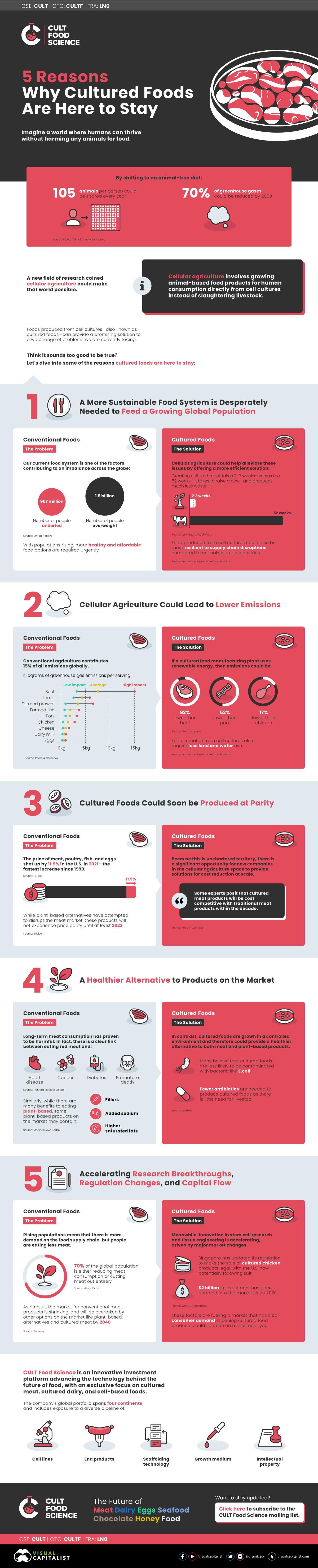
Cellular agriculture has the power to make this shift less daunting. The infographic above from CULT Food Science (CSE: CULT) explores five reasons why foods produced from cell cultures could make this world a reality.
The Case for Cultured Foods
First things first, the term cellular agriculture describes the process of growing animal agricultural products directly from cell cultures instead of using livestock.
Foods produced from cell cultures—also known as cultured foods—can provide a promising solution to a wide range of problems we are currently facing.
Sounds too good to be true? Let’s dive into some of the reasons cultured foods are here to stay:
1. A More Sustainable Food System is Desperately Needed
With populations rising at an unprecedented pace, more healthy and affordable food options are required urgently.
Cultured foods can provide a more efficient solution compared to conventional meat. In fact, it takes just 2-3 weeks to create a cultured meat product compared to the 52 weeks+ it takes to raise a farm animal such as a cow.
Compared to animal-sourced industries, food produced from cell cultures could also be more resilient to supply chain disruptions.
2. Cultured Foods Could Lead to Lower Emissions
Conventional agriculture contributes 15% of all emissions globally, with beef producing the highest level of greenhouse gases per serving.
A cultured foods manufacturing plant on the other hand could produce emissions that are:
92% lower than beef
52% lower than pork
17% lower than chicken
The caveat is that these figures refer to a plant that uses renewable energy. Foods created from cell cultures also require less land and water use, meaning they could be an more environmentally friendly option overall.
3. Cultured Foods Could Soon be Produced at Parity
In 2021, the price of meat, poultry, fish, and eggs shot up by 11.9% in the U.S.—the fastest increase since 1990.
While plant-based alternatives have attempted to disrupt the meat market, these products will not experience price parity until at least 2023.
Because this is unchartered territory, there is a huge opportunity for new companies in the cultured foods space to provide solutions for cost reduction at scale.
“Some experts posit that cultured meat products will be cost competitive with traditional meat products within the decade.”
—FOOD IN CANADA
4. A Healthier Alternative to Products on the Market
The long-term consumption of eating meat has proven to be harmful. In fact, there is a clear link between eating red meat and heart disease, cancer, diabetes, and premature death according to Harvard Medical School.
Similarly, while there are many benefits to eating plant-based, some plant-based products on the market may contain fillers, added sodium, and higher saturated fats.
In contrast, cultured foods are grown in a safe and controlled environment which comes with several benefits:
Cultured foods may be less likely to be contaminated with bacteria like E.coli
Fewer antibiotics are needed to produce cultured foods as there is little need for livestock
Therefore cultured foods could provide a healthier alternative to both meat and plant-based products in the long-run.
5. Accelerating Research Breakthroughs, Regulation Changes, and Capital Flow
Despite rising populations putting pressure on the food supply chain, meat consumption is in fact shrinking.
This means that the market for conventional meat products will be overtaken by other options like plant-based alternatives and cultured meat as soon as 2040.
To keep up with these major market changes, innovation in stem cell research and tissue engineering is accelerating. A whopping $2 billion in investment has been pumped into the market since 2020 according to Crunchbase.
What’s more, we’re starting to see changes in regulation around the world with Singapore being the first nation to legalize the sale of cultured meat products.
Investing in the Future of Food
CULT Food Science is an innovative investment platform advancing the technology behind the future of food with an exclusive focus on cultured meat, cultured dairy and cell-based foods.
The company’s portfolio spans four continents and includes exposure to a diverse pipeline of:
Cell lines
End products
Scaffolding technology
Growth medium
Intellectual property
Want to stay updated?
The Rise of Functional Food:
What Investors Need to Know
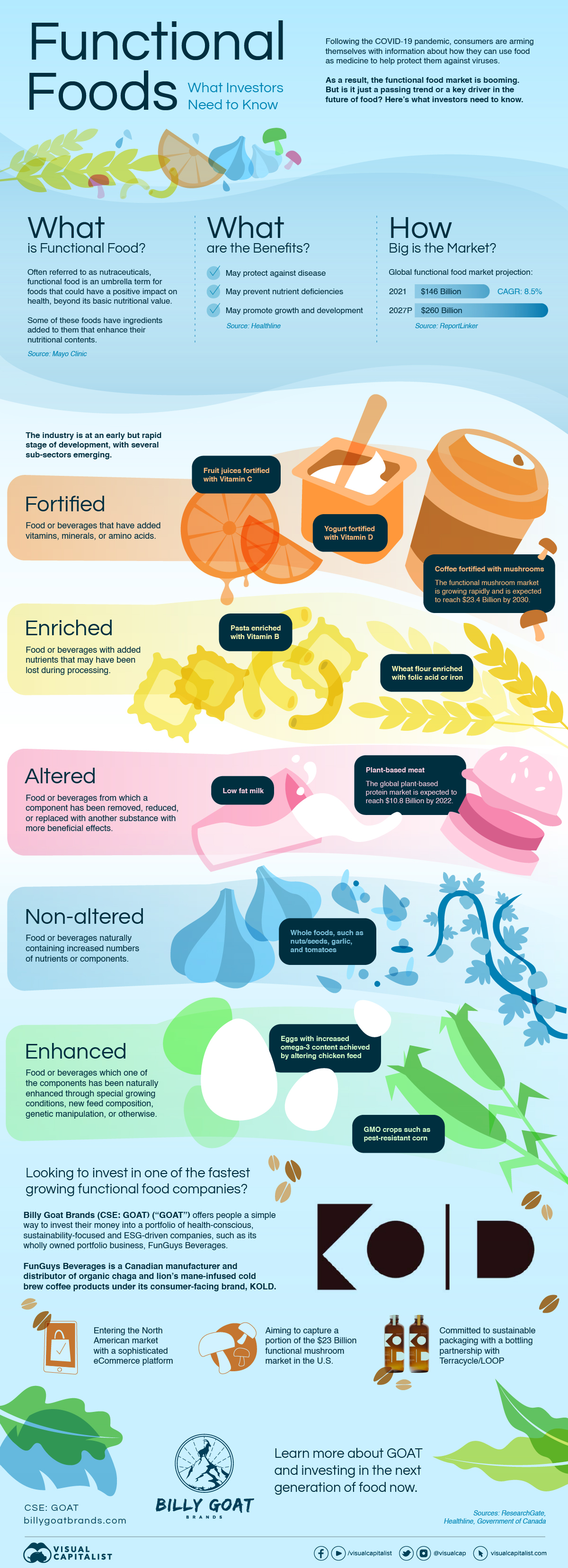
The Rise of Functional Food: What Investors Need to Know
Following the COVID-19 pandemic, consumers are looking for new ways to use food as medicine in a bid to help protect them against disease. As a result, the functional food market is booming.
But is it just the buzzword du jour, or a growth market that investors should seriously consider?
The infographic above from Billy Goat Brands (CSE: GOAT) (“GOAT”) breaks down the key points that investors need to know about how the market is structured.
Functional Food: The Basics
To start, let’s explain what functional food means.
Functional food is an umbrella term that describes food that has a positive impact on your health, beyond its basic nutritional value.
Take oatmeal for example. It contains soluble fiber that can help lower cholesterol levels and reduce inflammation. Therefore it is considered to be a food that is functional. Benefits of these foods may include things like:
Protecting against disease
Preventing nutrient deficiencies
Promoting growth and development
Some foods also have nutrients added to them to enhance their nutritional profile, such as milk with added Vitamin D, and therefore provide the same benefits to consumers.
While there is much debate around the official definition of the term functional food, the most important thing to remember is that they are foods that have added benefits—either natural superfoods, or enhanced during the production process.
Let’s dive into the market on a more granular level.
The Anatomy of the Functional Food Market
Given the shift in consumer values, the market for these kinds of foods is expected to see significant growth over the next decade, and is projected to reach $260 billion by 2027—a compound annual growth rate (CAGR) of 8.5%.
Even though the industry is at an early stage of development, several sub-sectors are emerging in the form of different functional food types.
| Food Type | Definition | Examples |
|---|---|---|
| Fortified | Food or beverages that have added vitamins, minerals, or amino acids. | Fruit juices fortified with Vitamin C, yogurt fortified with Vitamin D, coffee fortified with mushrooms. |
| Enriched | Food or beverages with added nutrients that may have been lost during processing. | Wheat flour enriched with folic acid or iron, pasta enriched with with Vitamin B. |
| Altered | Food or beverages from which a component has been removed, reduced or replaced with another substance with more beneficial effects. | Low fat milk, plant-based meat alternatives. |
| Non-altered | Food or beverages naturally containing increased numbers of nutrients or components. | Whole foods like nuts, seeds, garlic, and tomatoes. |
| Enhanced | Food or beverages which one of the components has been naturally enhanced through special growing conditions, new feed composition, genetic manipulation, or otherwise. | Eggs with increased omega-3 content achieved by altering chicken feed, GMO crops such as pest-resistant corn. |
Altered foods such as plant-based meat alternatives are taking the world by storm and are expected to reach almost $11 billion in 2022 alone.
Invest in the World’s Fastest Growing Functional Food Companies
Billy Goat Brands (CSE: GOAT) offers people a simple way to invest their money into a portfolio of health-conscious, sustainability-focused and ESG-driven companies, such as FunGuys Beverages.
FunGuys Beverages is a Canadian manufacturer and distributor of organic chaga and lion’s mane-infused cold brew coffee products under its consumer-facing brand: KOLD.
The company aims to capture a portion of the functional mushroom market in the U.S. and will be entering the North American market with a sophisticated eCommerce platform.
An Investor’s Guide
to AgTech & Food Innovation
An Investor’s Guide to AgTech & Food Innovation
The global food system is under immense pressure due to three overarching trends:
Population Growth
This naturally leads to an increasing demand for food. By 2060, the UN expects the global population to reach 10 billion people.Limited Capacity of Existing Agriculture
Existing farming methods are very resource intensive and production has already been pushed to the brink. The UN predicts that by 2050, food production will need to increase by 70%.Unsustainable Consumption
The world is consuming unsustainable amounts of food, particularly in terms of meat. While livestock accounts for 80% of agricultural land, it supplies just 18% of the global calorie supply.
As these trends collide, agriculture technology (AgTech) and food innovation are emerging as two possible solutions. This infographic from Global X ETFs will explain both.
The Major Themes of AgTech
AgTech is the use of technology to maximize crop yields while conserving water and land. Here is a quick explanation of its segments.
Precision Agriculture
Precision agriculture is the integration of artificial intelligence (AI) and the internet of things (IoT) into traditional farming practices. These technologies can provide farmers with more data, which in turn can be used to boost efficiency.
One example is the John Deere See & Spray machine, which uses various sensors to detect where weeds are. By only spraying weeds, farmers can reduce their herbicide use by up to 77%.
Robotics & Automation
Robotics & automation aims to reduce the amount of manual labor needed in agriculture. This multi-billion dollar market includes autonomous berry pickers, which demonstrate over 60% more productivity than humans.
Drones can also play a role, especially in regions where water is becoming scarce. For example, farmers in California are investing in drones that monitor fields for leaks and other issues. They claim this technology reduces their water inputs by over 40%.
Controlled Environment Agriculture (CEA)
CEA is the cultivation of plants in an indoor setting. This market is still in its infancy, but the ability to grow food almost anywhere, all year round, could transform the playing field for agriculture.
One of the most prominent CEA methods is hydroponics, where plants are cultivated in a nutrient-rich water-based solution instead of soil. Hydroponics could mitigate many of the world’s agricultural problems:
| Issue | Hydroponics Benefit |
|---|---|
| Food insecurity | A constant stream of nutrients means crops have 7 to 14 more growth cycles over traditional methods. |
| Water scarcity | Hydroponics systems make use of recirculated water, meaning plants grow with up to 90% less water. |
| Land degradation | Hydroponics systems can be stacked vertically, meaning farmers can grow 3 to 10 times more food in the same amount of space as traditional farms. |
Source: Princeton University
With pressures mounting on the global food system, innovative disruption will be needed to achieve long-term sustainability. AgTech solutions can certainly boost output, but what can be done on the consumption side?
Food Innovation
Food innovation refers to plant-based foods and other alternatives such as lab-grown meat. Given the immense scale (and carbon footprint) of the meat and dairy industry, these innovations could reap environmental benefits.
In terms of market share, alternative foods still have a long way to go. The following table lists global meat and dairy sales, by category, in 2020.
| Market | Traditional Option | Alternative Option | Alternative Share of Total |
|---|---|---|---|
| Meat | $1.4 Trillion | $6 Billion | 0.43% |
| Dairy | $574 Billion | $18 Billion | 3.14% |
Source: Global X ETFs
Considering that 80% of Americans have either purchased or are open to purchasing alternative meat products in the future, investors may view this sector as an attractive growth opportunity.
For further perspective, some analysts believe that by 2040, cultured meat (lab-grown meat) will account for 35% of the global market.
Introducing the Global X AgTech & Food Innovation ETF
The Global X AgTech & Food Innovation ETF (Ticker: KROP) seeks to provide investment results that correspond generally to the price and yield performance, before fees and expenses, of the Solactive AgTech & Food Innovation Index.
| Sector | Index Weight |
|---|---|
| Consumer Staples | 44.8% |
| Materials | 37.3% |
| Industrials | 11.6% |
| Health Care | 4.1% |
| Consumer Discretionary | 2.1% |
As of 01/31/2022
Investors can use this passively managed solution to gain exposure to innovation in the agriculture and food industries.
The Briefing
Land degradation is a long-term sustainability risk
Vertical farms can grow food indoors with less land and water than traditional methods
Is Vertical Farming the Future?
According to the World Wildlife Fund (WWF), half of the Earth’s topsoil has been lost over the past 150 years. This issue is known as land degradation, and it’s caused by natural and human forces such as droughts, overfarming, and pollution.
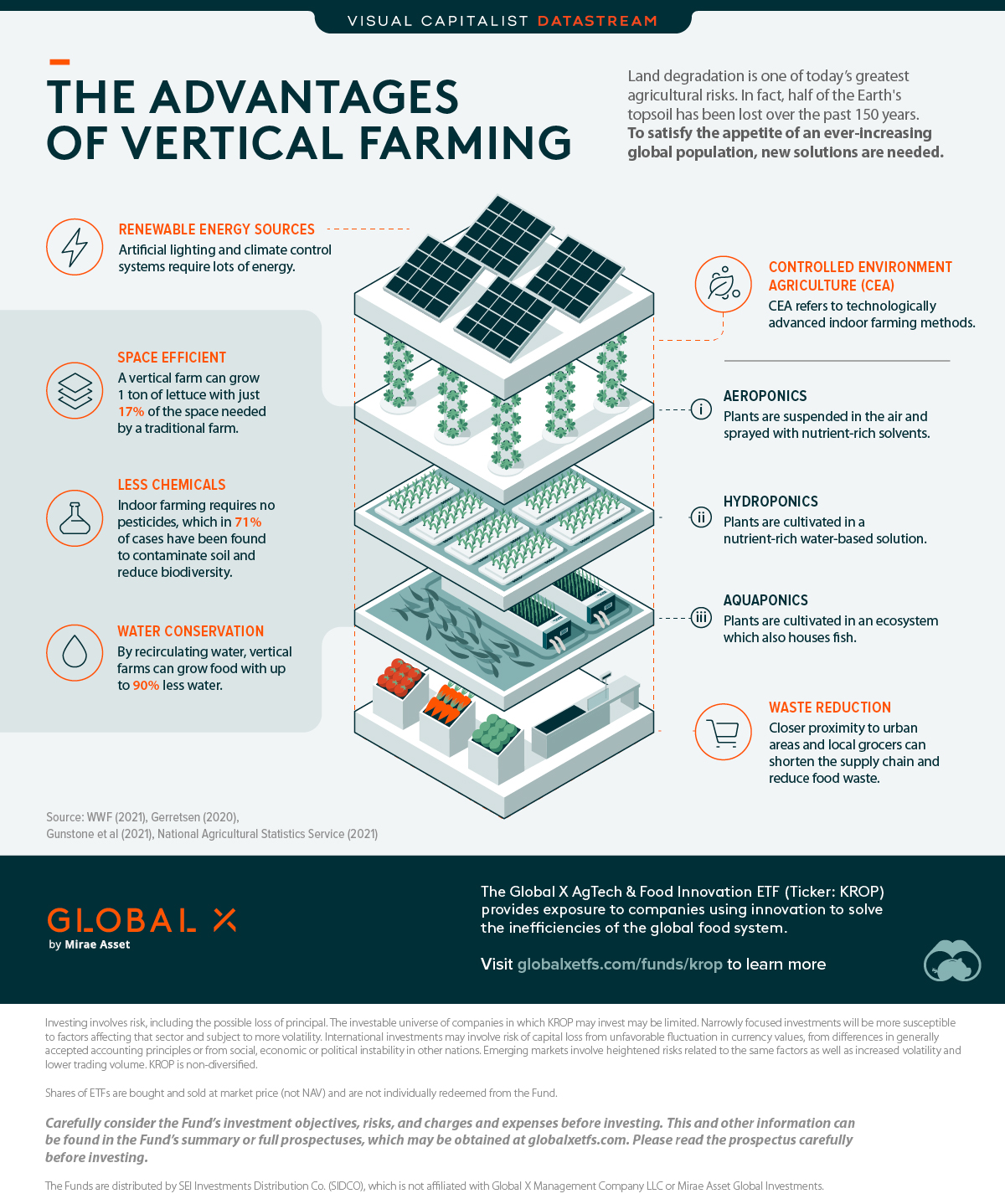
In this graphic sponsored by Global X ETFs, we’ve illustrated an innovative solution to land degradation known as vertical farming.
Advantages of Vertical Farming
Vertical farming is best defined as growing food indoors and on vertically stacked layers. It utilizes technologies known as controlled environment agriculture (CEA):
Aeroponics: Plants are suspended in the air and sprayed with nutrient-rich solvents
Hydroponics: Plants are cultivated in a nutrient-rich water-based solution
Aquaponics: Plants are cultivated in an ecosystem which also houses fish
Vertical farms can grow 1 ton of lettuce with just 17% of the space needed for a traditional farm, meaning they are much more space efficient. This is a direct solution for land degradation, but the benefits don’t end there.
Farming in a controlled environment cuts down on chemical usage because there is no longer a need for pesticides. A recent U.S. study found that in 71% of usage cases, pesticides have contaminated soil and reduced biodiversity.
Furthermore, vertical farms can reduce water use by up to 90% thanks to recirculation. This is a massive improvement when considering that traditional farms account for 70% of global water consumption.
What’s the Trade-off?
Like most things in life, vertical farms also have their drawbacks.
The first challenge is high energy consumption due to the lack of natural sunlight and water. Both of these inputs must be provided by using electricity, which may not be ideal depending on location. The second challenge is costs, not just because of energy consumption, but also due to the equipment needed for CEA systems.
The table below compares a traditional outdoor farm with a theoretical vertical farm. These estimates illustrate a clear trade-off between i) greater output and less water usage; and ii) a larger carbon footprint.
| Metric | Traditional Outdoor Farm | Vertical Farm | Percentage Difference |
|---|---|---|---|
| Lettuce output per 1 acre | 16 tons | 126 tons | +787% |
| Kg CO₂ emitted per ton of lettuce | 160 kg | 540 kg | +337% |
| KL of water used per ton of lettuce | 118 kL | 6 kL | -95% |
Traditional farm yields are based on the U.S. 2020 average. Source: Global X ETFs
With global population expected to reach 10 billion people by 2060, more efficient methods of farming are needed. Vertical farms, alongside other innovations in agriculture and food, could be the answer.
3 Reasons for the Fertilizer and Food Shortage
This was originally posted on Elements. Sign up to the free mailing list to get beautiful visualizations on natural resource megatrends in your email every week.
Bad weather, the Russian invasion of Ukraine, and a shortage of fertilizer have led to fears of a global food crisis.
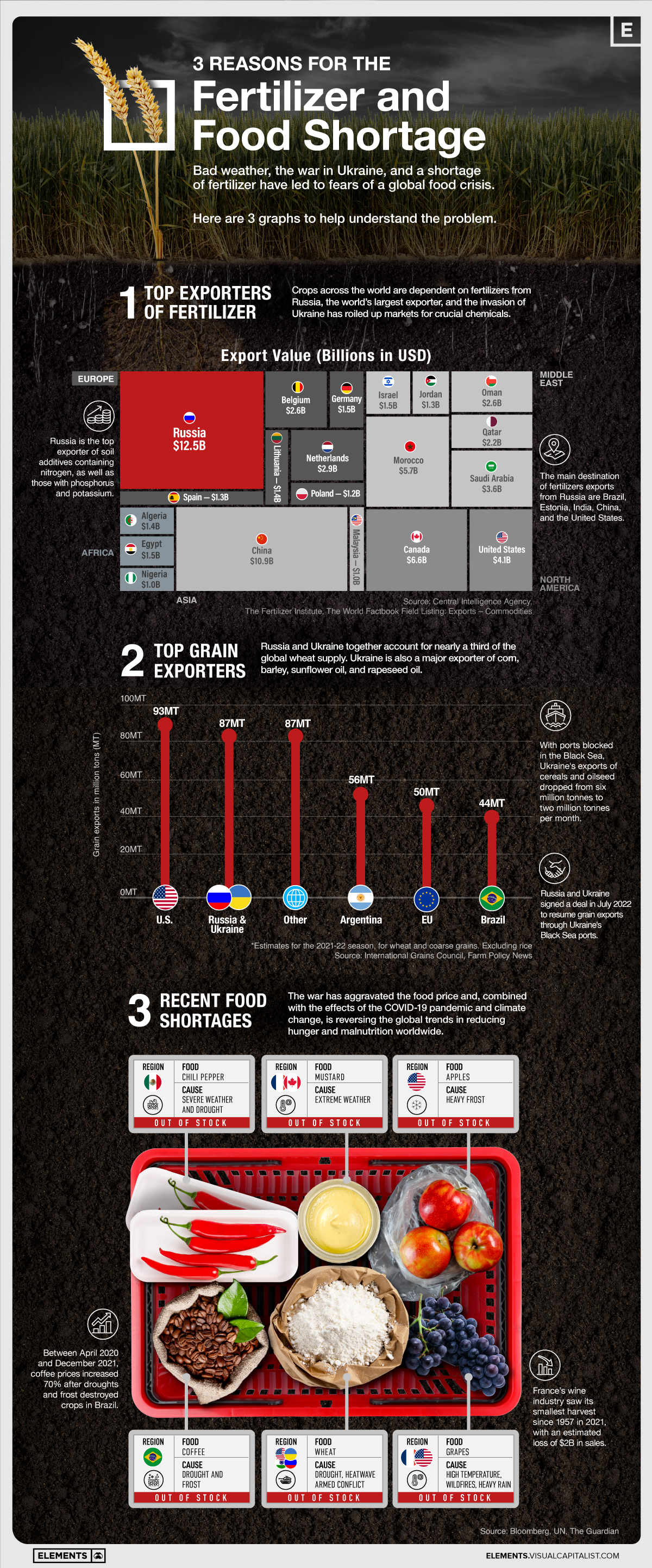
This infographic will help you understand the problem by highlighting three key factors behind the mounting food crisis.
#1: The Fertilizer Shortage
Since the beginning of the Russian invasion of Ukraine in February 2022, the war has disrupted shipments of fertilizer, an essential source of nutrients for crops.
Russia is the world’s top exporter of nitrogen fertilizer and ranks second in phosphorus and potassium fertilizer exports. Belarus, a Russian ally also contending with Western sanctions, is another major fertilizer producer. In addition, both countries collectively account for over 40% of global exports of the crop nutrient potash.
Here are the top 20 fertilizer exporters globally:
| Rank | Country | Exports Value (Billions in USD) |
|---|---|---|
| #1 | Russia | $12.5 |
| #2 | China | $10.9 |
| #3 | Canada | $6.6 |
| #4 | Morocco | $5.7 |
| #5 | United States | $4.1 |
| #6 | Saudi Arabia | $3.6 |
| #7 | Netherlands | $2.9 |
| #8 | Belgium | $2.6 |
| #9 | Oman | $2.6 |
| #10 | Qatar | $2.2 |
The main destination of fertilizer exports from Russia are large economies like India, Brazil, China, and the United States.
However, many developing countries—including Mongolia, Honduras, Cameroon, Ghana, Senegal, and Guatemala—rely on Russia for at least one-fifth of their fertilizer imports.
Furthermore, the war intensified trends that were already disrupting supply, such as increased hoarding by major producing nations like China and sharp jumps in the price of natural gas, a key feedstock for fertilizer production.
#2: Global Grain Exports
The blockade of Ukrainian ports by Russia’s Black Sea fleet, along with Western sanctions against Russia, has worsened global supply chain bottlenecks, causing inflation in food and energy prices around the world.
This is largely because Russia and Ukraine together account for nearly one-third of the global wheat supply. Wheat is one of the most-used crops in the world annually, used to make a variety of food products like bread and pasta. Additionally, Ukraine is also a major exporter of corn, barley, sunflower oil, and rapeseed oil.
| Producer | Grain Exports in Million Tons (MT) |
|---|---|
| United States | 93MT |
| Russia & Ukraine | 87MT |
| Argentina | 56MT |
| EU | 50MT |
| Brazil | 44MT |
| Other | 87MT |
As a result of the blockade, Ukraine’s exports of cereals and oilseed dropped from six million tonnes to two million tonnes per month. After two months of negotiations, the two countries signed a deal to reopen Ukrainian Black Sea ports for grain exports, raising hopes that the international food crisis can be eased.
#3: Recent Food Shortages
Besides the war in Ukraine, factors including the COVID-19 pandemic and climate change resulted in nearly one billion people going hungry last year, according to United Nations.
France’s wine industry saw its smallest harvest since 1957 in 2021, with an estimated loss of $2 billion in sales due to increasingly higher temperatures and extreme weather conditions.
Heat, drought, and floods also decimated crops in Latin America, North America, and India in recent months. Between April 2020 and December 2021, coffee prices increased 70% after droughts and frost destroyed crops in Brazil.
In the face of multiple crises, the World Bank recently announced financial support of up to $30 billion to existing and new projects in areas such as agriculture, nutrition, social protection, water, and irrigation.
Plant-Based Products: The Journey from Bean to Burger
Plant-Based Products: The Journey from Bean to Burger
As plant-based products become more and more popular, their demand continues to skyrocket.
As a result, alternatives like meatless meat are expected to take a bite out of the conventional protein market in the coming years. In fact, the global plant-based market value is expected to grow 5.5x to reach a projected $162 billion by 2030.
So how do these plant-based alternatives end up on people’s plates? This infographic from the Very Good Food Company (VGFC) traces the supply chain to discover how a plant-based product, such as a vegetable burger, goes from farm to fork.
Step 1: Source the Ingredients
Many meatless patties are made of ingredients ranging from: nuts, mushrooms, tofu, tempeh, grains, vegetables, beans, or legumes.
According to a survey of over 27,000 global consumers, 88% prioritize buying from companies with ethical sourcing strategies. Moreover, these trends are much more pronounced in younger consumers (aged 18-24), compared to older generations (aged 65+).
Step 2: Prepare the Ingredients
After inspection at the manufacturing plant, the ingredients are washed and thoroughly cleaned. This ensures that no dirt or bacteria is left on the raw, often organic products.
From there, the grains are cooked until softened, and strained. Meanwhile, the vegetables are chopped into uniform pieces, either by machine or by hand.
Step 3: Form the Patties
Once that’s done, pre-measured amounts of the grains and vegetables are mixed thoroughly in an industrial mixing bowl to achieve the right ratio.
The mixture is loaded into an automatic patty-making machine—which presses the vegetable burgers into round discs.
Step 4: Bake and Freeze the Patties
The newly formed plant-based patties are loaded onto baking trays, and cooked in an industrial-size oven. From here, they enter a freezing chamber (below 32°F/0°C).
This causes the patties to freeze within 30 minutes, causing ice crystals to form in them. When the meatless patties are cooked, the ice crystals melt, keeping them juicy.
Step 5: Package the Patties
The patties are vacuum packaged and sealed in plastic by serving size, and accompanied with pre-printed cardboard sleeves.
Vacuum sealing helps keep the patties fresher by increasing their shelf life and improving food safety. For many customers, whether or not a plant-based product has sustainable packaging will have a significant impact on their purchases:
67% of surveyed consumers consider recyclability to be important
83% of younger consumers would be willing to pay more for sustainably packaged products, compared to 70% of all consumers
As more and more veggie burgers get shipped to stores around the world, companies are looking for more sustainable ways to package patties and to reduce the need for single-use plastics.
The Benefits of Plant-Based Products
Not only are plant-based burgers cruelty-free, they also have a better environmental footprint compared to animal meat:
Produce 30-90% less GHG emissions
Use 47-99% less land
Use 72-99% less water
The Very Good Food Company is a global brand which prides itself on finding innovative ways to make the healthiest food possible. Because VGFC’s founders come from a restaurant background, the company naturally prioritizes organic, high-quality ingredients, with minimal processing throughout the supply chain.
Mapped: Where Does Our Food Come From?
Where Does Our Food Come From?
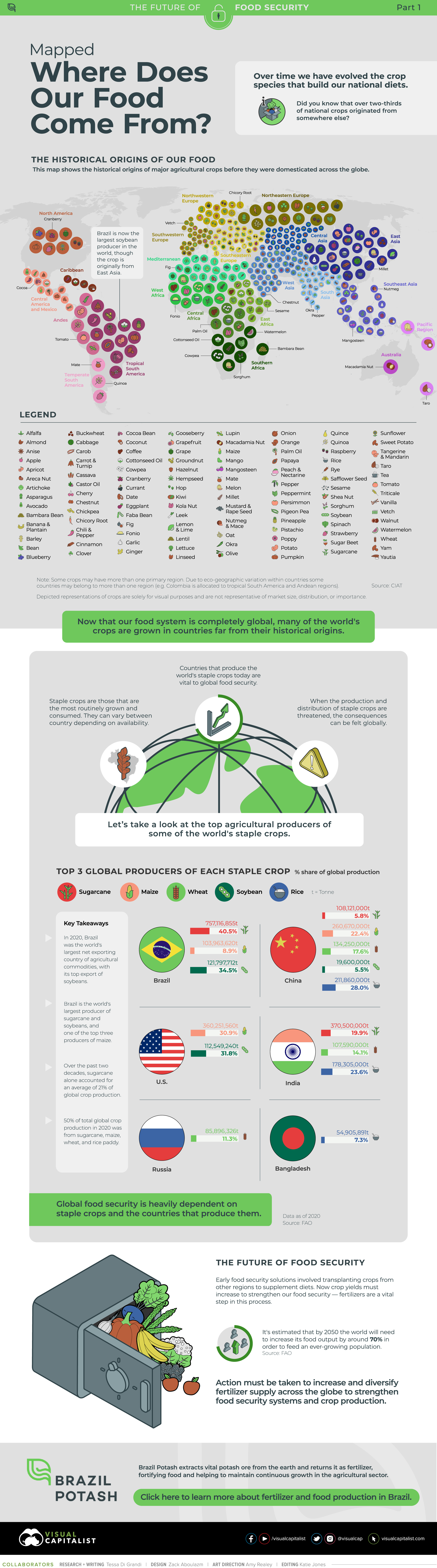
Did you know that over two-thirds of national crops originated from somewhere else?
Humans have been selecting and growing crops for specific traits since the origins of agriculture some 10,000 years ago, shaping where and what crops are grown today.
Now our food system is completely global and many of the world’s top producers of staple crops are in countries far from their historical origin. For example, Brazil is now the largest soybean producer in the world, though the crop is originally from East Asia.
The above infographic by Brazil Potash shows the historical origins of crops before they were domesticated across the globe and the main producers of our staple crops today.
Producers Of Staple Crops Today
Staple crops are those that are the most routinely grown and consumed. These can vary between countries depending on availability.
In 2020, sugarcane, maize, wheat, and rice made up around 50% of global crop production.
But when the production and distribution of staple crops are threatened, the consequences can be felt globally. Let’s take a look at the countries that were the top three producers of some of our staple crops in 2020.
| Crop | Country | Percentage of Global Production |
|---|---|---|
| Sugar Cane | Brazil | 40.5% |
| Sugar Cane | India | 19.9% |
| Sugar Cane | China | 5.8% |
| Maize | U.S. | 30.9% |
| Maize | China | 22.4% |
| Maize | Brazil | 8.9% |
| Wheat | China | 17.6% |
| Wheat | India | 14.1% |
| Wheat | Russia | 11.3% |
As you can see from the data above, Brazil is the world’s largest producer of sugarcane and one of the top three producers of maize.
The Future of Food Security
Global food security depends on staple crops and the countries that produce them. As the global population increases, so does the need to grow more crops.
The FAO estimates that by 2050 the world will need to increase its food output by around 70% in order to feed an ever-growing population.
Early food security solutions were transplanting crops from other regions to supplement diets. Now crop yields must increase as the next evolution in strengthening our food security. Fertilizers are a vital step in this process and are an essential ingredient in the future of global food security. They provide vital nutrients that increase crop production and strengthen nutrition security.
Brazil Potash extracts vital potash ore from the earth for it to return to the earth as fertilizer, fortifying food and helping to maintain continuous growth in the agricultural sector.
交互式地图:跟踪世界饥饿和粮食不安全
交互式地图:跟踪世界饥饿和粮食不安全
饥饿仍然是世界上最大也是最容易解决的问题之一。
根据联合国世界粮食计划署 (WFP)的数据,每天有超过 7 亿 人(占世界人口的 8.8%)空腹入睡。
此处显示的世界粮食计划署的 实时饥饿地图 跟踪严重饥饿的核心指标,如家庭食品消费、生计、儿童营养状况、死亡率和获得清洁水的情况,以便对国家进行排名。
但是,虽然 严重 饥饿衡量的是短期无法满足食品消费需求,通常与危机有关,但世界上许多人也遭受 长期 饥饿。这是持续无法满足食物消费要求,通常持续至少六个月。
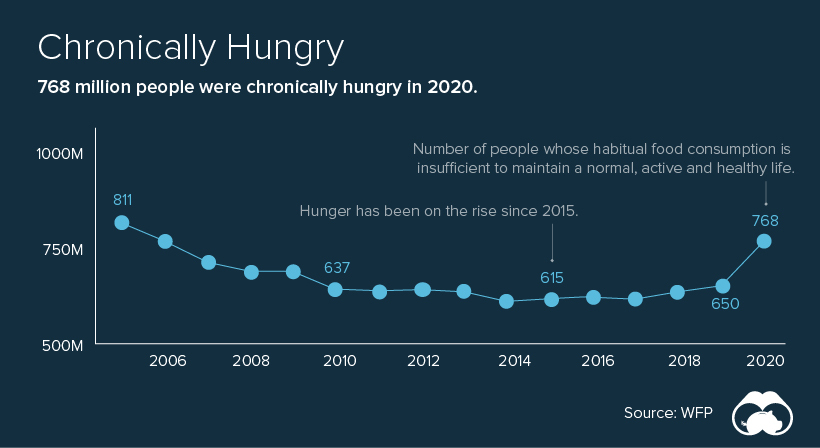
在 2014 年至 2019 年坐着将近 6 亿之后,在 COVID-19 大流行期间,世界上受饥饿影响的人数 有所增加。
2020 年, 1.55 亿 人(占世界人口的 2%)遭受严重饥饿,需要紧急援助。
为养活世界而战
世界饥饿问题并不新鲜,解决这个问题的尝试几十年来一直是头条新闻。
1985 年 7 月 13 日,在伦敦温布利大球场,查尔斯王子和戴安娜王妃正式开启了 Live Aid,这是一场全球摇滚音乐会,旨在为遭受饥荒的非洲人筹集资金。
此次活动之后在世界各地的其他场馆举行了类似的音乐会,通过卫星将全球 110 个国家的超过 10 亿观众连接起来,为非洲的饥荒救济筹集了超过 1.25 亿美元(按今天的美元计算为 3.09 亿美元)。
但 35 多年后,非洲大陆仍在苦苦挣扎。据联合国统计,世界上粮食消费不足发生率最高的 12 个国家中,有 9 个在非洲。
| 国家 | 受饥饿影响的人口百分比 | 人口(百万) | 地区 |
|---|---|---|---|
阿富汗  | 93% | 40.4 | 亚洲 |
索马里  | 68% | 12.3 | 非洲 |
布基纳法索  | 61% | 19.8 | 非洲 |
南苏丹  | 60% | 11.0 | 非洲 |
他们有  | 60% | 19.1 | 非洲 |
塞拉利昂  | 55% | 8.2 | 非洲 |
叙利亚  | 55% | 18.0 | 中东 |
尼日尔  | 55% | 22.4 | 非洲 |
莱索托  | 50% | 2.1 | 非洲 |
几内亚  | 48% | 12.2 | 非洲 |
贝宁  | 47% | 11.5 | 非洲 |
也门  | 44% | 30.0 | 中东 |
非洲 约有 3000 万人面临严重 粮食不安全的影响,包括营养不良、饥饿和贫困。
浪费的剩菜
尽管全球粮食危机的许多原因都涉及冲突或环境挑战,但 粮食浪费是其中一个重要因素。
据联合国称,全球有三分之一的供人类消费的食物丢失或浪费了。这相当于 每年浪费约13 亿吨食物,价值约 1 万亿美元。
所有生产但从未食用的食物足以 养活 20 亿 人。这是全球营养不良人数的两倍多。富裕国家的消费者每年浪费的食物几乎与撒哈拉以南非洲的全部净食物产量一样多。
解决世界饥饿
虽然许多人在身体不适的意义上可能并不“饥饿”,但他们可能仍然粮食不安全,无法定期获得足够安全和营养的食物来维持正常的生长发育。
据估计,消除世界饥饿需要 每年 70 亿至 2650 亿美元。
但要解决这个问题,投资必须用在正确的地方。专家表示,政府和组织需要向风险最大的地区提供粮食和人道主义救济,提高农业生产力,并投资于更高效的供应链。
投资者应了解植物性食品市场的 10 件事
投资者应了解的有关植物性食品市场的知识
植物性食品越来越受欢迎——而且 速度很快。
到 2030 年,全球植物性食品市场的 价值预计将达到1619 亿美元。 与 2021 年相比增长了 355% 。
有兴趣投资这个快速发展的行业吗?这张来自 Very Good Food Company (VGFC)的图片 强调了您应该了解的有关植物性食品市场未来的信息。
1. 消费者越来越注重健康
随着植物性食品越来越受欢迎,并且有更多的产品可供选择,消费者开始更加挑剔他们愿意购买的产品类型。
对于许多消费者而言,健康是做出购买决定时的关键考虑因素。一项全球调查显示,在 8,500 名受访者中,超过 50% 的人 出于健康原因是素食主义者。
但并非任何植物性产品都能减少它。消费者开始对企业提出 更高的标准,期望植物性产品具有高营养价值、低盐含量和优质蛋白质。
2. 消费者的社会意识越来越强
消费者也越来越了解环境问题,以及植物性饮食如何帮助减少 温室气体排放。根据与上述相同的调查,出于环境和可持续发展的原因,近三分之二 (64%) 的受访者是素食主义者。
一些专家认为,随着气候变化的影响在全球范围内变得更加明显,这个数字只会增加。
3. 以植物为基础的技术创新涌入
随着消费者需求的增长和对 植物性食品行业 不断发展的期望,这一领域的新技术进步正在迅速涌现。
例如,细胞培养肉市场正在迅速获得关注。细胞培养肉是在实验室中用动物细胞培育出来的肉。它在生物学上与传统肉类相同。
虽然细胞培养肉尚未大规模进入商业市场,但一些初创公司已经上市,例如 MeaTech3D、 Mosa Meat和 UPSIDE Foods。最近, MeaTech 宣布计划到 2022 年开始预生产细胞培养鸡脂肪。
未来 20 年,细胞培养肉的使用量预计将飙升。事实上,到 2040 年,它可能占 全球肉类市场的35% ,这将导致传统肉类的市场份额急剧下降。
4. 植物基市场多元化
除了肉类替代品,其他植物性替代品也越来越受欢迎,尤其是鸡蛋替代品和涂抹酱。2020 年,美国植物性鸡蛋销售额达到 2700 万美元,比上年增长 167.8%。
| 类别 | 2020年销售额 | 同比增长 |
|---|---|---|
| 植物性鸡蛋 | 2700万美元 | 167.80% |
| 植物奶 | 25亿美元 | 20.40% |
| 植物性奶酪 | 2.7亿美元 | 42.50% |
| 植物性涂抹酱、蘸酱、酱汁 | 6100万美元 | 83.40% |
虽然鸡蛋替代品和涂抹酱增长迅速,但植物奶仍然是总销售额中最受欢迎的产品类别,占植物性食品市场总量的 35%。
5. 零售商推动以植物为基础
零售商开始注意到植物性产品的日益流行,并因此将植物性食品整合到他们的产品中。
例如, 英国最大的杂货店品牌Tesco预计到 2025 年植物基产品的销售额将增长 300% 。 而 全球最大的食品和饮料制造商之一 联合利华预计将从 植物基肉类中获得12 亿美元的收入和乳制品在未来五到七年内的销售额—— 比他们 2020 年的替代品销售收入高出约5 倍。
6. 以植物为基础的公司发展迅速
由于市场蓬勃发展,许多植物性食品公司正在经历显着增长。例如,加拿大植物性食品公司 The Very Good Food Company 的收入从 2020 年第一季度到 2021 年第一季度增长了 680%。
在同一时间段内,VGFC 的产品销售额增长了 77%,其电子商务销售额增长了 1744%。自从该公司最近与 Waygar Capital 和 Ninepoint Partners 达成了7000 万美元的 贷款协议以帮助扩大业务以来,即将出现更多增长 。
7.越来越多的消费者成为弹性素食者
并不是每个人都在过渡到完全以植物为基础的生活方式。
随着植物性饮食的好处越来越明显,越来越多的人开始限制肉类摄入量,或者成为 弹性素食者——主要吃植物性饮食,但偶尔吃肉或鱼的人。
事实上,近 三分之一 的美国人减少了肉类和奶制品的消费,并认为自己是弹性素食主义者。
| 类别 | 调查受访者百分比 |
|---|---|
| 杂食动物 | 65% |
| 弹性素食主义者 | 29% |
| 素食者 | 4% |
| 素食主义者 | 2% |
做一个弹性素食主义者比以往任何时候都更容易,因为植物性产品变得更容易获得,肉类替代品的味道也有所改善。
8. 餐厅正在采用更多以植物为基础的选择
由于消费者的需求,餐厅正在调整和创造更具包容性的菜单,为客人提供多样化的素食、素食和无乳制品选择。
A&W 是一家颇受欢迎的加拿大快餐连锁店,早在 2018 年就推出了植物汉堡。由于其受欢迎程度,该餐厅正在通过在菜单中添加 Beyond Meat 肉块来扩展其植物菜单 选项。
9. 年轻一代优先考虑植物性饮食
以植物为基础的运动主要是由年轻一代推动的。
在对 1,200 多名受访者进行的一项调查中, 22% 的千禧一代表示他们在生活中的某个时刻采取了素食生活方式,而 X 世代和 婴儿潮一代的这一比例仅为13%和11% 。
许多千禧一代,即使他们没有完全以植物为基础,也试图限制他们的肉类摄入量——45% 的千禧一代受访者声称他们正在积极尝试减少肉类消费。
然而,Z 世代是植物性运动背后的推动力,其中 79% 的人声称每周吃一到两次植物性食物。
10. 政府支持植物产业
独立企业并不是推动以植物为基础的繁荣的唯一参与者——政府也在加紧支持这个快速发展的行业。
例如,加拿大政府最近宣布计划 向植物性食品行业 投资1.5 亿美元,并与Protein Industries Canada签署了一项协议。这笔资金将用于植物性食品制造、研发和技术创新。
未来以植物为基础
有多种驱动因素支持快速增长的植物性食品行业,因此,预计在不久的将来会有更多增长。
像 VGFC 这样的公司处于这一运动的前沿,提供不牺牲口味且未经高度加工的产品。
饥饿大流行:COVID-19 效应
关于全球粮食不安全
COVID-19 如何加剧全球粮食不安全
在 COVID-19 占据头条新闻的同时,另一种紧急情况正在威胁着全世界数百万人的生命——粮食不安全。
然而,两者是非常交织在一起的。到 2020 年底,当局估计全球将有超过 2.65 亿 人处于饥饿边缘,几乎是目前危机级别粮食不安全率的两倍。
今天的可视化使用第四份年度全球粮食危机报告 ( GRFC 2020 ) 中的数据来展示当前形势的规模不断扩大,以及它在全球仅 55 个国家的高度集中。
全球概览
该报告着眼于严重粮食不安全的普遍存在 ,这对生活、生计或两者都有严重影响。粮食安全阶段综合分类 ( IPC )如何对严重粮食不安全的不同阶段进行分类?
阶段 1: 最小/无
第 2 阶段: 压力大
第三阶段: 危机
第四阶段: 紧急情况
阶段 5: 灾难/饥荒
根据 IPC,必须采取紧急行动从第 3 阶段开始减轻这些影响。已经有 1.35 亿 人经历严重的粮食不安全(第 3 阶段或更高阶段)。以下是按国家/地区细分的方式:
| 国家/地区 | 分析的总人口(百万) | 危机中的人口(第 3 阶段以上,数百万) | 危机中分析人口的比例 |
|---|---|---|---|
| 阿富汗¹ | 30.7 | 11.3 | 37% |
| 安哥拉¹ (3 个省的 24 个市镇) | 0.9 | 0.6 | 62% |
| 孟加拉国 (科克斯巴扎尔和东道国人口) | 3.5 | 1.3 | 37% |
| 布基纳法索1 | 21.4 | 1.2 | 6% |
| 布隆迪 | 11.5 | 0.2 | 2% |
| 佛得角 | 0.5 | 0.01 | 2% |
| 喀麦隆¹ (7 个地区) | 16.1 | 1.4 | 8% |
| 中非共和国¹ (不包括 Lobaye) | 4.4 | 1.8 | 41% |
| 乍得¹ | 14.3 | 0.6 | 4% |
| 哥伦比亚¹ (委内瑞拉移民) | 1.6 | 0.9 | 55% |
| 象牙海岸 | 19.8 | 0.06 | 0% |
| 总人口 | 8.251亿 | 1.3499亿 |
显示第 1 到 11 个条目,共 55 个条目
资料来源:GRFC 2020,表 5 – 2019 年发生粮食危机的国家严重粮食不安全人口的峰值
数量
在灾难中(IPC/CH 阶段 5)
尽管即使在最好的时候,饥饿也是一个紧迫的全球性问题,但 COVID-19 大流行的持续影响预计将使这些数字增加近一倍,增加 1.3 亿人——到 2020 年底总计 2.65 亿人 。
从这个角度来看,这大致等于美国每个城镇的人口总和。
危机中的大陆
粮食不安全影响着世界各地的人口,但非洲面临的障碍比任何其他大陆都大。下面的地图提供了更深入的了解:
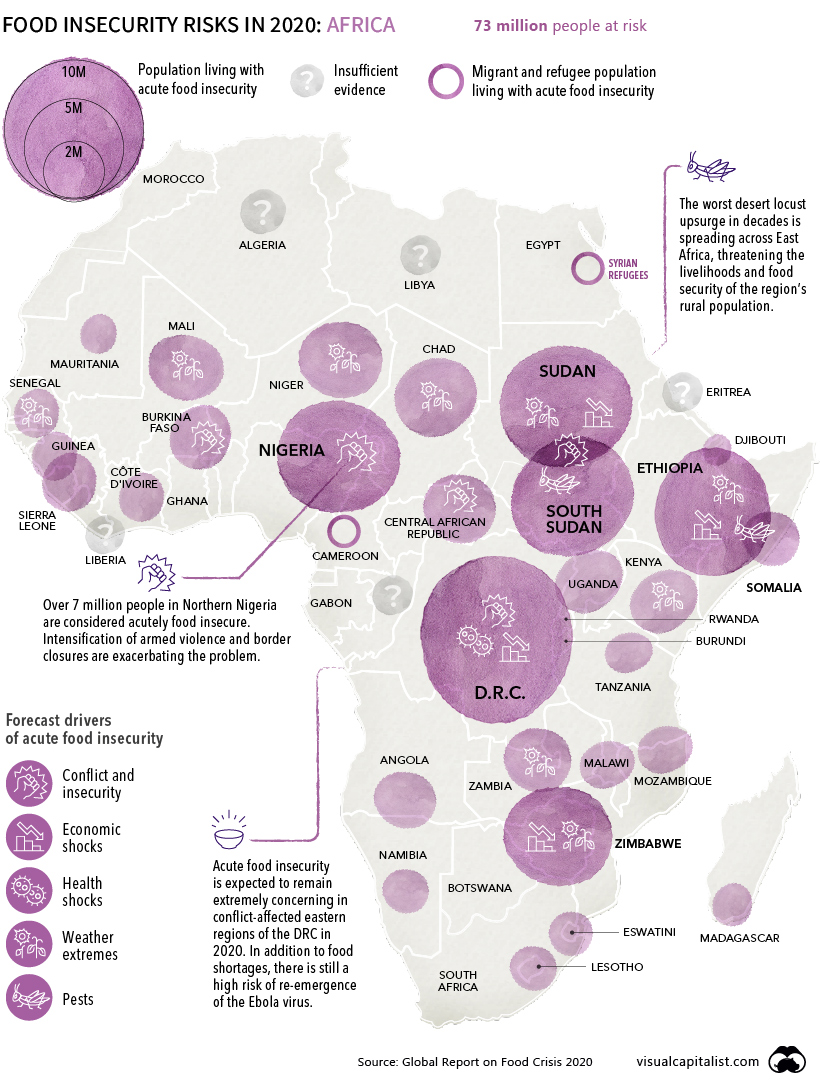
报告分析的人口中有一半以上( 7300 万人 )位于撒哈拉以南非洲。在整个非洲大陆发现的严重粮食不安全的主要驱动因素包括:
冲突/不安全
示例:州际冲突、内部 暴力、区域/全球不稳定或政治危机。
在许多情况下,这些导致人们流离失所成为难民。极端天气
示例:干旱和洪水经济冲击
宏观经济例子:恶性通货膨胀和货币贬值
微观经济例子:食品价格上涨,购买力下降害虫
示例:沙漠蝗虫、粘虫健康冲击
示例:疾病爆发,水质、卫生设施或空气质量差可能会加剧这种情况流离失所
冲突、粮食不安全和天气冲击的主要副作用。
一个受到严重影响的国家是刚果 民主共和国,该国有超过 1500 万人 面临严重的粮食不安全问题。刚果民主共和国东部地区正经历激烈的武装冲突,截至2020年3月,该国也面临埃博拉疫情卷土重来的高风险。
与此同时,在东非,新一代 蝗虫 袭击了农田,摧毁了数百万人的重要粮食供应。天气条件将这群不断增长的数万亿只蝗虫推向了通常不习惯与害虫打交道的国家。蜂群有可能在短短几个月内呈指数增长,因此这可能会在 2020 年继续在该地区造成大问题。
中东和亚洲的不安全
在中东,还有 4300 万人面临着类似的挑战。 也门 是世界上粮食最不安全的国家,有 1590 万人 (占分析人口的 53%)处于危机之中。它也是唯一一个粮食不安全处于灾难(IPC/CH 阶段 5)级别的地区,这是近三年内战的结果。
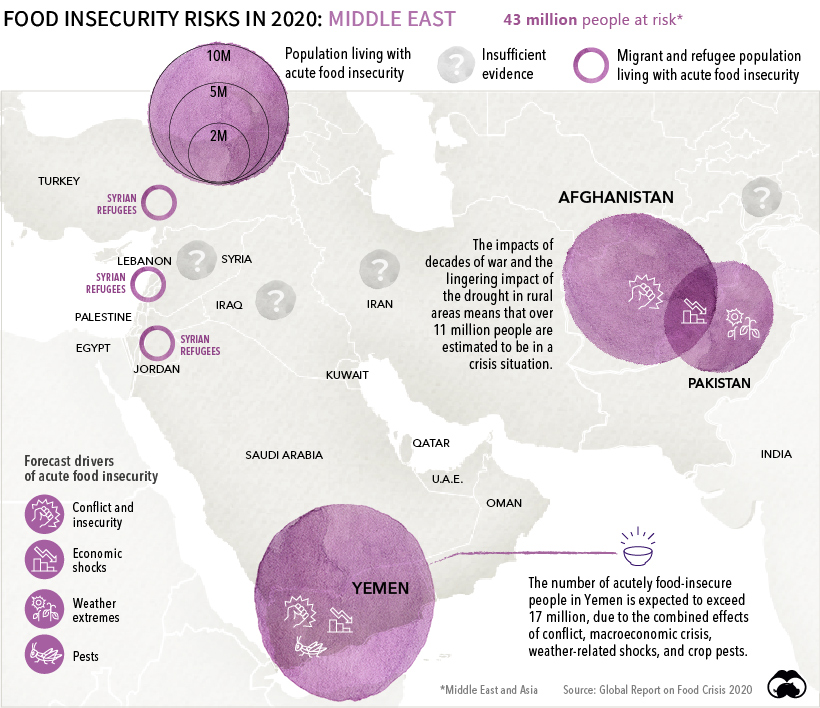
中东另一个动荡不安的地方是阿富汗,那里有 1130 万人 发现自己处于严重粮食不安全的危急状态。2020 年 1 月至 3 月期间,超过 138,000 名 难民从伊朗和巴基斯坦返回该国,给粮食资源带来了压力。
在接受分析的巴基斯坦人口中,超过一半 (51%) 也面临严重的粮食不安全问题,这一比例在亚洲最高。这些数字因极端天气条件而恶化,例如低于平均水平的季风降雨。
不完整的分析
随着 COVID-19 使经济状况恶化,它还可能导致主要人道主义组织的资金削减。 据世界粮食计划署执行主任称,如果发生这种情况,每天可能有超过 30 万人死亡。
GRFC 报告还警告说,由于存在重大数据缺口和持续存在的挑战,这些预测仍然不够充分。由于可用数据不足,伊朗或菲律宾等 16 个国家未被纳入分析。
需要做更多的工作来了解全球粮食不安全的真正严重性,但显而易见的是,持续的大流行不会给这些地区带来任何好处。到尘埃落定之时,粮食不安全问题可能会变得更加复杂。
培养食品留在这里的 5 个原因
培养食品留在这里的 5 个原因
想象一个人类可以在不伤害任何动物作为食物的情况下茁壮成长的世界。
通过减少肉类消费并转向植物性饮食,到 2050 年我们可以减少 70% 的温室气体排放 ,并且每人每年可以减少 105 只动物。
细胞农业有能力让这种转变不那么令人生畏。上面的信息图来自 CULT Food Science(CSE:CULT), 探讨了为什么用细胞培养物生产的食物可以让这个世界成为现实的五个原因。
培养食品的案例
首先,细胞农业一词描述了直接从细胞培养物而不是使用牲畜来种植动物农产品的过程。
由细胞培养物生产的食品(也称为培养食品)可以为我们目前面临的各种问题提供有前途的解决方案。
听起来好得令人难以置信?让我们深入探讨培养食品留在这里的一些原因:
1. 迫切需要一个更可持续的食物系统
随着人口以前所未有的速度增长,迫切需要更健康和负担得起的食物选择。
与传统肉类相比,培养食品可以提供更有效的解决方案。事实上, 与饲养牛等农场动物需要 52 周以上的时间相比,创造一种人造肉产品仅需2-3 周。
与动物来源的行业相比,细胞培养生产的食品也可能更能抵御供应链中断。
2. 培养食品可以减少排放
传统农业占全球所有排放量的 15%,牛肉每份产生的温室气体水平最高。
另一方面,养殖食品制造厂可能产生的排放物是:
比牛肉低 92%
比猪肉低52%
比鸡肉低17%
需要注意的是,这些数字指的是使用可再生能源的工厂。由细胞培养物制成的食物还需要更少的土地和水资源使用,这意味着它们总体上可能是一种更环保的选择。
3. 培养食品很快就能以平价生产
2021 年,美国肉类、家禽、鱼类和鸡蛋的价格上涨了 11.9% ,是 1990 年以来的最快涨幅。
虽然以植物为基础的替代品试图扰乱肉类市场,但这些产品至少要到 2023 年才能实现价格平价。
由于这是一个未知领域,因此培养食品领域的新公司有巨大的机会提供大规模降低成本的解决方案。
“一些专家认为,在十年内,养殖肉类产品将在成本上与传统肉类产品竞争。”
—加拿大食品
4. 市场上产品的更健康替代品
事实证明,长期吃肉是有害的。事实上,根据哈佛医学院的说法,吃红肉与心脏病、癌症、糖尿病和过早死亡之间存在明显的联系。
同样,虽然吃植物性食物有很多好处,但市场上的一些植物性产品可能含有填充剂、添加的钠和更高的饱和脂肪。
相比之下,养殖食品是在安全可控的环境中种植的,它具有以下几个好处:
培养食品可能不太可能被大肠杆菌等细菌污染
由于几乎不需要牲畜,因此生产养殖食品所需的抗生素更少
因此,从长远来看,培养食品可以为肉类和植物性产品提供更健康的替代品。
5. 加速研究突破、监管变革和资本流动
尽管人口增长给食品供应链带来压力,但肉类消费实际上正在减少。
这意味着传统肉类产品的市场最快将 在 2040 年被植物替代品和培养肉等其他选择所取代。
为了跟上这些重大的市场变化,干细胞研究和组织工程领域的创新正在加速。 根据 Crunchbase 的数据,自 2020 年以来,已向市场注入了高达 20 亿美元的投资。
更重要的是,我们开始看到世界各地的监管发生变化,新加坡成为第一个将养殖肉类产品的销售合法化的国家。
投资食品的未来
CULT Food Science 是一个创新投资平台,推动食品未来背后的技术发展,专注于人造肉、人造乳制品和细胞食品。
该公司的投资组合横跨四大洲,包括涉足以下多元化渠道:
细胞系
终端产品
脚手架技术
生长培养基
知识产权
想要保持更新?
功能性食品的兴起:
投资者需要知道什么
功能性食品的兴起:投资者需要知道的
在 COVID-19 大流行之后,消费者正在寻找将食物用作药物的新方法,以帮助保护他们免受疾病侵害。因此,功能性食品市场蓬勃发展。
但这只是流行语,还是投资者应该认真考虑的增长市场?
上面来自Billy Goat Brands(CSE:GOAT)(“GOAT”)的信息图 分解了投资者需要了解的有关市场结构的关键点。
功能性食品:基础知识
首先,让我们解释一下功能性食品的含义。
功能性食品是一个总括性术语,它描述的食物除了其基本营养价值外,还对您的健康产生积极影响 。
以燕麦片为例。它含有可溶性纤维,可以帮助降低胆固醇水平和减少炎症。因此,它被认为是一种功能性食品。这些食物的好处可能包括:
预防疾病
预防营养缺乏
促进生长发育
有些食物还添加了营养素以增强其营养成分,例如添加了维生素 D 的牛奶,因此可以为消费者提供同样的好处。
尽管围绕功能性食品一词的官方定义存在很多争论,但最重要的是要记住,它们是具有额外益处的食品——无论是天然的超级食品,还是在生产过程中得到强化。
让我们更深入地了解市场。
功能性食品市场剖析
鉴于消费者价值观的转变,此类食品的市场预计将在未来十年内出现显着增长,预计到 2027 年将达到 2600 亿美元 —— 复合年增长率 (CAGR) 为 8.5%。
尽管该行业处于发展的早期阶段,但多个子行业正在以不同功能性食品类型的形式出现。
| 食物类型 | 定义 | 例子 |
|---|---|---|
| 强化 | 添加了维生素、矿物质或氨基酸的食品或饮料。 | 富含维生素 C 的果汁、富含维生素 D 的酸奶、富含蘑菇的咖啡。 |
| 丰富 | 添加了可能在加工过程中丢失的营养成分的食品或饮料。 | 富含叶酸或铁的小麦粉,富含维生素 B 的意大利面。 |
| 改变了 | 去除、减少或用另一种具有更有益效果的物质替代的食品或饮料。 | 低脂牛奶、植物性肉类替代品。 |
| 未更改 | 天然含有更多营养素或成分的食物或饮料。 | 全食物,如坚果、种子、大蒜和西红柿。 |
| 增强型 | 通过特殊的生长条件、新的饲料成分、基因操作或其他方式自然增强其中一种成分的食品或饮料。 | 通过改变鸡饲料、抗虫玉米等转基因作物获得的 omega-3 含量增加的鸡蛋。 |
植物性肉类替代品等改良食品 正在席卷全球,预计仅在 2022 年就将达到近 110 亿美元 。
投资全球增长最快的功能性食品公司
Billy Goat Brands(CSE:GOAT)为人们提供了一种简单的方式,可以将资金投资于注重健康、注重可持续发展和 ESG 驱动的公司组合,例如 FunGuys Beverages。
FunGuys Beverages 是一家加拿大制造商和分销商,以其面向消费者的品牌:KOLD 生产有机白桦茸和狮子鬃毛冷萃咖啡产品。
该公司旨在占领美国功能性蘑菇市场的一部分,并将通过成熟的电子商务平台进入北美市场。
投资者指南
到农业科技和食品创新

农业科技与食品创新投资者指南
由于三大趋势,全球粮食系统正承受着巨大压力:
人口增长
这自然会导致对食物的需求增加。到2060年,联合国预计全球人口将达到100亿。现有农业产能有限
现有耕作方式非常耗费资源,生产已经走到了尽头。联合国预测,到2050年,粮食产量需要增加70%。不可持续的消费
世界正在消耗不可持续数量的食物,尤其是肉类。虽然牲畜占农业用地的 80%,但它提供的热量仅占全球热量供应的 18%。
随着这些趋势的碰撞,农业技术 (AgTech) 和食品创新正在成为两种可能的解决方案。这张来自 Global X ETF 的信息图 将对两者进行解释。
农业科技的主要主题
AgTech 是利用技术在保护水和土地的同时最大限度地提高作物产量。这是对其细分的快速解释。
精准农业
精准农业是将人工智能 (AI) 和物联网 (IoT) 整合到传统农业实践中。这些技术可以为农民提供更多数据,而这些数据又可以用来提高效率。
一个例子是 John Deere See & Spray 机器,它使用各种传感器来检测杂草的位置。通过只喷洒杂草,农民可以减少高达 77% 的除草剂使用量。
机器人与自动化
机器人和自动化旨在减少农业所需的体力劳动。这个价值数十亿美元的市场包括 自动浆果采摘机,其生产率比人类高出 60% 以上。
无人机也可以发挥作用,尤其是在缺水地区。例如,加利福尼亚州的农民正在投资无人机来监测田地是否存在泄漏和其他问题。他们声称这项技术减少了 40% 以上的水输入。
受控环境农业 (CEA)
CEA 是在室内环境中种植植物。这个市场仍处于起步阶段,但几乎在任何地方、全年都可以种植粮食的能力可能会改变农业的竞争环境。
最突出的 CEA 方法之一是 水培法,植物在营养丰富的水基溶液而不是土壤中种植。水培法可以缓解世界上的许多农业问题:
| 问题 | 水培效益 |
|---|---|
| 粮食不安全 | 源源不断的养分意味着作物比传统方法多 7 到 14 个生长周期。 |
| 水资源短缺 | 水培系统使用循环水,这意味着植物生长所需的水最多可减少 90%。 |
| 土地退化 | 水培系统可以垂直堆叠,这意味着农民可以在相同的空间内种植比传统农场多 3 到 10 倍的食物。 |
资料来源:普林斯顿大学
随着全球粮食系统面临越来越大的压力,需要创新的颠覆方式来实现长期的可持续性。AgTech 解决方案固然可以提高产量,但在消费端可以做些什么呢?
食品创新
食品创新是指植物性食品和其他替代品,例如实验室培育的肉类。鉴于肉类和奶制品行业的巨大规模(和碳足迹),这些创新可以获得 环境效益。
就市场份额而言,替代食品还有很长的路要走。下表按类别列出了 2020 年全球肉类和奶制品销售额。
| 市场 | 传统选项 | 备选方案 | 总计替代份额 |
|---|---|---|---|
| 肉 | 1.4 万亿美元 | 60亿美元 | 0.43% |
| 奶制品 | 5740亿美元 | 180亿美元 | 3.14% |
资料来源:Global X ETF
考虑到 80% 的美国人已经购买或愿意在未来购买替代肉类产品,投资者可能将该行业视为一个有吸引力的增长机会。
进一步来看,一些分析人士认为,到 2040 年,人造肉(实验室培育肉)将占 全球市场的35% 。
推出 Global X AgTech & Food Innovation ETF
Global X AgTech & Food Innovation ETF (股票代码:KROP) 力求提供与 Solactive AgTech & Food Innovation Index的价格和收益表现(扣除费用和开支之前)大致对应的投资结果。
| 部门 | 指数权重 |
|---|---|
| 必需消费品 | 44.8% |
| 材料 | 37.3% |
| 工业品 | 11.6% |
| 卫生保健 | 4.1% |
| 非必需消费品 | 2.1% |
截至 2022 年 1 月 31 日
投资者可以使用这种被动管理的解决方案来接触农业和食品行业的创新。
简报会
土地退化是一个长期的可持续性风险
与传统方法相比,垂直农场可以用更少的土地和水在室内种植食物
垂直农业是未来吗?
根据世界野生动物基金会 (WWF) 的数据,在过去的 150 年中,地球表土的一半已经流失。这个问题被称为 土地退化,它是由干旱、过度耕作和污染等自然和人为因素造成的。
在这张由 Global X ETF赞助的图表中,我们展示了一种称为垂直农业的土地退化创新解决方案。
垂直农业的优势
垂直农业的最佳定义是在室内和垂直堆叠的层上种植食物。它利用称为 受控环境农业 (CEA)的技术:
气培法:将植物悬浮在空气中并喷洒富含营养的溶剂
水培法:植物在营养丰富的水基溶液中栽培
鱼菜共生:植物在一个生态系统中种植,该生态系统也有鱼
垂直农场可以种植 1 吨生菜, 所需空间仅为传统农场的17% ,这意味着它们的空间效率更高。这是土地退化的直接解决方案,但好处还不止于此。
在受控环境中耕种可以减少化学品的使用,因为不再需要杀虫剂。美国最近的一项研究发现,在 71% 的使用案例中,杀虫剂 污染了土壤并减少了生物多样性。
此外,由于再循环,垂直农场可以减少高达 90% 的用水量。考虑到传统农场占 全球用水量的70% ,这是一个巨大的进步。
什么是权衡?
与生活中的大多数事物一样,垂直农场也有其缺点。
第一个挑战是由于缺乏自然阳光和水而导致的高能耗。这两种输入都必须通过使用电力来提供,这可能并不理想,具体取决于位置。第二个挑战是成本,不仅仅是因为能源消耗,还因为 CEA 系统所需的设备。
下表比较了传统的室外农场和理论上的垂直农场。这些估计说明了i) 更高的产量和更少的用水量之间的明确权衡 ;ii ) 更大的碳足迹。
| 公制 | 传统户外农场 | 垂直农场 | 百分比差异 |
|---|---|---|---|
| 生菜亩产 | 16吨 | 126吨 | +787% |
| 每吨生菜排放的千克二氧化碳 | 160公斤 | 540 公斤 | +337% |
| 每吨生菜使用 KL 水 | 118千升 | 6千升 | -95% |
传统农场的产量是基于美国 2020 年的平均水平。资料来源:Global X ETF
到 2060 年,全球人口预计将达到 100 亿,因此需要更高效的耕作方法。垂直农场以及 农业和食品领域的其他创新可能就是答案。
肥料和粮食短缺的 3 个原因
这最初发布在 Elements上。注册 免费邮件列表, 每周在您的电子邮件中获得关于自然资源大趋势的精美可视化。
恶劣的天气、俄罗斯入侵乌克兰以及化肥短缺引发了对全球 粮食危机的担忧。
此信息图将通过强调日益严重的粮食危机背后的三个关键因素来帮助您理解问题。
#1:化肥短缺
自 2022 年 2 月俄罗斯开始入侵乌克兰以来,战争中断了肥料的运输,肥料是农作物的重要营养来源。
俄罗斯是世界上最大的氮肥出口国,磷钾肥出口量位居第二。白俄罗斯是另一个主要的化肥生产国,它也是俄罗斯的盟友,也在应对西方的制裁。此外,这两个国家合计占 全球作物营养钾出口量的40%以上。
以下是 全球前20 大肥料出口商 :
| 秩 | 国家 | 出口值(十亿美元) |
|---|---|---|
| #1 |  俄罗斯 俄罗斯 | $12.5 |
| #2 |  中国 中国 | $10.9 |
| #3 |  加拿大 加拿大 | $6.6 |
| #4 |  摩洛哥 摩洛哥 | $5.7 |
| #5 |  美国 美国 | $4.1 |
| #6 |  沙特阿拉伯 沙特阿拉伯 | $3.6 |
| #7 |  荷兰 荷兰 | $2.9 |
| #8 |  比利时 比利时 | $2.6 |
| #9 |  我自己的 我自己的 | $2.6 |
| #10 |  卡塔尔 卡塔尔 | $2.2 |
俄罗斯化肥出口的主要目的地是印度、巴西、中国和美国等大型经济体。
然而,许多发展中国家——包括蒙古、洪都拉斯、喀麦隆、加纳、塞内加尔和危地马拉——至少有五分之一的化肥进口依赖俄罗斯。
此外,战争加剧了已经中断供应的趋势,例如中国等主要生产国增加囤积以及 天然气价格大幅上涨,天然气是化肥生产的主要原料。
#2:全球谷物出口
俄罗斯黑海舰队对乌克兰港口的封锁,以及西方对俄罗斯的制裁,加剧了全球供应链瓶颈,导致全球食品和能源价格上涨。
这主要是因为俄罗斯和乌克兰合计占 全球 小麦供应量的近三分之一。小麦是世界上每年使用最多的作物之一,用于制作面包和面食等各种食品。此外,乌克兰还是玉米、大麦、葵花籽油和菜籽油的主要出口国。
| 制作人 | 粮食出口百万吨 (MT) |
|---|---|
| 美国 | 93吨 |
俄罗斯和  乌克兰 乌克兰 | 87吨 |
 阿根廷 阿根廷 | 56吨 |
 欧洲联盟 欧洲联盟 | 50吨 |
 巴西 巴西 | 44吨 |
| 其他 | 87吨 |
由于封锁,乌克兰的谷物和油籽出口量从每月 600 万吨下降到 200 万吨。经过两个月的谈判,两国签署协议 , 重新开放乌克兰黑海港口的粮食出口,为缓解国际粮食危机带来了希望。
#3:最近的粮食短缺
据 联合国称,除乌克兰战争外,COVID-19 大流行和气候变化等因素导致去年近 10 亿 人挨饿 。
2021 年,法国葡萄酒行业出现了自 1957 年以来的最小收成,由于气温升高和极端天气条件,估计销售额损失 20 亿美元。
最近几个月,高温、干旱和洪水也使拉丁美洲、北美和印度的农作物减产。2020 年 4 月至 2021 年 12 月期间,在干旱和霜冻摧毁了巴西的农作物后,咖啡价格上涨了 70%。
面对多重危机,世界银行最近宣布 向农业、营养、社会保护、水和灌溉等领域的现有和新项目提供高达300 亿美元的财政支持。
植物性产品:从豆类到汉堡的旅程

植物性产品:从豆类到汉堡的旅程
随着植物性产品越来越受欢迎,它们的需求持续飙升。
因此,预计未来几年,无肉肉等替代品将抢占传统蛋白质市场。事实上,到 2030 年,全球 植物基市场价值 预计将增长 5.5 倍,预计达到 1620 亿美元 。
那么这些以植物为基础的替代品是如何出现在人们的餐桌上的呢?这张来自 Very Good Food Company (VGFC)的信息 图追踪供应链,以发现植物性产品(例如蔬菜汉堡)如何从农场到餐桌。
第 1 步:采购原料
许多无肉馅饼的原料包括:坚果、蘑菇、豆腐、豆豉、谷物、蔬菜、豆类或豆类。
根据对 27,000 多名全球消费者的调查 , 88% 的 消费者优先从具有道德采购策略的公司购买。此外,与老一代(65 岁以上)相比,这些趋势在年轻消费者(18-24 岁)中更为明显。
第 2 步:准备配料
在制造工厂进行检查后,对成分进行清洗和彻底清洁。这样可以确保没有污垢或细菌留在生的、通常是有机的产品上。
从那里开始,将谷物煮熟直至变软并过滤。同时,蔬菜被机器或手工切成均匀的块。
第 3 步:形成馅饼
完成后,将预先称量的谷物和蔬菜在工业搅拌碗中彻底混合,以达到正确的比例。
将混合物装入自动馅饼制作机中,将蔬菜汉堡压成圆盘。
第 4 步:烘烤和冷冻肉饼
新形成的植物肉饼被装在烤盘上,并在工业规模的烤箱中烹制。他们从这里进入冷冻室(低于 32°F/0°C)。
这会导致馅饼在 30 分钟内结冰,从而在其中形成冰晶。当无肉馅饼煮熟时,冰晶融化,使它们保持多汁。
第五步:包装馅饼
肉饼按食用份量真空包装并用塑料密封,并配有预印纸板套。
真空密封有助于通过延长肉饼的保质期和提高食品安全性来保持肉饼的新鲜度。对于许多客户而言,植物基产品是否具有 可持续包装 将对他们的购买产生重大影响:
67% 的受访消费者认为可回收性很重要
83% 的年轻消费者愿意为可持续包装的产品支付更多费用,而在所有消费者中这一比例为 70%
随着越来越多的素食汉堡被运往世界各地的商店,公司正在寻找更可持续的方式来包装肉饼并减少对一次性塑料的需求。
植物性产品的好处
植物性汉堡不仅零残忍,而且 与动物肉相比,它们的环境足迹也更好:
温室气体排放量减少 30-90%
减少 47-99% 的土地使用
用水量减少 72-99%
Very Good Food Company 是一个全球品牌,以寻找创新方法来制作最健康的食品而自豪。由于 VGFC 的创始人来自餐厅背景,因此该公司自然会优先考虑有机、优质的原料,并在整个供应链中进行最少的加工。
映射:我们的食物来自哪里?
我们的食物从何而来?
您是否知道全国三分之二以上的农作物产自其他地方?
自大约 10,000 年前农业起源以来,人类一直在选择和种植具有特定特性的作物,塑造了今天种植作物的地点和品种。
现在,我们的粮食系统已完全全球化,世界上许多主要农作物的主要生产国都位于远离其历史起源地的国家。例如,巴西现在是世界上最大的大豆生产国,尽管这种作物最初来自东亚。
巴西钾肥的上述信息图 显示了农作物在全球驯化之前的历史起源,以及当今主要农作物的主要生产国。
当今主要作物的生产者
主要作物是那些最经常种植和消费的作物。这些可能因国家/地区而异,具体取决于可用性。
2020 年,甘蔗、玉米、小麦和水稻占全球作物产量的 50% 左右。
但当主要作物的生产和分配受到威胁时,全球都会感受到其后果。 让我们来看看2020 年一些主要农作物的前三大生产国 。
| 庄稼 | 国家 | 占全球产量的百分比 |
|---|---|---|
| 甘蔗 | 巴西 | 40.5% |
| 甘蔗 |  印度 印度 | 19.9% |
| 甘蔗 | 中国 | 5.8% |
| 玉米 | 我们 | 30.9% |
| 玉米 | 中国 | 22.4% |
| 玉米 | 巴西 | 8.9% |
| 小麦 | 中国 | 17.6% |
| 小麦 | 印度 | 14.1% |
| 小麦 | 俄罗斯 | 11.3% |
从上面的数据可以看出,巴西是世界上最大的甘蔗生产国,也是世界三大玉米生产国之一。
粮食安全的未来
全球粮食安全取决于主要作物及其生产国。随着 全球人口的 增加,种植更多农作物的需求也在增加。
粮农组织估计,到 2050 年,世界需要将粮食产量增加 约 70% ,才能 养活 不断增长的人口。
早期的粮食安全解决方案是从其他地区移植作物来补充饮食。现在,作为加强我们粮食安全的下一步发展,作物产量必须增加。 化肥 是这一过程中至关重要的一步,也是未来全球粮食安全的重要组成部分。它们提供重要的营养素,可增加作物产量并加强营养安全。
Brazil Potash 从地球上提取重要的钾盐矿石,将其作为肥料返回地球,强化食品并帮助维持农业部门的持续增长。

