-
1 学习导航
-
2 视频
-
3 学习资料
I. Learning Objectives
1. Understand brief introduction of China’smountains
2. Understand how to introduce MountTaishan
II. Learning Requirements
1.Finish studying video 4.2 given bylecturer
2. Finish self-learning about the learningmaterial from 4.2.
3. Finish all the exercises in 4.2.
4. Finish the extra reading.
III. Preview Questions
1. what is your favorite mountain?Why?
IV. Useful Sentences
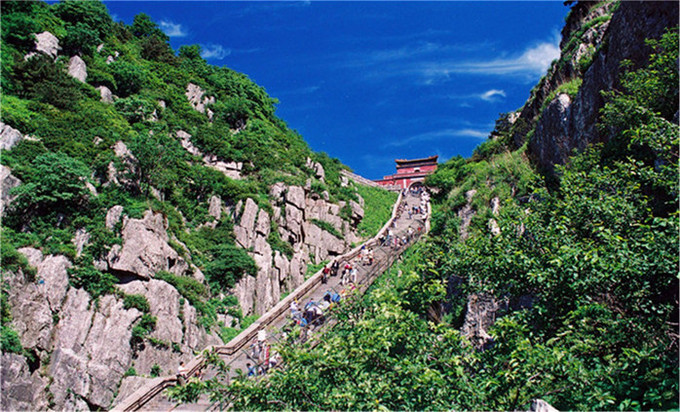
1.Mount Taishan ranks first among the Fiveholy Mountains in China. It is located in Taian City, Shandong Province.
2.The mountain is an early birthplace ofChina's ancient civilization. In history, there were72 emperors who had come tooffer sacrifices to the holy mountain and worshipping Heaven and Earth.
3. Mount Taishan has been included in theUNESCO world heritage list since 1987.The total area of the mountain is 426square kilometers.
V. Extra Reading
Mt. Huangshan
Located in southern Anhui Province,Mount Huangshan,or YellowMountain covers an area of 250 square kilo- meters,of which 154square kilometers are key scenic attractions. The mountain has 72 strangelyshaped peaks,of which Celestial Capital Peak,Lotus Peak .andBrightness Apex are all over 1800m above sea level with the impact of abruptshooting majesty,grandeur,and delicate grace.
The pines on the mountain are tall and have fascinating shapes. Thefamous Welcoming Guests(Yingke)Pine(1 500 years old)and See-Guest-Off Pine havebecome a symbol of being faithful,unyielding and hospitable. More than 200 days each year on MtHuangshan are, misty and cloudy. The vapors coagulate to form a sea of clouds.As the clouds cloak the mountain, they give a feeling of being in fairyland.
Mt Huangshan holds the charms of all other famous mountains in China,and claimsto be "the most spectacular mountain in the world".It is asmagnificent as Mt Taishan,precipitous as Mt Huashan,graceful as Mt Emei,and has themisty cloud of Mt Hengshan , the delicate rocks of Mt Yandang,and thepouring waterfalls of Mt Lushan. Xu Xia ke traveler and geologist of MingDynasty,visited Mt Huangshan twice and praised that “Once on top,one finds noother match一This is the acme!” and soon after,there is the saying “No mountain is worth seeing after a trip to the Five SacredMountains,but none of the Five is worth seeing after a trip toHuangshan".
Mt Huangshan has more than -t00 famous scenic attractions, of which140 have been developed and opened to tourists. Mt Huangshan is an integratedscenic zone with all the rare beauties of peaks,rocks, pines,clouds,and springs,particularlyreputed for its four wonders of strange pines,grotesque rocks,cloud seas,and hotsprings. There are not only 2lakes,3 waterfalls,16 springs,and 24 streamsthat add a charm to each other,but also the ancient traces of Quaternary glaciers found by China'sdistinguished geologist Li Si-guang. The mountain is abundant with nativeplants and animal resources,and the wealth of water potentials provide the mountain with anadditional amazing beauty.
Apart from the miraculous views of the natural landscape,the sites ofhuman culture in Mt Huangshan are even more quantitative and brilliant. Thebroad-minded mountain has accepted and melted together in itself the culturalideologies and events of all times and classes,and formed thedistinctive culture of its own. It is the cradle of the influential school oflandscape painting,and it preserves over 200 sites of delicate cliff inscriptions ofthe past times.
In December of 1990,UNESCO included Mt Huangshan on their World Heritage List as aproperty of the world, for both its natural and cultural values. In February 2004,Mt HuangshanNational Geopark was approved by UNESCO as a site of the World Geological Parkson its list of World Network of Geoparks.