
目录

  • 1 Syllabus
    • 1.1 Syllabus
  • 2 第一单元
    • 2.1 CH 6 Applications of Definite Integrals——Area
    • 2.2 Applications of Definite Integrals: Volume
    • 2.3 Applications of Definite Integrals: Volume
    • 2.4 Exercises and Economics
    • 2.5 Applications of Definite Integrals——arc length, surface Area; Exercise
    • 2.6 CH7 Concepts for differential equations
  • 3 第二单元
    • 3.1 CH8  Concept of Difference equation, solution structure
    • 3.2 First-Order Difference Equations
    • 3.3 First-Order Difference Equations
    • 3.4 Exercise
    • 3.5 2nd-Order Difference Equations
    • 3.6 2nd-Order Difference Equations
  • 4 第三单元
    • 4.1 First-Order Differential Equations
    • 4.2 First-Order Differential Equations
    • 4.3 First-Order Differential Equations-2nd
    • 4.4 First-Order Differential Equations-3nd
    • 4.5 Applications
    • 4.6 Second-Order Differential Equations
  • 5 第四单元
    • 5.1 Second-Order Differential Equations with constant coefficients-i
    • 5.2 Second-Order Differential Equations with constant coefficients-i
    • 5.3 Second-Order Differential Equations with constant coefficients-ii
    • 5.4 Second-Order Differential Equations with constant coefficients-ii
    • 5.5 Applications
    • 5.6 Exercise
  • 6 第五单元
    • 6.1 Cobweb medel
    • 6.2 Exercise
    • 6.3 CH9 Concepts of series
    • 6.4 Concepts of series
    • 6.5 Positive series
    • 6.6 Positive series
  • 7 第六单元
    • 7.1 Absolute and Conditional Convergence
    • 7.2 Absolute and Conditional Convergence
    • 7.3 Exercise
    • 7.4 Exercise
    • 7.5 Series of functions, Taylor series
    • 7.6 Series of functions, Taylor series
  • 8 第七单元
    • 8.1 Power series
    • 8.2 Power series
    • 8.3 Expansion as Taylor series
    • 8.4 Expansion as Taylor series
    • 8.5 Expansion inderectly
    • 8.6 Expansion inderectly
  • 9 第八单元
    • 9.1 Exercise
    • 9.2 CH10 Three-Dimensional Coordinate Systems
    • 9.3 Three-Dimensional Coordinate Systems
    • 9.4 Cylinders and revolution Surfaces
    • 9.5 Cylinders and revolution Surfaces
    • 9.6 Curves in Space
  • 10 第九单元
    • 10.1 Projection
    • 10.2 Quadric Surfaces
    • 10.3 Vectors
    • 10.4 The Dot Product & Cross Product
    • 10.5 The Dot Product & Cross Product
    • 10.6 Lines and Planes in Space
  • 11 第十单元
    • 11.1 Lines and Planes in Space
    • 11.2 Lines and Planes in Space
    • 11.3 Exercise
    • 11.4 Exercise
    • 11.5 CH11 Concepts for Multi Variable functions
    • 11.6 Continuity
  • 12 第十一单元
    • 12.1 Partial Derivatives
    • 12.2 Partial Derivatives
    • 12.3 cross elasticity
    • 12.4 Perfect differential
    • 12.5 Perfect differential
    • 12.6 Exercise
  • 13 第十二单元
    • 13.1 The Chain Rule
    • 13.2 The Chain Rule
    • 13.3 Implicit Multi Variable functions
    • 13.4 Implicit Multi Variable functions
    • 13.5 Extreme Values
    • 13.6 Extreme Values
  • 14 第十三单元
    • 14.1 Exercise
    • 14.2 Exercise
    • 14.3 CH12 Double Integrals’ properties
    • 14.4 Double Integrals’ properties
    • 14.5 Double and Iterated Integrals over Rectangles
    • 14.6 Double and Iterated Integrals over Rectangles
  • 15 第十四单元
    • 15.1 Double Integrals in Polar Form
    • 15.2 Double Integrals in Polar Form
    • 15.3 Exercise
    • 15.4 Line Integrals
    • 15.5 Line Integrals
    • 15.6 Exercise
  • 16 第十五单元
    • 16.1 Green Formula
    • 16.2 Triple integrals
    • 16.3 Triple integrals
    • 16.4 Exercise
CH 6 Applications of Definite Integrals——Area

1 Syllabus


2BOOK 

Calculus 9e Purcell-Varberg-Rigdon

3 Reference

4 Contents

This chapter is the application and extension of the definiteintegral, which includes the calculation of various geometric and physicalquantities. Through the study of this Chapter, the necessary primary idea isthe element approach, which could lead to some basic and useful formula. Then,one should be master a variety of geometric and physical calculation formula.It is noticeable that the calculation formula of the same quantity, like: thearea of a plane graph, the volume of a rotating body, and the arc length of aplane curve, may have different forms under different cases (parametricequations, polar coordinates). So, it is crucial to gain proficiency in theformula of each form.

本章是对定积分的定义的应用与推广,主要内容是各种几何及物理量的计算。在学习时,首先要掌握基本思想:元素法,要学会利用它推导一些简单的计算公式。然后,要掌握各种几何及物理量的计算公式。需要注意的是,同一个量(如平面图形的面积、旋转体体积、平面曲线弧长)的计算公式在不同情况(参数方程、极坐标)下有不同的表现形式,对于每一种形式的公式,都要多加练习以求熟练掌握。

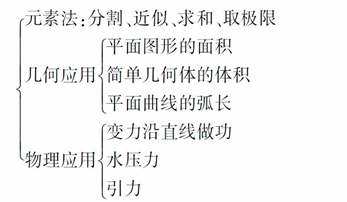
Knowledge Structure Graph
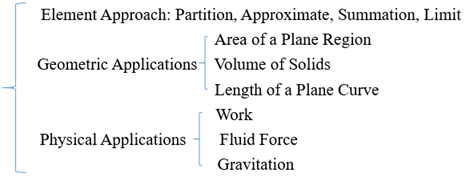


知识结构网
5 PPT


I. Current Chapter: CH 6 Applicationsof Definite Integral (授课章节:第六章  定积分的应用)

II. Requirements of the Chapter (本章节要求):

1) The Element Approach元素法;

2) The Area of a Plane Region (RectangularCoordinate System, Polar Coordinate System) 平面图形的面积的求法(直角坐标系、极坐标系)

3) The Volume of Solids旋转体等体积的求法;

4) The Length of a Plane Curve弧长的求法;

5) Physical Applications 物理应用;

IIIThe Task本节课的要求:

1)     Watching the  Videos here or 校内平台优慕课

2Key Point知识要点

6.1 The Element Approach元素法

3) Keynote学习课件


I. Current Chapter: CH 6 Applicationsof Definite Integral (授课章节:第六章  定积分的应用)

II. Requirements of the Chapter (本章节要求):

1) The Element Approach元素法;

2) The Area of a Plane Region (RectangularCoordinate System, Polar Coordinate System) 平面图形的面积的求法(直角坐标系、极坐标系)

3) The Volume of Solids旋转体等体积的求法;

4) The Length of a Plane Curve弧长的求法;

5) Physical Applications 物理应用;

IIIThe Task本节课的要求:

1)     Watching the  Videos here or 校内平台优慕课

2Key Point知识要点

6.2 The Area of a Plane Region(Rectangular Coordinate System) 平面图形的面积(直角坐标系)

3) Keynote学习课件


I. Current Chapter: CH 6 Applicationsof Definite Integral (授课章节:第六章  定积分的应用)

II. Requirements of the Chapter (本章节要求):

1) The Element Approach元素法;

2) The Area of a Plane Region (RectangularCoordinate System, Polar Coordinate System) 平面图形的面积的求法(直角坐标系、极坐标系)

3) The Volume of Solids旋转体等体积的求法;

4) The Length of a Plane Curve弧长的求法;

5) Physical Applications 物理应用;

IIIThe Task本节课的要求:

1)    Watching the  Videos here or 校内平台优慕课

2Key Point知识要点

6.2 The Area of a Plane Region (Polar Coordinate System) 平面图形的面积的求法(极坐标)

3) Keynote学习课件


6 以下是视频分段的版本