-
1 Article
-
2 Words and&nb...
-
3 Notes on&nbs...



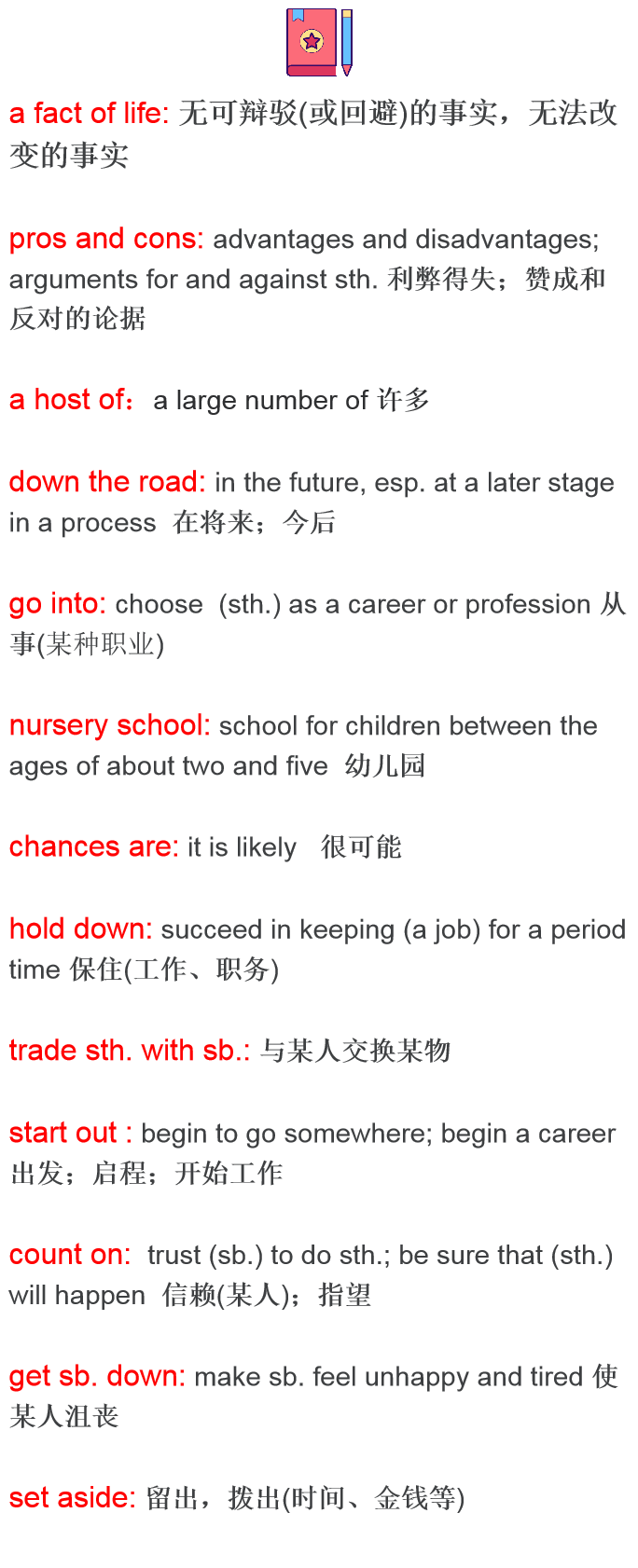
1 Working after school, evenings, or weekends is a fact of life for many students. But there are pros and cons to consider before you decide whether a part-time job is right for you.
2 A part-time job can have real benefits. Here are the major pluses of working when your main “job” is still being a student:
3 • Diverse financial rewards. Of course the number-one benefit of a part-time job is money. But beyond that, a part-time job introduces you to a host of real-world financial concepts and practices. Once you have a regular income, you’ll probably want a checking account. Learning to manage a checkbook is a key skill you’ll need later in life. And then there are taxes. You’ll learn about withholding, W-2 forms, and other wonders of the real world.
4 • Exploring career options. You also can use a part-time job to help you identify your job interests. For example, if you think you’d like to go into teaching, why not get an after-school job at a nursery school or day-care center? See what it’s really like to be responsible for a large group of children. What parts of the job do you like/dislike? You may make contacts who might be able to help you down the road when you’re looking for a full-time job. Even if you don’t get paid, this kind of experience is valuable.
5 • Developing people skills. Working helps develop your skills in dealing with people. In high school, you tend to interact most with two groups of people: teachers and students. In the workforce, chances are you’ll be exposed to a greater range of people. Your boss and adult co-workers will give you a different perspective on life. If you work with the public, you’ll be exposed to all age groups, and to people from a wide range of social and economic backgrounds. The more exposure you get to different types of people, the better prepared you’ll be to face the challenges of life after high school.
The Downside of Working
6 On the negative side, holding down a part-time job can put a wrinkle in other parts of your daily routine. After all, real life is never perfect.
7 • Scheduling conflicts. What happens when your friends plan to go to a concert, but you are scheduled to work that night? If you’re lucky, you can trade shifts with someone else. If not, you’ll have to work. Such conflicts are bound to happen. Working is not always convenient, and there will be times when you’d prefer to be doing something else.
8 • Dirty work. Someone’s got to do it and that someone may be YOU. Don’t let that get you down, though. Eventually more education and experience will put you in a better position. Meanwhile, however, you may be assigned tasks that are boring, repetitive, or unpleasant.
9 • Low pay. Because you’re just starting out, your pay may be lower than that of more experienced adults. That means you must work quite a while to accumulate substantial amounts of money. The federal minimum-wage law will help you in most job categories, but don’t count on getting rich unless you win the lottery!
No Mistake About It
10 If you do decide to work, you can ensure a good experience by avoiding these common mistakes:
11 • Working too many hours. The more hours you work, the less time you have for homework and extracurricular activities. If you work too many hours, something has to suffer: your schoolwork, your social life, or both. While in school, make it a practice to work no more than 15 to 20 hours a week.
12 • Job hopping. What if you take a part-time job but find that you hate it? It’s OK to switch to another job, but don’t make changing jobs a habit. This can aggravate employers. And once such a pattern is established, other employers may be reluctant to hire you.
13 • Spending all you earn. Having your own money is great. But don’t make the mistake of spending all your earnings. Take a portion of each paycheck and set it aside. Open a savings account. If you start a regular savings program, you’ll be surprised at how quickly money accumulates. And you’ll get more out of working.
14 If you do decide that a part-time job is right for you, why not give it a try? As part-time worker Adam Schreier puts it, “Don’t be afraid to put in an application anywhere you’re interested.”
(740 words)