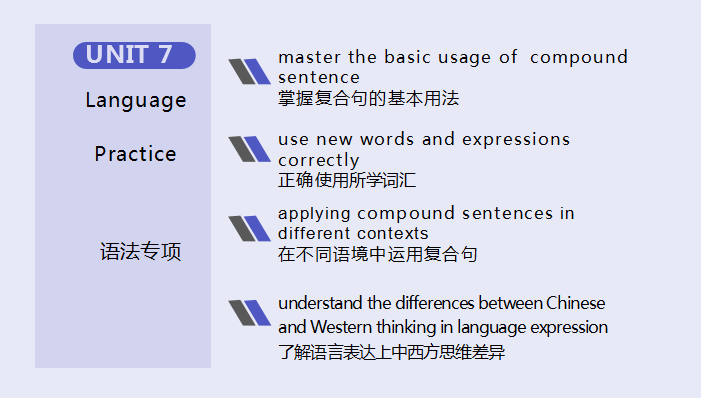
Learning objectives 学习目标
Keys and difficulties 重点、难点
重点:掌握并列连词及其用法,并进行实际运用。
难点:能在具体语境中准确使用并列句。
Step 1 Warming up
1. 拓展活动:“我说你猜”。教师描述如下,学生猜出是哪种科技产品。
Just give it a voice command and it will do as you say!(语法框中第一句)
2.教材活动Grammar:学生阅读语法框中的句子,观察斜体部分,理解句间关系,教师检查学生对例句的理解。学生讨论共同点,师生总结并列句的结构及特征。
Step 2 Presentation
1. Brainstorm:学生思考还有哪些常见的并列连词,将它们所表达的关系进行分类。
关系 | 并列连词 |
并列关系 | and、both…and…、as well as、not only…but (also)… |
转折关系 | but、yet、still、while、or |
选择关系 | or、or else、otherwise、neither…nor…、either…or… |
因果关系 | so、for |
*2. 学生观看第七单元配套语法微课视频,回忆上一活动Brainstorm中的重点知识。
Step 3 Practice
1. Read and underline. 处理教材活动15。
(1)学生阅读文章,先圈出文中的并列连词,再画出并列句,教师检查反馈。
(2)教师设问如下,学生用文中原句或自己的理解思考作答。
2. Read and complete.处理教材活动16。
*(1)Brainstorm:学生思考历史上的伟大发明及发明家。教师可适当提供图片作为提示以激活学生思维,也可使用match的方式。
(2)学生阅读短文,理解短文意思。
Step 4 Practice
1. Choose and complete. 处理教材活动18。
(1)师生一起复习本单元科技产品相关词汇,重点复习教材活动18练习中的搭配。
(2)学生选择合适的短语,用其适当形式补全句子。
2. Read and complete. 处理教材活动 19。
(1)学生读懂文章,了解文章大致内容。并选择合适的单词,用其适当形式补全短文。全班共同核对答案。
*(2)学生根据重点词汇介绍短文。
重点单词和语句。
Grammar 语法内容
1. 概念理解:
两个或两个以上独立的主谓结构或简单句并列在一起,我们称之为并列句。各个简单句间是平行并列的关系,而非从属关系,即没有主从句之分。并列句的各个分句间可用逗号、分号、起连接作用的副词或并列连接词来连接。
2. 结构:
基本结构是“简单句+并列连词+简单句”。
3. 连接词:
1)能连接并列句的连词
and(和,又),but(但是),for(因为),however(然而),or(或者),
so(所以,因而),while(然而),yet(然而)
2)能连接并列句的复合连词
or else(否则,要不然),
either...or...(要么……,要么……;或者……,或者……),
neither...nor...(既不……,也不……),
not only...but also(不仅……,而且……)
3)能连接并列句的副词
besides(而且,还有),hence(因此),otherwise(否则,要不然),
then(然后,于是),therefore(因此,所以),thus(因而,从而)
4. 分类:
根据并列分句之间的不同关系,并列句则可以分为以下四种。
1)表示并列关系
此类并列连词有:and, both...and..., not only...but also, neither...nor, on the one hand..., on the other hand
e.g. My father bought me a present, and I like it very much.
爸爸给我买了一件礼物,我非常喜欢。
e.g. I can speak both English and Chinese. 我不仅能说英语,而且也能说汉语。
e.g. Neither he nor I can speak a foreign language. 我和他都不会说外语。
e.g. He as well as his students gets up at 6 o'clock. 不仅他的学生们而且他也是6点钟起床。
2)表示转折关系
此类并列连词有:but, however, while, yet
e.g. Lucy likes red while Lily likes white. 露西喜欢红色,而莉莉喜欢白色。
e.g. He worked hard. However, he failed. 他很努力,然而还是失败了。
3)表示选择关系
此类并列连词有:or, otherwise, either...or...
e.g. Either he or she is going to help you. 不是他帮你就是她帮你。
e.g. Would you like coffee or tea? 你想要咖啡还是茶?
在否定句中,如果所接的两部分都有否定词,则用and而不用or连接。
e.g. There is no water and no air on the moon. 月球上没有水,也没有空气。
4)表示因果关系
此类并列连词有:so, for, therefore
e.g. Kate was ill, so she didn't go to school. 凯特生病了,所以她没有去上学。
单项选择
( )1. We should __________ be polite to the others _________ help them when necessary.
A. not only; but also B. neither; nor
C. not; but D. either; or
( )2. ——When and where shall we talk about the plans?
—— You can come to my office tomorrow __________ I'll come to your place next Monday.
A. and B. or C. but D. so
( )3. The shops were closed __________ I couldn't buy anything.
A. so B. but C. and D. or
( )4.Parents and teachers are sometimes strict, __________ remember, they make rules to help us.
A. and B. but C. but D. so