Inventory often forms the largest singleitem of cost for a business soit is essential that the inventory purchased is the most suitable for theintended purpose.
Inventory includes:
Raw materials or components to be used inthe manufacture of products.
Items that are part way through themanufacturing process (WIP).
Items that have completed themanufacturing process.
Items bought to be sold on (retailer orwholesaler).
Items that will be used for general dayto day running of the business.
Reasons why a business needs inventory are as follows:
It acts as a buffer in times
Quantity discounts by buying in bulk
Seasonal and other price fluctuations (end of season sale)
Help the production process flow smoothly and efficiently
Technical reason, e.g. food items need to‘mature’
This process needs a great deal of paperwork and strict internal controls.
Internal control consists of full documentation and appropriate authorisation of all transactions, movements of materials and of all requisitions, orders,receipts and payments.
If control is to be maintained overpurchasing, it is necessary to ensure that:
Only necessary items are purchased
Orders are placed with the most appropriate supplier after considering price and delivery details
The goods that are actually receivedare the goods that were ordered and in the correct quantity/quality
The price paid for the goods is correct (i.e. what was agreed when the order was placed).
It is useful to have an overview of the purchasing process:
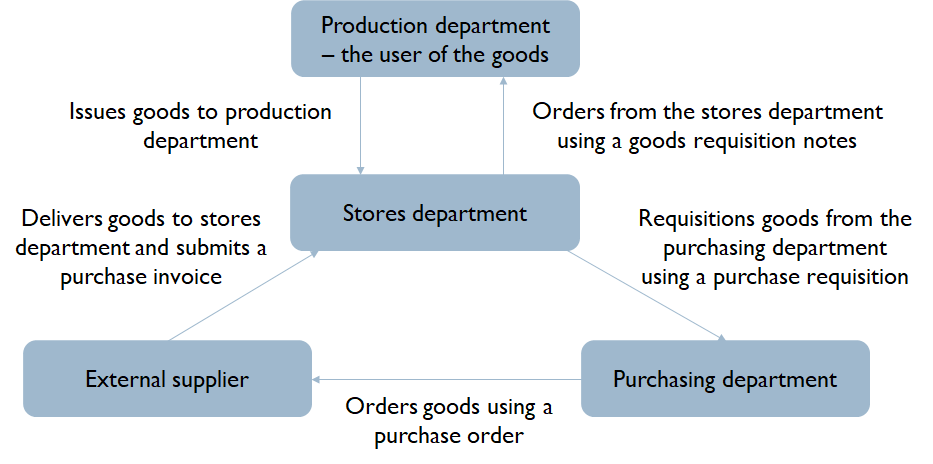
Goods or Materials requisition notes
Purchase requisition
Purchase order form
Delivery note
Goods received note (GRN)
Purchase invoice
Materials returned notes
Materials transfer notes
Goods returned notes
Credit notes