
5.1Bridge
A bridge is a structure built to span a physical obstacle, such as a body of water, valley, or road, without closing the way underneath. It is constructed for the purpose of providing passage over the obstacle, usually something that is otherwise difficult or impossible to cross. There are many different designs that each serve a particular purpose and apply to different situations. Designs of bridges vary depending on the function of the bridge, the nature of the terrain where the bridge is constructed and anchored, the material used to make it and the funds available to build it.
Most likely, the earliest bridges were fallen trees and stepping stones, while Neolithic people built boardwalk bridges across marshland. The Arkadiko Bridge dating from the 13th century BC, in the Peloponnese, in southern Greece is one of the oldest arch bridges still in existence and use. The simplest type of a bridge is stepping stones, so this may have been one of the earliest types. Neolithic people also built a form of boardwalk across marshes; examples of such bridges include the Sweet Track and the Post Track in England, approximately 6000 years old.Undoubtedly, ancient people would also have used log bridges; that is a timber bridge that fall naturally or are intentionally felled or placed across streams. Some of the first man-made bridges with significant span were probably intentionally felled trees.
Types of bridges
Bridges can be categorized in several different ways. Common categories include the type of structural elements used, by what they carry, whether they are fixed or movable, and by the materials used.
Structure types
Bridges may be classified by how the actions of tension, compression, bending, torsion and shear are distributed through their structure. Most bridges will employ all of these to some degree, but only a few will predominate. The separation of forces and moments may be quite clear. In a suspension or cable-stayed bridge, the elements in tension are distinct in shape and placement. In other cases the forces may be distributed among a large number of members, as in a truss.
Beam bridge
Beam bridges are horizontal beams supported at each end by substructure units and can be either simply supported when the beams only connect across a single span, or continuous when the beams are connected across two or more spans. When there are multiple spans, the intermediate supports are known as piers. The earliest beam bridges were simple logs that sat across streams and similar simple structures. In modern times, beam bridges can range from small, wooden beams to large, steel boxes. The vertical force on the bridge becomes a shear and flexural load on the beam which is transferred down its length to the substructures on either side. They are typically made of steel, concrete or wood. Girder bridges and plate girder bridges, usually made from steel, are types of beam bridges. Box girder bridges, made from steel, concrete, or both, are also beam bridges. Beam bridge spans rarely exceed 250 feet (76 m) long, as the flexural stresses increase proportional to the square of the length (and deflection increases proportional to the 4th power of the length). However, the main span of the Rio–Niteroi Bridge, a box girder bridge, is 300 metres (980 ft).The world's longest beam bridge is Lake Pontchartrain Causeway in southern Louisiana in the United States, at 23.83 miles (38.35 km), with individual spans of 56 feet (17 m). Beam bridges are the simplest and oldest type of bridge in use today, and are a popular type.
Truss bridge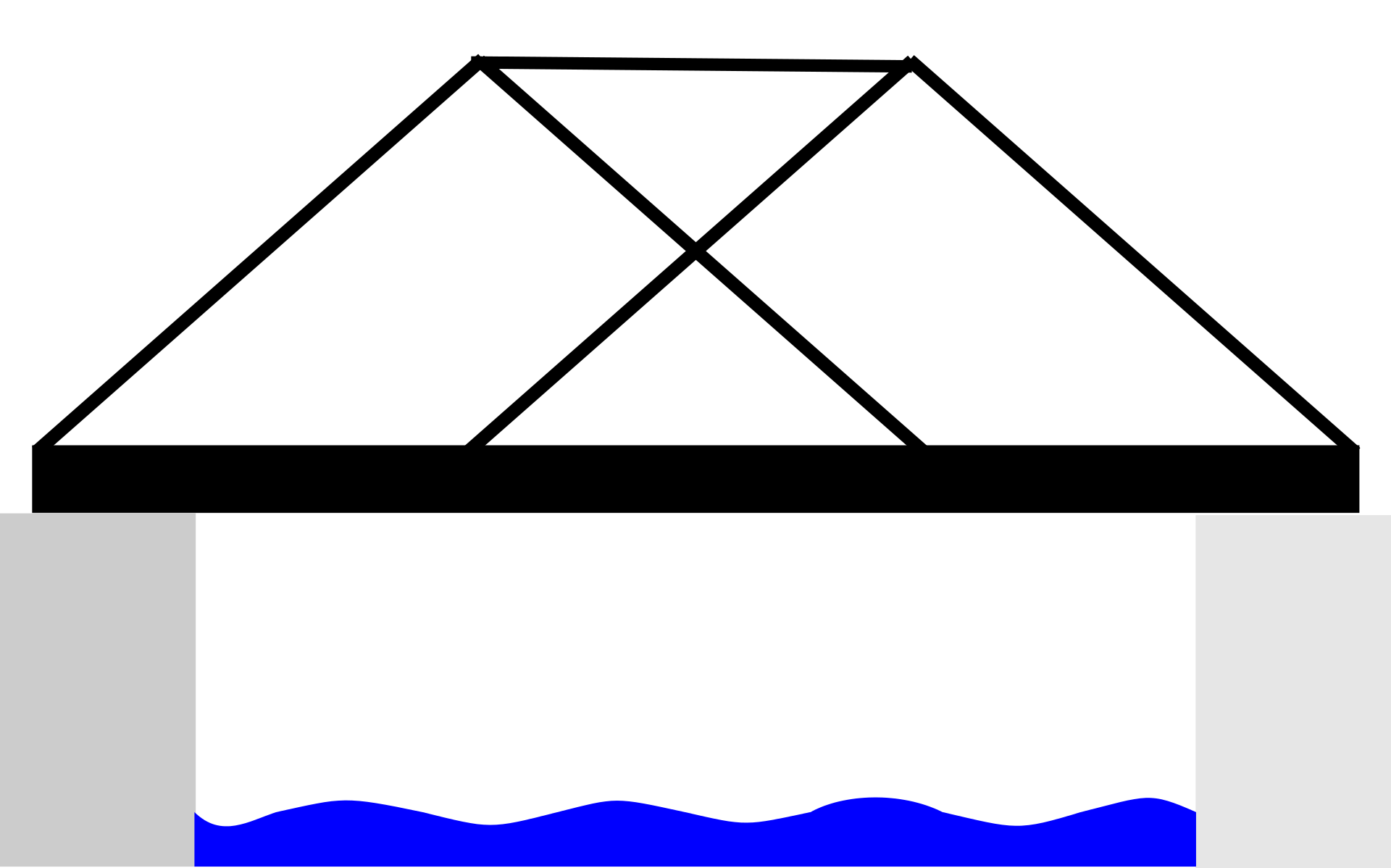
A truss bridge is a bridge whose load-bearing superstructure is composed of a truss. This truss is a structure of connected elements forming triangular units. The connected elements (typically straight) may be stressed from tension, compression, or sometimes both in response to dynamic loads. Truss bridges are one of the oldest types of modern bridges. The basic types of truss bridges shown in this article have simple designs which could be easily analyzed by nineteenth and early twentieth century engineers. A truss bridge is economical to construct owing to its efficient use of materials.
Cantilever bridge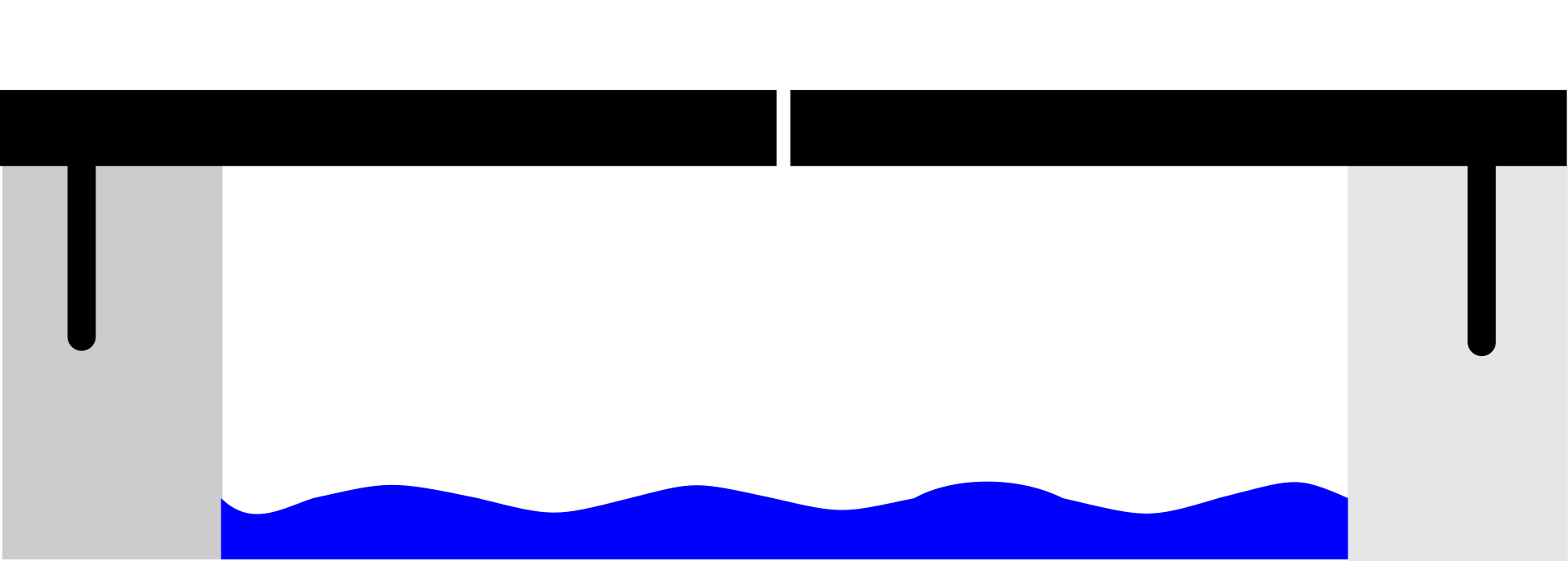
Cantilever bridges are built using cantilevers—horizontal beams supported on only one end. Most cantilever bridges use a pair of continuous spans that extend from opposite sides of the supporting piers to meet at the center of the obstacle the bridge crosses. Cantilever bridges are constructed using much the same materials and techniques as beam bridges. The difference comes in the action of the forces through the bridge. Some cantilever bridges also have a smaller beam connecting the two cantilevers, for extra strength. The largest cantilever bridge is the 549-metre (1,801 ft) Quebec Bridge in Quebec, Canada.
Arch bridge
Arch bridges have abutments at each end. The weight of the bridge is thrust into the abutments at either side. The earliest known arch bridges were built by the Greeks, and include the Arkadiko Bridge. With the span of 220 metres (720 ft), the Solkan Bridge over the Soča River at Solkan in Slovenia is the second-largest stone bridge in the world and the longest railroad stone bridge. It was completed in 1905. Its arch, which was constructed from over 5,000 tonnes (4,900 long tons; 5,500 short tons) of stone blocks in just 18 days, is the second-largest stone arch in the world, surpassed only by the Friedensbrücke (Syratalviadukt) in Plauen, and the largest railroad stone arch. The arch of the Friedensbrücke, which was built in the same year, has the span of 90 m (295 ft) and crosses the valley of the Syrabach River. The difference between the two is that the Solkan Bridge was built from stone blocks, whereas the Friedensbrücke was built from a mixture of crushed stone and cement mortar. The world's largest arch bridge is the Chaotianmen Bridge over the Yangtze River with a length of 1,741 m (5,712 ft) and a span of 552 m (1,811 ft). The bridge was opened April 29, 2009, in Chongqing, China.
Tied-arch bridge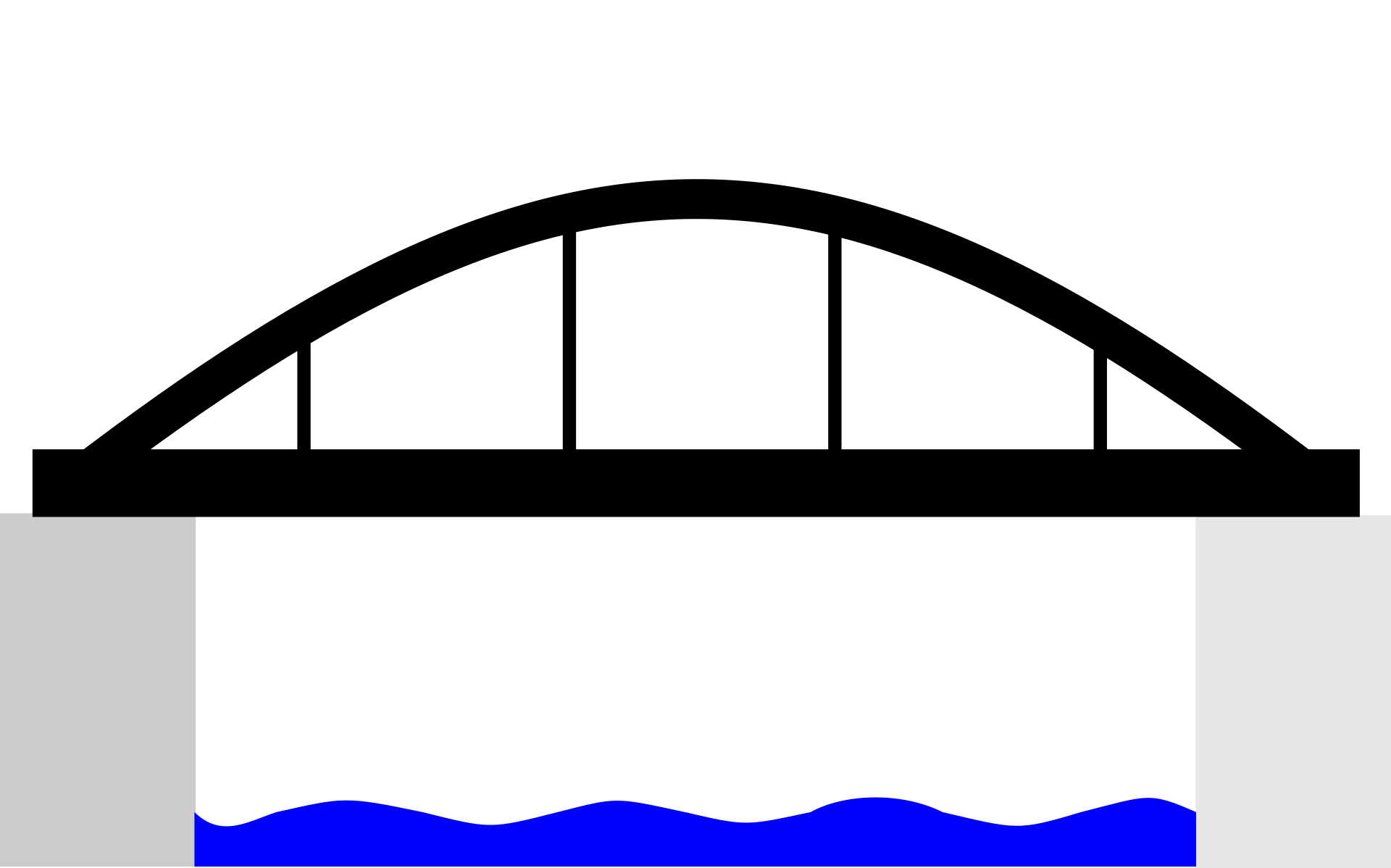
Tied-arch bridges have an arch-shaped superstructure, but differ from conventional arch bridges. Instead of transferring the weight of the bridge and traffic loads into thrust forces into the abutments, the ends of the arches are restrained by tension in the bottom chord of the structure. They are also called bowstring arches.
Suspension bridge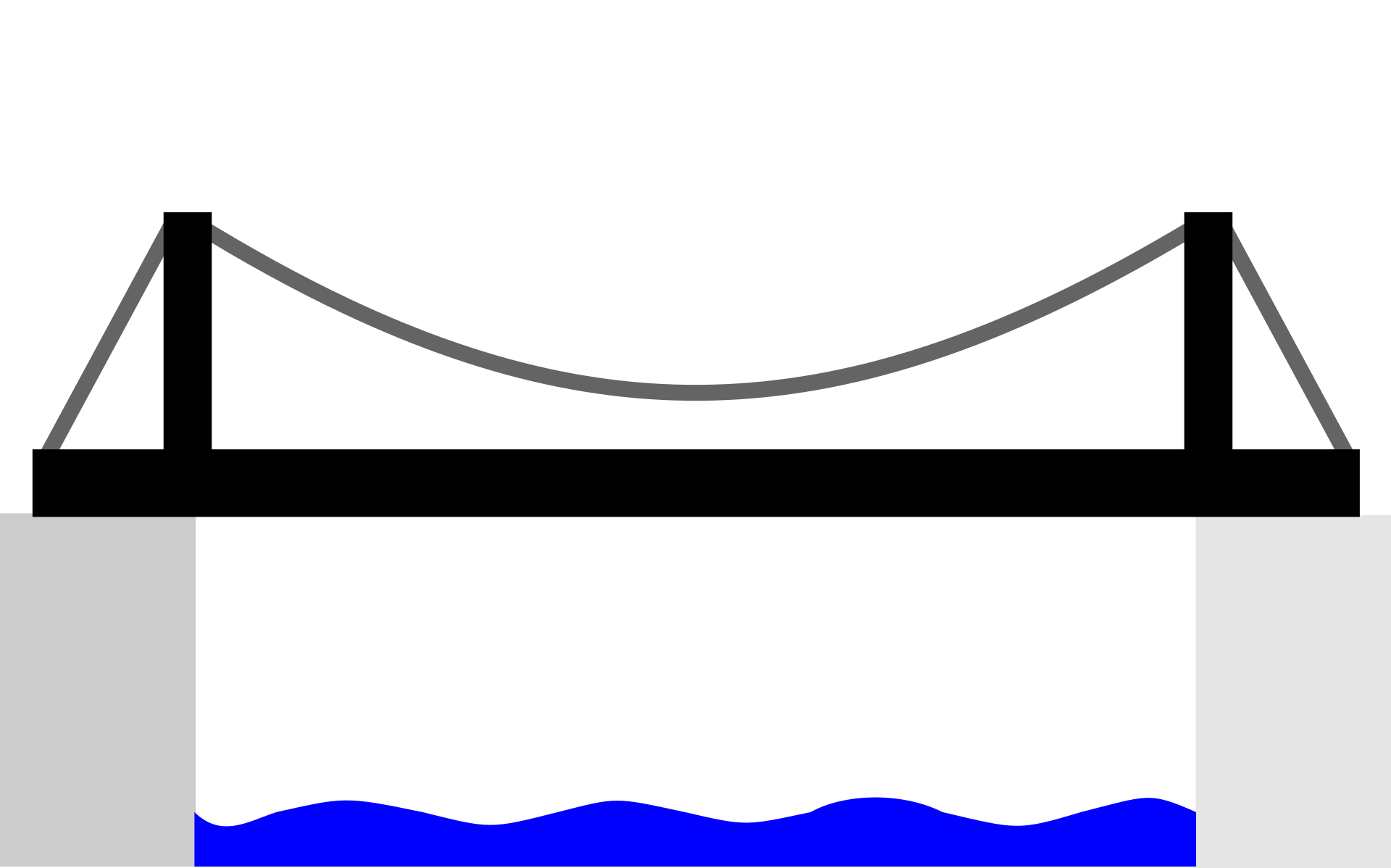
Suspension bridges are suspended from cables. The earliest suspension bridges were made of ropes or vines covered with pieces of bamboo. In modern bridges, the cables hang from towers that are attached to caissons or cofferdams. The caissons or cofferdams are implanted deep into the bed of the lake, river or sea. Sub-types include the simple suspension bridge, the stressed ribbon bridge, the underspanned suspension bridge, the suspended-deck suspension bridge, and the self-anchored suspension bridge. There is also what is sometimes called a "semi-suspension" bridge, of which the Ferry Bridge in Burton-upon-Trent is the only one of its kind in Europe. The longest suspension bridge in the world is the 3,909 m (12,825 ft) Akashi Kaikyō Bridge in Japan.
Cable-stayed bridge
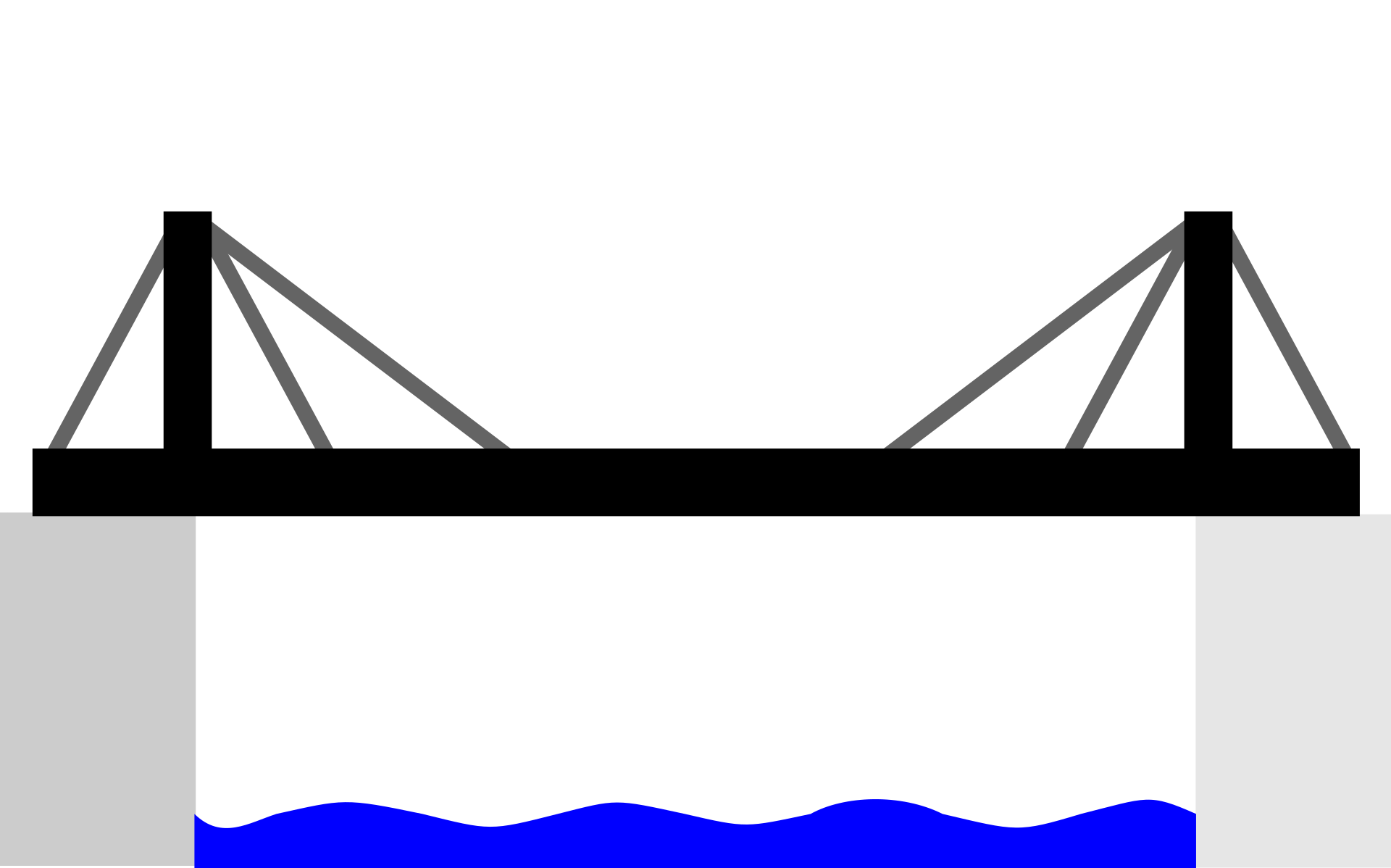
Cable-stayed bridges, like suspension bridges, are held up by cables. However, in a cable-stayed bridge, less cable is required and the towers holding the cables are proportionately higher. The first known cable-stayed bridge was designed in 1784 by C. T. (or C. J.) Löscher. The longest cable-stayed bridge since 2012 is the 1,104 m (3,622 ft) Russky Bridge in Vladivostok, Russia.
Bridge types by material
The materials used to build the structure are also used to categorize bridges. Until the end of the 18th century, bridges were made out of timber, stone and masonry. Modern bridges are currently built in concrete, steel, fiber reinforced polymers (FRP), stainless steel or combinations of those materials. Living bridges have been constructed of live plants such as Ficus elastica tree roots in India and wisteria vines in Japan.
| Bridge type | Materials used |
|---|---|
| Cantilever | For small footbridges, the cantilevers may be simple beams; however, large cantilever bridges designed to handle road or rail traffic use trusses built from structural steel, or box girders built from prestressed concrete. |
| Suspension | The cables are usually made of steel cables galvanised with zinc, along with most of the bridge, but some bridges are still made with steel-reinforced concrete. |
| Arch | Stone, brick and other such materials that are strong in compression and somewhat so in shear. |
| Beam | Beam bridges can use pre-stressed concrete, an inexpensive building material, which is then embedded with rebar. The resulting bridge can resist both compression and tension forces. |
| Truss | The triangular pieces of truss bridges are manufactured from straight and steel bars, according to the truss bridge designs. |
Type of bridges
Video from TerryGrantGH
https://www.youtube.com/watch?v=52ECMAIWOxA&feature=emb_logo
Quiz
Topic Discussion
References
Brunning, Richard (February 2001). "The Somerset Levels". Current Archaeology. XV (4) (172 (Special issue on Wetlands)): 139–143.
National Parks Conference, Department of the Interior (1915). Proceedings of the National parks conference held at Berkeley, California March 11, 12, and 13, 1915. Washington, DC: Government Printing Office. p. 60. Retrieved March 14, 2010. (A log bridge) is a bridge composed of log beams, the logs being in natural condition or hewn, which are thrown across two abutments, and over which traffic may pass.
Bennett, David (2000). "The history and development of bridges". In Ryall, M.J.; Parke, G.A.R.; Harding, J.E. (eds.). The manual of bridge engineering (Google books). London: Thomas Telford. p. 1. ISBN 978-0-7277-2774-9. Retrieved March 14, 2010.
Kutz, Myer (2011). Handbook of Transportation Engineering, Volume II: Applications and Technologies, Second Edition. McGraw-Hill Professional. ISBN 978-0-07-161477-1.
DeLony, Eric (1996). "Context for World Heritage Bridges". Icomos.org. Archived from the original on February 21, 2005.
"History of Bridges". Historyworld.net. Archived from the original on January 6, 2012. Retrieved January 4, 2012.
"Lessons from Roman Cement and Concrete". Pubs.asce.org. Archived from the original on February 10, 2005. Retrieved January 4, 2012.
Dikshitar, V.R.R. Dikshitar (1993). The Mauryan Polity, Motilal Banarsidass, p. 332 ISBN 81-208-1023-6.
Dutt, Romesh Chunder (2000). A History of Civilisation in Ancient India: Vol II, Routledge, p. 46, ISBN 0-415-23188-4.
"suspension bridge" in Encyclopædia Britannica (2008). 2008 Encyclopædia Britannica, Inc.
Nath, R. (1982). History of Mughal Architecture, Abhinav Publications, p. 213, ISBN 81-7017-159-8.
"Iron Bridge". Engineering Timelines. Engineering Timelines. Archived from the original on March 4, 2016. Retrieved November 18, 2016.
"Historic Wooden Bridges/"Covered Bridges"". HSNB.DE. July 11, 2011. Archived from the original on March 4, 2016. Retrieved October 15, 2018.
"Hidden Masterpieces: Covered Bridges in PA". Pennsylvania Book Center. Spring 2010. Retrieved October 15, 2018.
"Throwback Thursday: Covered bridges". Canadian Geographic. May 28, 2015. Retrieved October 15, 2018.
"Visit America's Most Idyllic Covered Bridges". Architectural Digest. December 2016. Retrieved October 15, 2018.
Sapp, Mark E. (February 22, 2008). "Welding Timeline 1900–1950". WeldingHistory.org. Archived from the original on August 3, 2008. Retrieved April 29, 2008.
"Beam bridges". Design Technology. Archived from the original on May 18, 2008. Retrieved May 14, 2008.
Structural Beam Deflection Stress Bending Equations / Calculation Supported on Both Ends Uniform Loading Archived January 22, 2013, at Archive.today. Engineers Edge. Retrieved on April 23, 2013.
"A big prefabricated bridge". Life. 40 (22): 53–60. May 28, 1956.
"ASCE | Civil What? | Bridges". www.asceville.org. Archived from the original on February 3, 2017. Retrieved February 2, 2017.
Naito, Clay; Sause, Richard; Hodgson, Ian; Pessiki, Stephen; Macioce, Thomas (2010). "Forensic Examination of a Noncomposite Adjacent Precast Prestressed Concrete Box Beam Bridge". Journal of Bridge Engineering. 15 (4): 408–418. doi:10.1061/(ASCE)BE.1943-5592.0000110.
Gorazd Humar (September 2001). "World Famous Arch Bridges in Slovenia". In Charles Abdunur (ed.). Arch'01: troisième Conférence internationale sur les ponts en arc Paris (in English and French). Paris: Presses des Ponts. pp. 121–124. ISBN 2-85978-347-4. Archived from the original on July 30, 2016.
"Longest bridge, steel arch bridge". Guinness World Records. Archived from the original on October 19, 2013. Retrieved February 18, 2013.
A.O.P. Guide to Burton-on-Trent, 1911, p. 13[full citation needed]
Sigmund, Pete (February 7, 2007). "The Mighty Mac: A Sublime Engineering Feat". Construction Equipment Guide. Archived from the original on April 5, 2013. Retrieved May 14, 2008.
Johnson, Andy. "Cable Stay vs Suspension Bridges". U.S. Department of Energy. Archived from the original on May 18, 2008.
Walther, René (1999). Cable Stayed Bridges. p. 7. ISBN 978-0-7277-2773-2. Archived from the original on November 15, 2016.
Poser, Marcel. "Cable Stayed Structures and Stay Cable Technology" (PDF). Archived from the original (PDF) on February 9, 2013.
Elder, Miriam (July 2, 2012). "Russian city of Vladivostok unveils record-breaking suspension bridge". The Guardian. London. Archived from the original on January 20, 2016. Retrieved February 3, 2016.
Žnidarič, Aleš; Pakrashi, Vikram; O'Brien, Eugene; O'Connor, Alan (December 2011). "A review of road structure data in six European countries". Proceedings of the Institution of Civil Engineers - Urban Design and Planning. 164 (4): 225–232. doi:10.1680/udap.900054. hdl:10197/4877. ISSN 1755-0793. S2CID 110344262.
"How are Living Root Bridges Made?". The Living Root Bridge Project. May 5, 2017. Archived from the original on September 5, 2017. Retrieved September 8, 2017.
"The Vine Bridges of Iya Valley". Atlas Obscura. Archived from the original on September 8, 2017. Retrieved September 8, 2017.
"Cantilever". Bridges of Dublin. Archived from the original on October 29, 2014.
"Suspension Bridges". Made How. Archived from the original on January 2, 2015.
"Beam Bridges". Nova Online. PBS. Archived from the original on January 6, 2015.
K, Aggeliki; Stonecypher, Lamar (February 10, 2010). "Truss Bridge Designs". Bright Hub Engineering. Archived from the original on February 19, 2015.
https://en.wikipedia.org/wiki/Bridge

